
Final bell tolls for several schools

Students, staff say goodbye in districts around the metro area.

June 12, 2010 at 3:28AM
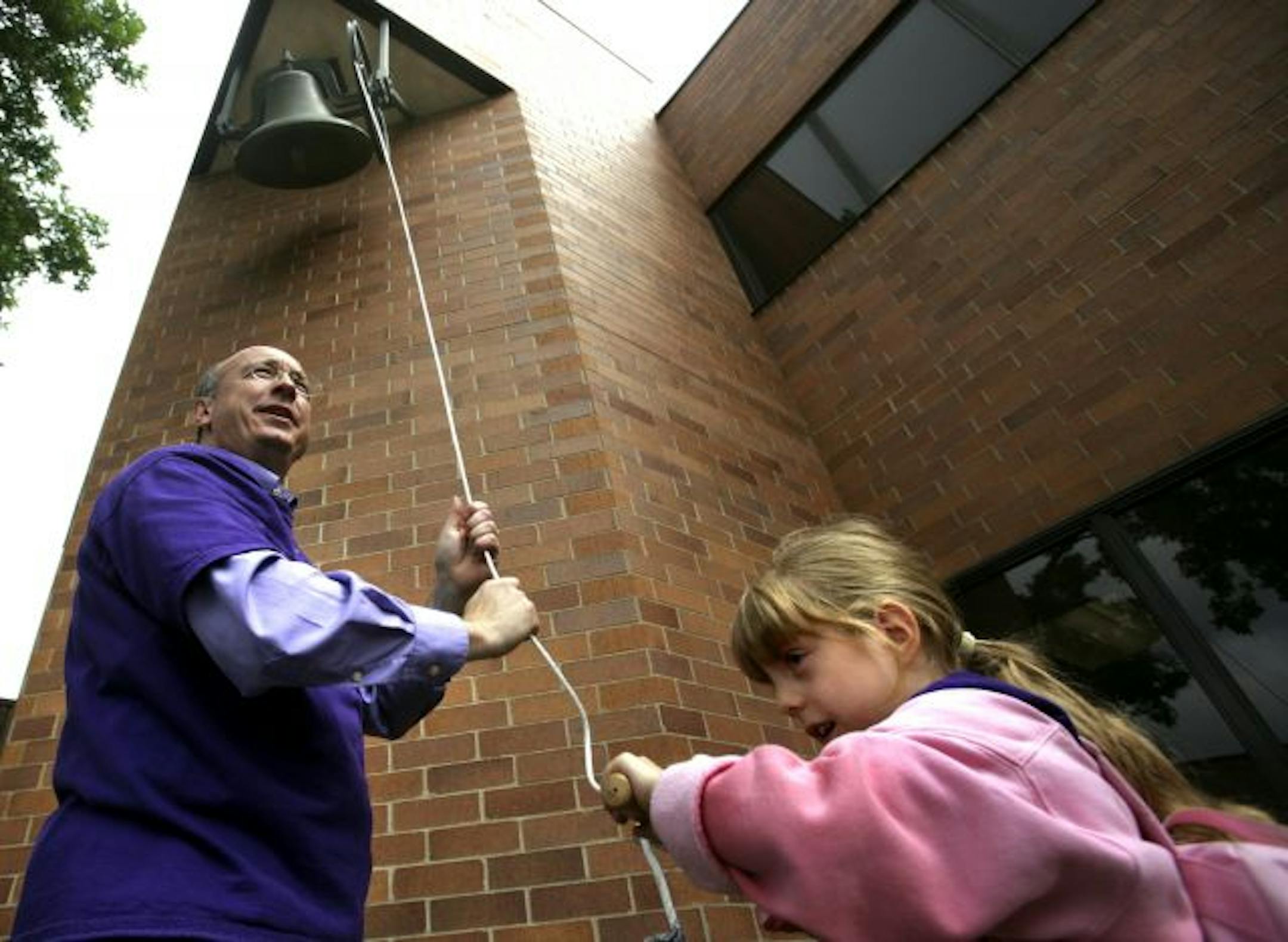
Kindergarten student Hailey Farley, with the help of principal Mark Vandersteen, to ring the bell at�Longfellow Humanities Magnet school which is one of eight in St. Paul set to close on Friday. The school will mark this occaision by allowing each of its 203 students to tug the bell cable, ringing the school bell for the final time. While the school was rebuilt in the 1970s, it kept the bell that was built into the original school some 100 years ago.
Kindergarten student Hailey Farley, with the help of Principal Mark Vandersteen, rang the bell Friday at Longfellow Magnet Elementary School, one of eight public schools in St. Paul that closed this week. Longfellow marked its final day by allowing each of its 200 students to tug the bell cable. After the school was rebuilt in the 1970s, it kept the bell that was built into the original school more than 100 years ago. (Star Tribune/The Minnesota Star Tribune)

Hailey Farley was among 200 students to ring the school bell Friday at Longfellow Magnet Elementary School in St. Paul, and the last who will ever do so.

When Longfellow opened in 1887, it had a bell tower to announce the beginning and end of classes to neighborhood families. When the "new" building opened in 1975, the bell was mounted there. Now Longfellow, like so many Twin Cities schools, has closed -- forever.

Hailey is one of 4,500 St. Paul students and thousands more statewide who will be affected by school closings this spring. St. Paul public schools closed eight schools this week, underscoring declining enrollment and tight budgets in the district. Other districts are feeling the pinch, too. Minneapolis public schools is closing three schools, and the Anoka-Hennepin district, the state's largest, is closing eight.

Private schools and even some charter schools are struggling as well. St. Bernard's High School in St. Paul, a 53-year-old institution, closed a week ago, and its companion grade school ended a 118-year run a year ago.

The closings leave in their wake generations of memories collected in schools such as Longfellow, Roosevelt and Ames. In recent weeks the schools have held events to say goodbye to the buildings and their traditions.

Former students, teachers and staff came to talk about changes in the local geography and the time when there was space and woods just outside the school communities, before neighborhoods became crowded.

Others talked about changes in demographics inside the schools, which opened with student bodies that were virtually all white at a time when the only men in the schools taught gym or shop class. Now they're closing with large majorities of children of color.

"Change has happened before," said Elona Street-Stewart, chair of the St. Paul school board. The buildings being closed are special, she said, "but only because of the experiences the students have had in them."

One such student, Dick Abbott, enrolled at what was then Ames Junior High in 1933, when it held kindergarten through ninth grades. Abbott, now 81, attended a closing celebration for the school earlier this week "to see some of the old-timers." He saw one or two.

Abbott's homecoming shouldn't be unusual, especially for him. A resident of nearby North St. Paul, he's never lived too far away from the neighborhood school. When Abbott attended Ames, his house was where the school's playground now sits. It was demolished with a row of other houses to make room for school grounds some years ago.

But in some ways school has not changed at all, Abbott said. "Just like any kid, I didn't like going to school."

Gregory A. Patterson • 612-673-7287

about the writer

about the writer

GREGORY A. PATTERSON, Star Tribune

More from No Section

See More
FILE -- A rent deposit slot at an apartment complex in Tucker, Ga., on July 21, 2020. As an eviction crisis has seemed increasingly likely this summer, everyone in the housing market has made the same plea to Washington: Send money — lots of it — that would keep renters in their homes and landlords afloat. (Melissa Golden/The New York Times) ORG XMIT: XNYT58
Melissa Golden/The New York Times

It’s too soon to tell how much the immigration crackdown is to blame.