


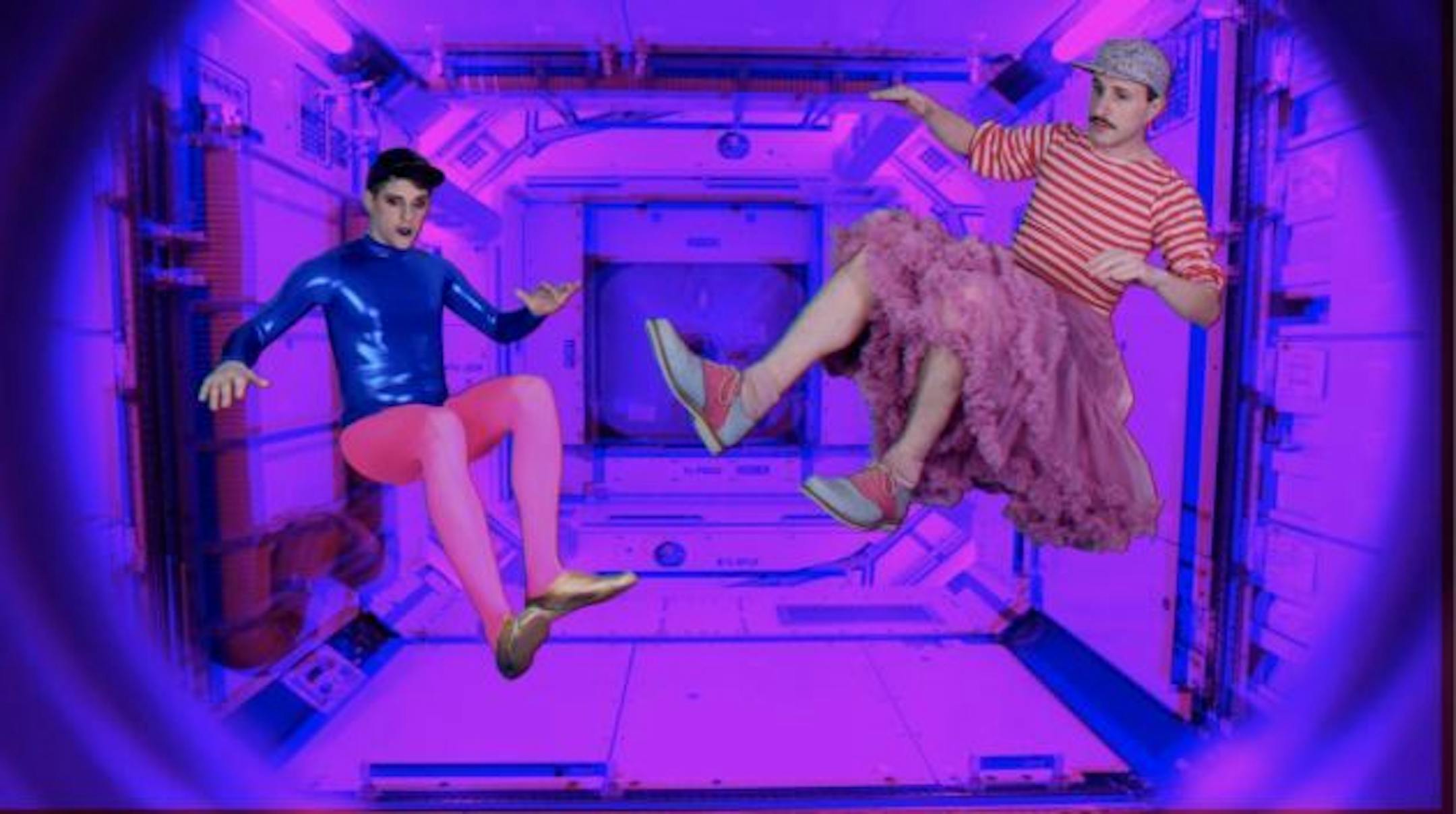
Above: Still from Princess' video "Out There." Images courtesy of the artists.
Michael O'Neill and Alexis Gideon are not queens. They are Princess, a collaborative band/performance art duo formed in 2004, disbanded in 2006 and now back at it since 2017, spurred on by the 2016 election and its political aftermath.
They've been performing at mostly museums and art galleries, but oon Mon., April 1 at 7:30 p.m. they're coming to 7th St. Entry for a live performance and simultaneous screening of their video "Out There," which battles toxic masculinity in the age of #metoo through time travel and attempting to find a utopic planet where sexism doesn't exist. A funky sci-fi narrative mixed with feminist vibes emerges as the characters travel through time wearning gender fluid costumes that switch from suits to tights to leotards to skirts and tutus.
O'Neill, a seasoned musician and artist who has performed around the world with the popular art/performance band MEN, and Gideon, also a musician/performer who as worked with the likes of Dan Deacon and tUnE-yArDs, took a nearly 13-year hiatus from their Princess collaboration. I caught up with them for a brief Q&A about the show and their hour-long video. This interview has been edited for clarity.
ALICIA ELER: Where did the idea for the "Out There" video work come from?
MICHAEL O'NEILL: We created a fictitious version of PRINCESS, of ourselves, who proclaim the Earth of being this misogynistic utopia. They go to another planet and want to find a place where it's better, and bring that back to Earth. They don't realize it is an ego-driven mission. So they go from planet to planet, looking, and then stumble upon these worlds that appear to be utopian but then find there's something dysfunctional and corrupt going on there too. Not till they realize till the end of it — SPOILER ALERT! – do they realize that it is all kind of a dream, but what wasn't a dream are these sort of transmissions from a divine feminine planet, guiding them toward a place where they can understand it is not they – the men – in this situation that can save the planets. It is by way of giving over the mic or allowing space for a woman's voice to emerge that they learn. The change is not an outward change, it is an inward change – that as men they need to learn to listen and create more space in the world.
AE: What drove you/Princess to explore the intersection of queerness and masculinity through performance?


