

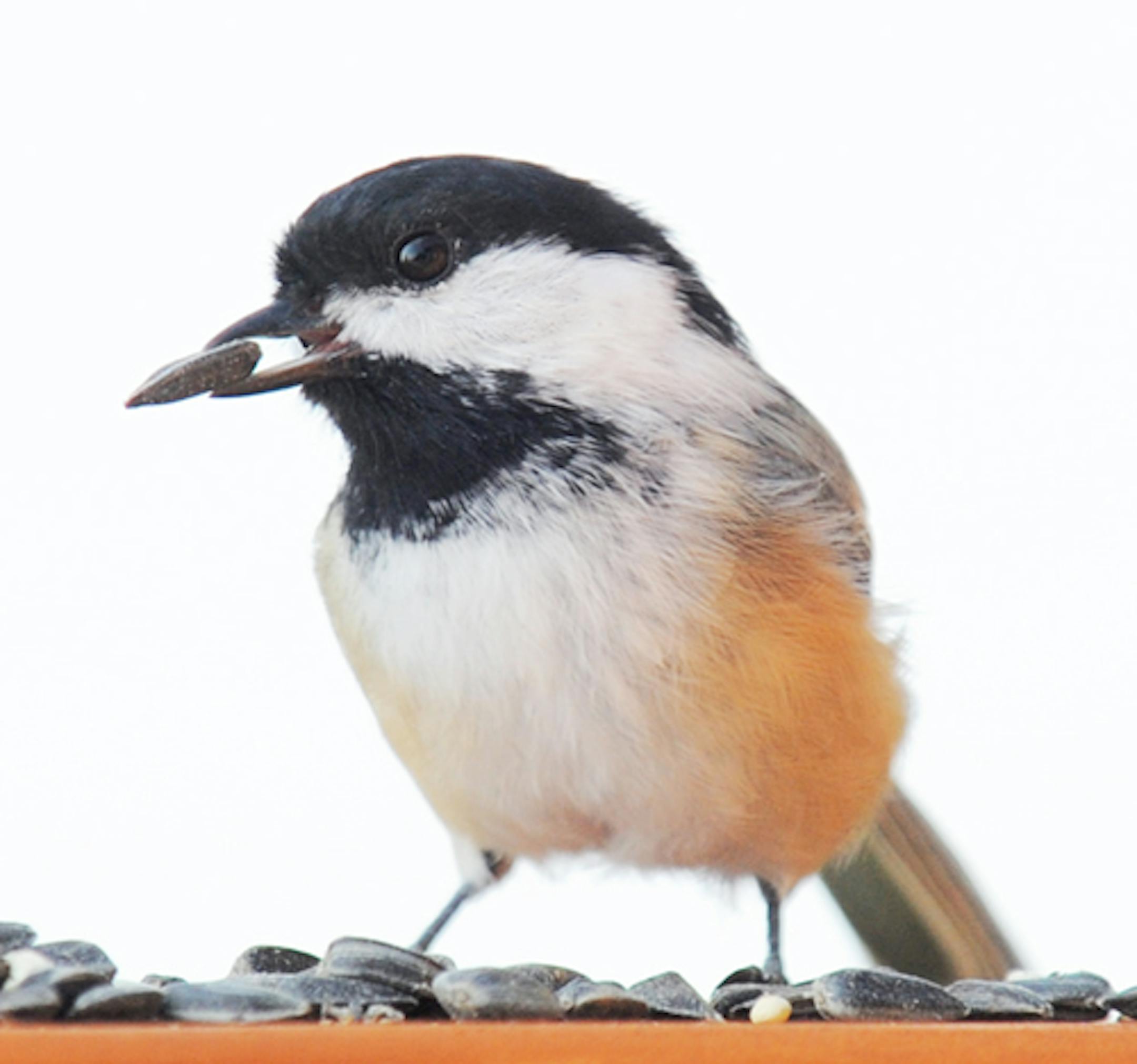
After nesting seasons and again in winters I've counted as many as seven Black-capped Chickadees in our yard, visiting one feeder or another. They're not easy to count, constantly coming and going from the feeders. In most cases the birds would take a seed to the cedar tree or the willow near four of the feeders, duck out of sight, eat, then flit back to the feeders. They're never identified as individuals in any way, so I assumed that the birds of the Year of Seven were the same birds I saw the day before or the day after.
That might not be the case. Doing some Internet research on chickadees I came across a study done in northern Maine in which chickadees somehow were counted individually. Banding was not mentioned (but some kind of ID coding must have been used). The man wrote that as many as 110 individual chickadees used his feeders during a two-day period, not all at the same time. The study was published in the ornithological journal The Wilson Bulletin. Our backyard isn't exactly northern Maine, however, and that many chickadees must be some kind of record. I thought seven was good.
Perhaps the chickadees we see here change from day to day, move around the neighborhood. I have read that non-migrants such as chickadees do make short-distance migrations, "ours" moving south for whatever length of time while chickadees from north of us come here. Again, no indication of how that information was acquired.
The Wilson article also said that chickadees found feeders more readily in October than in January. And that use of the feeders varied "markedly" in both number of birds present and frequency of use among individuals. That makes sense. Numbers do change here, too, from zero to seven as far as I know. Another study done in Wisconsin in 1985 found that feeders were used more often prior to sunset than after sunrise, and that air temperatures made no difference. I agree.
I found studies that said juncos prefer thistle seed to canary seed, reportedly because the time required to open the shell and extract the kernel was shorter for thistle. Juncos preferred thinner to thicker seeds because, the author wrote, small items are easier for small bills to handle.
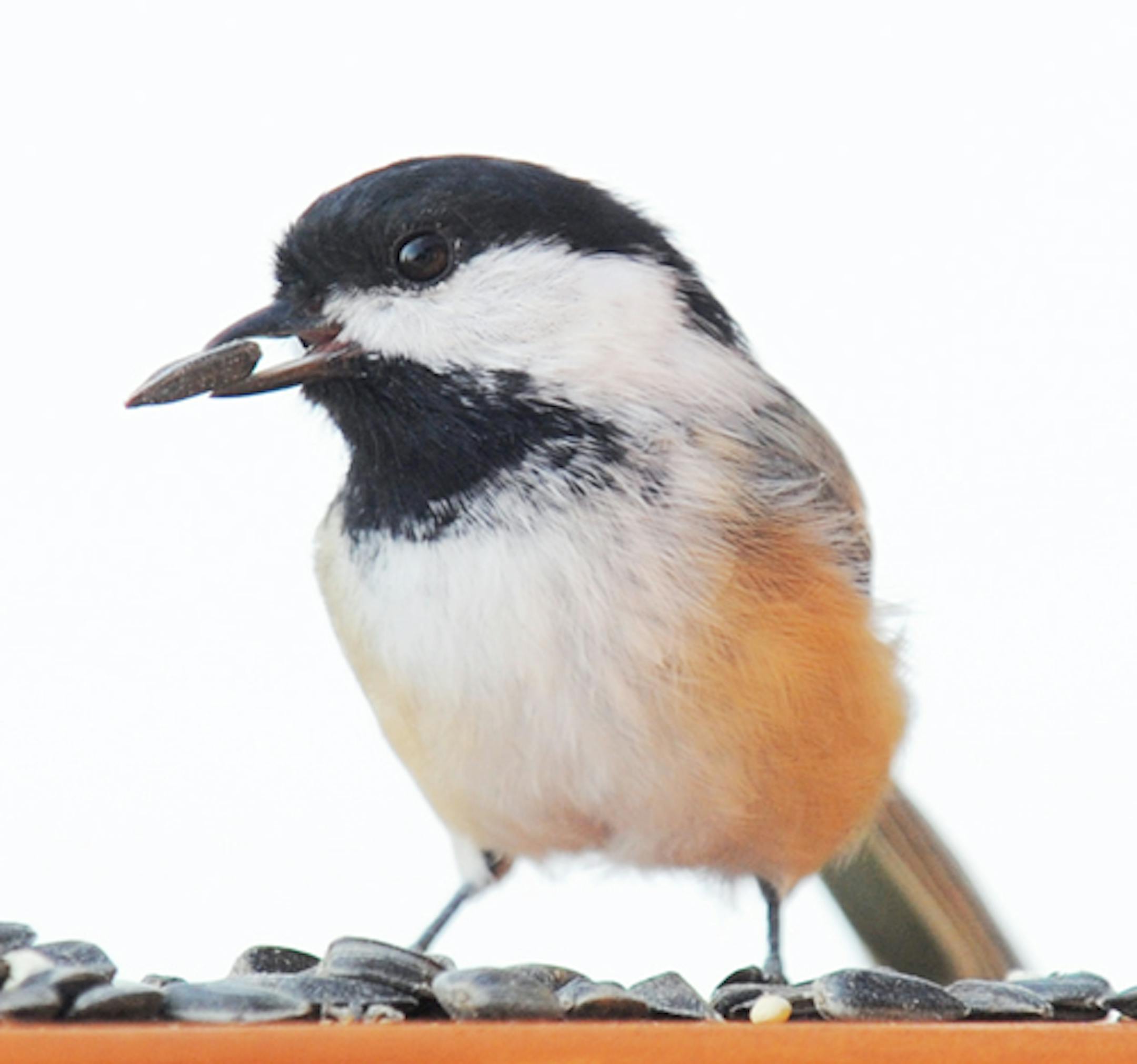
Below, a Black-capped Chickadee with a black oil sunflower seed, probably a small, thin one.
Generally, larger birds coming to the research feeders ate seeds both large and small, but showed preference for smaller seeds. It was thought they did this because smaller seeds were easier to process, reducing foraging time and thus exposure to predation.
Cardinals observed in that study made little distinction between larger and smaller sunflower seeds. Larger sizes did not slow them up at all.

