

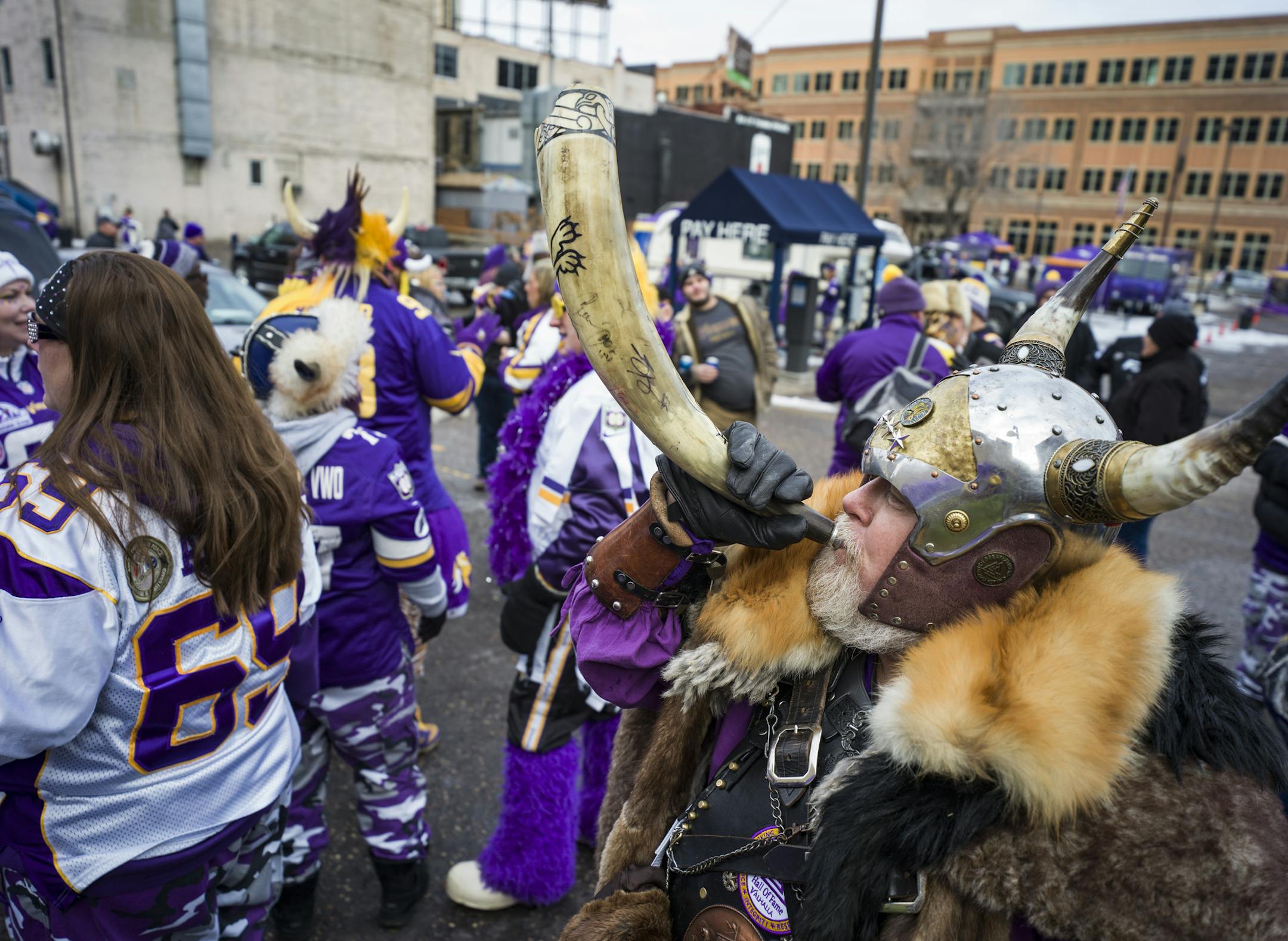
At their final tailgating session at U.S. Bank Stadium this year, garishly dressed Vikings fans chowed on doughnuts, homemade chili and freshly grilled burgers even as they fretted about the future of the tradition.
On their minds Sunday wasn't only the playoff hopes for the purple-and-gold, but the encroachment of development around the stadium. New apartment buildings and parking ramps on Washington Avenue are expected to eliminate surface parking lots that double as gameday party pads.
Erik Christensen of Sioux Falls, S.D., was part of a group that took over several spaces on the "Skol Lot" with propane-heated tents and a grill customized to travel on his truck. "We've heard this lot is going to get closed next year," Christensen said. "We're worried … like, where do we go?"
City leaders have long sought to replace surface parking with amenities such as housing, retail and restaurants. Washington Avenue has transformed in the past few years from empty storefronts on a commuter corridor to a destination neighborhood with hotels, high-end condos, restaurants and a Trader Joe's grocery store.
Despite the tailgaters' professed commitment, Vikings vice president Jeff Anderson said the team lots weren't sold out at the beginning of the season — although they were by the end.
"Obviously, it's an evolving landscape for tailgating over the last few years," he said. "We know it's an important tradition and we want to continue to offer it in some form."
For now, the Vikings control about 360 tailgating spots on four lots. About a third of those spots will be eliminated next spring when team owners and real estate developers Mark, Zygi and Leonard Wilf plan to break ground on an apartment tower in the Skol Lot used by Christensen's group at Washington Avenue and Park Avenue S.
With their love of open pavement, tailgaters are at odds with urban planners. Development around U.S. Bank Stadium was the major selling point for the Vikings when they asked lawmakers and City Hall for the public to pick up almost half the cost of the $1.1 billion stadium. The stadium's predecessor, the Metrodome, was derided for failing to spark neighborhood development.


