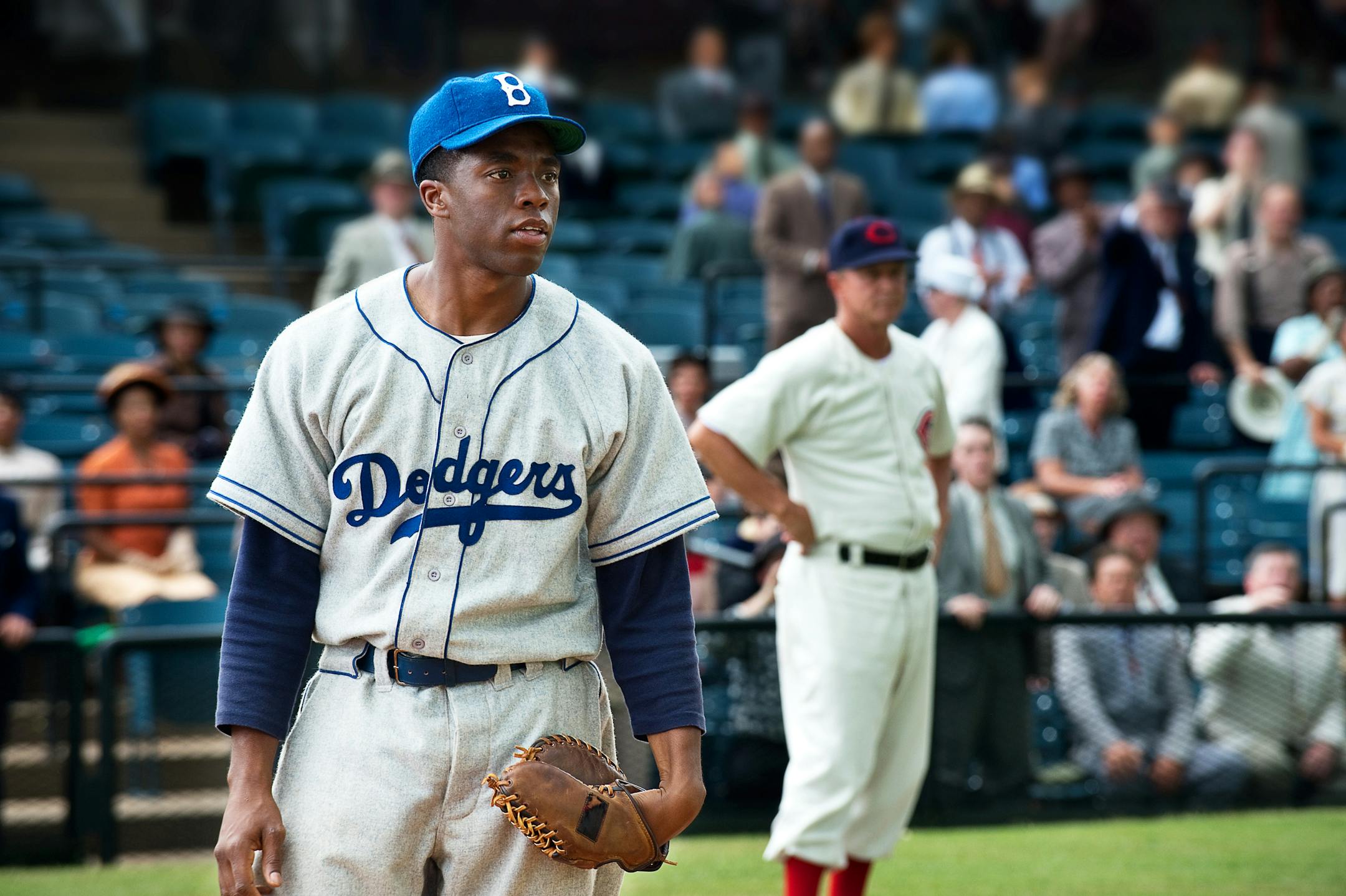
In 1947, America had Jackie Robinson. Now America has "42."
Generations of Americans are leaving movie theaters this week having learned and even felt, perhaps for the first time, the pain and shame of an era many never really knew before.
Now they know: Before America was a nation of desegregated schools, buses and restaurants — before most Americans had even heard of Martin Luther Ling Jr. — our country's civil rights generation had but one icon of human equality. He stood head and shoulders above all others — even when he was sliding in the dirt and jabbing his toe beneath Yogi Berra's mitt, famously stealing home in the World Series.
This powerful movie celebrates how, in 1947, the man with the blue 42 on his Brooklyn Dodgers uniform became the first black athlete to play major league baseball. "42" doesn't merely show us the bigotry and death threats Robinson endured. It educates us by allowing us to feel his pain. And our shame.
Yet "42" is really just the end of the beginning of the Jackie Robinson story. It stops after that epic first year. But the real Jackie Robinson story — his story and our nation's story — went on for a quarter century.
So today we'll educate ourselves by taking a guided tour of Washington's monument to Jackie Robinson. You never heard of it? Probably not. After all, it doesn't tower above the capital skyline like George Washington's, nor sit and gaze down at us like Abe Lincoln's.
Washington's monument to Jackie Robinson stands just 131 pages tall, a monument originally made of paper and microfilm. It is the FBI's file on Jack Roosevelt Robinson. Part of it is the FBI's investigation of all those evil death threats. The rest mainly feeds FBI Director J. Edgar Hoover's conviction that America's civil rights movement was but a tool of Soviet Communism's plan to subvert American democracy.
Here — read the FBI's words for yourself. The FBI memos, originally stamped "CONFIDENTIAL" or "SECRET," were declassified in 1984.