Fast pace gives St. Paul's summer-school preschoolers a leg up on the fall

District opened doors this summer to students brand new to school.

July 12, 2013 at 9:32PM
icon2:16

There is little letup in the action in Mary Harris' summer-school classroom in St. Paul.

Songs are to be sung, rules observed and words to be rhymed — all from the moment the preschoolers sit down to eat their breakfasts.

For most Minnesota students, summer-school programs are an opportunity to catch up or take skills to new levels. But for the 5-year-olds in Room 1311 at Eastern Heights Elementary on St. Paul's East Side, the goals are simpler. Learning to share and take turns in line are fine for now, Harris said.

The preschoolers are new to district classrooms and taking part in a program that is a first for the St. Paul school district. In 2007, when it last opened summer school to preschoolers, the program was a continuation of full-year pre-K classes, with kids already attuned to classroom rituals.

For this summer's program, which lasted four weeks and ends on Friday, teachers and students started from scratch, bringing special meaning to the chant led by Harris this week: "Nay Ta came to school today / We're so glad / We'll say 'hooray!' "

Even the kids who were absent got their shoutouts.

St. Paul takes its pre-K programming seriously. Twice in recent years, voters have agreed to kick in extra money so that the district could offer the full-year program to more of its students. This year, it served 1,094 with another 709 on the waiting list.

A Wilder Research study has shown that students who entered kindergarten in St. Paul after having attended a district pre-K program were further along in the areas of reading, math, spelling and vocabulary than those who did not. The widest gap was in vocabulary, followed by reading.
For the four-week program, expectations are lowered, but assessments still made. While kids buzzed about in clusters near her, Lisa Gruenewald, supervisor of the district's Office of Early Learning, pulled out a sheet revealing one student's knowledge of language and literacy and of mathematical and logical thinking.

The student knew only the letter "W," but Gruenewald said that mattered less than the fact the district had information to pass on to teachers as they head into the fall.

"Their kindergarten teachers would have no idea," she said. "They'd have nothing."

Learning furiously

This summer, the district had 11 preschool classrooms in seven schools. Ninety percent of the 400 students had not been a part of last year's pre-K program; they came from the waiting list, Gruenewald said. All will attend kindergarten in the fall.

The program's funding came from part of a $207,000 grant administered by the state Department of Education.

In September, Harris begins her sixth year as a pre-K teacher. A former second-grade instructor, she recalls the day when Gruenewald asked her about her willingness to teach the younger children.

"Pre-K? I thought, 'How hard can that be?' " she said. "But I was blown away."

Summer classes run for 2 ½ hours, with one group in the morning and another in the afternoon. The pace of activities, from vocabulary cards being flashed one moment to kids going 'round the mulberry bush the next, seems steady enough. But Harris said: "The challenge for me is I want to put so much in."

She had hoped her students would have gotten a better handle on rhyming, which is important, she said, because similar sounds "make the words come quicker." Harris noted, too, that while some students knew how to write their names, they could not yet identify the letters.

But they were an eager bunch, and obedient, too, returning to their places in a circle and waiting their turns to play a game involving a sandwich shop. When Harris turned up cards with cartoon animals on them, Nay Ta Wah, wearing a white shirt with pink petals on the shoulders, quickly but politely exclaimed, "Unicorn!"

"Our job is constant. We don't stop," the teacher said. "But they're like little sponges. They want to be here."

Anthony Lonetree • 651-925-5036


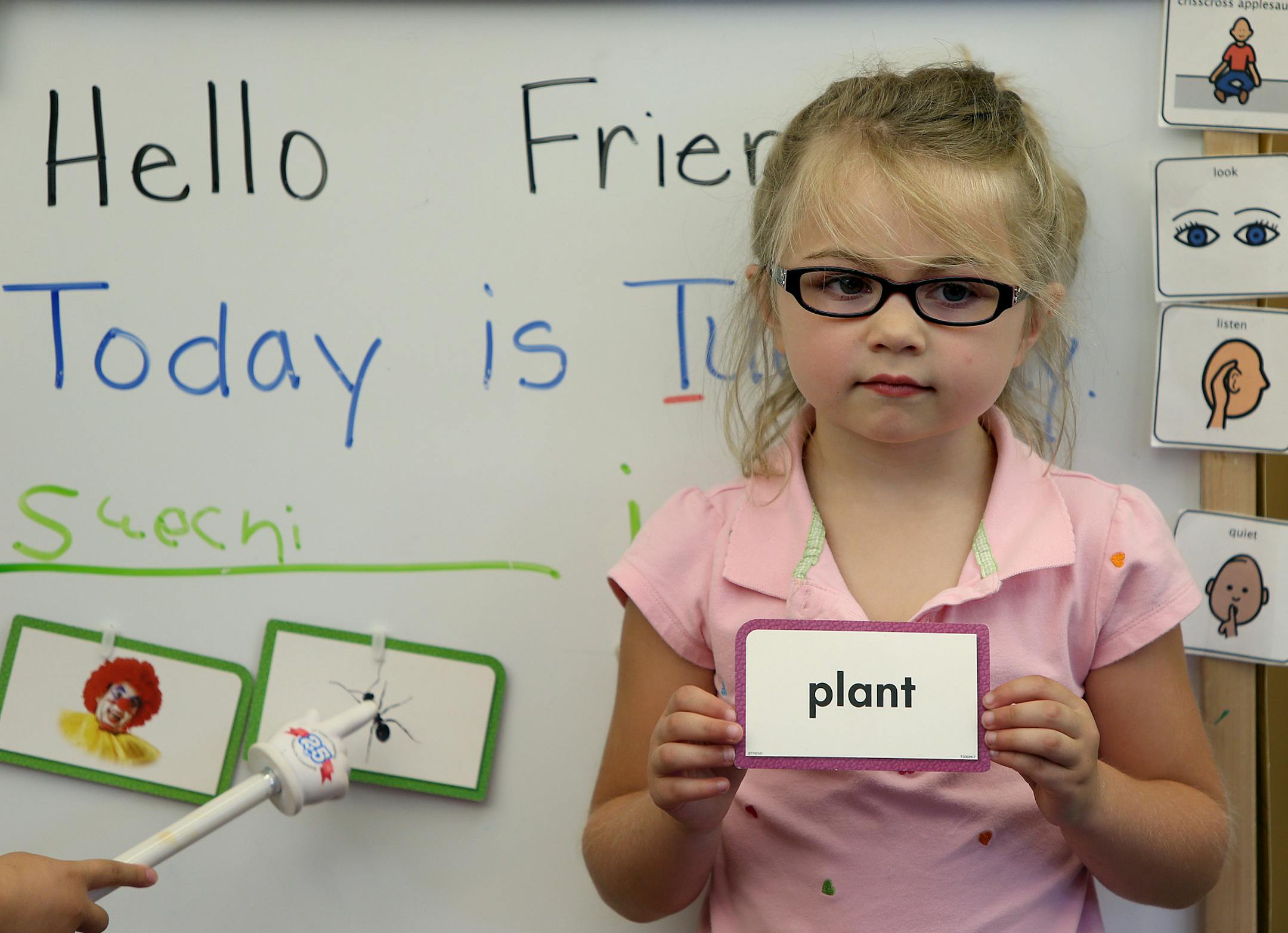
July 9, 2013: Pre-schooler Heidi Bierschank was called to participate in a morning grammar exercise at Eastern Heights Elementary School in St. Paul.
Preschooler Heidi Bierschank participated in a grammar exercise at St. Paul’s Eastern Heights Elementary School on Tuesday morning. (Star Tribune/The Minnesota Star Tribune)
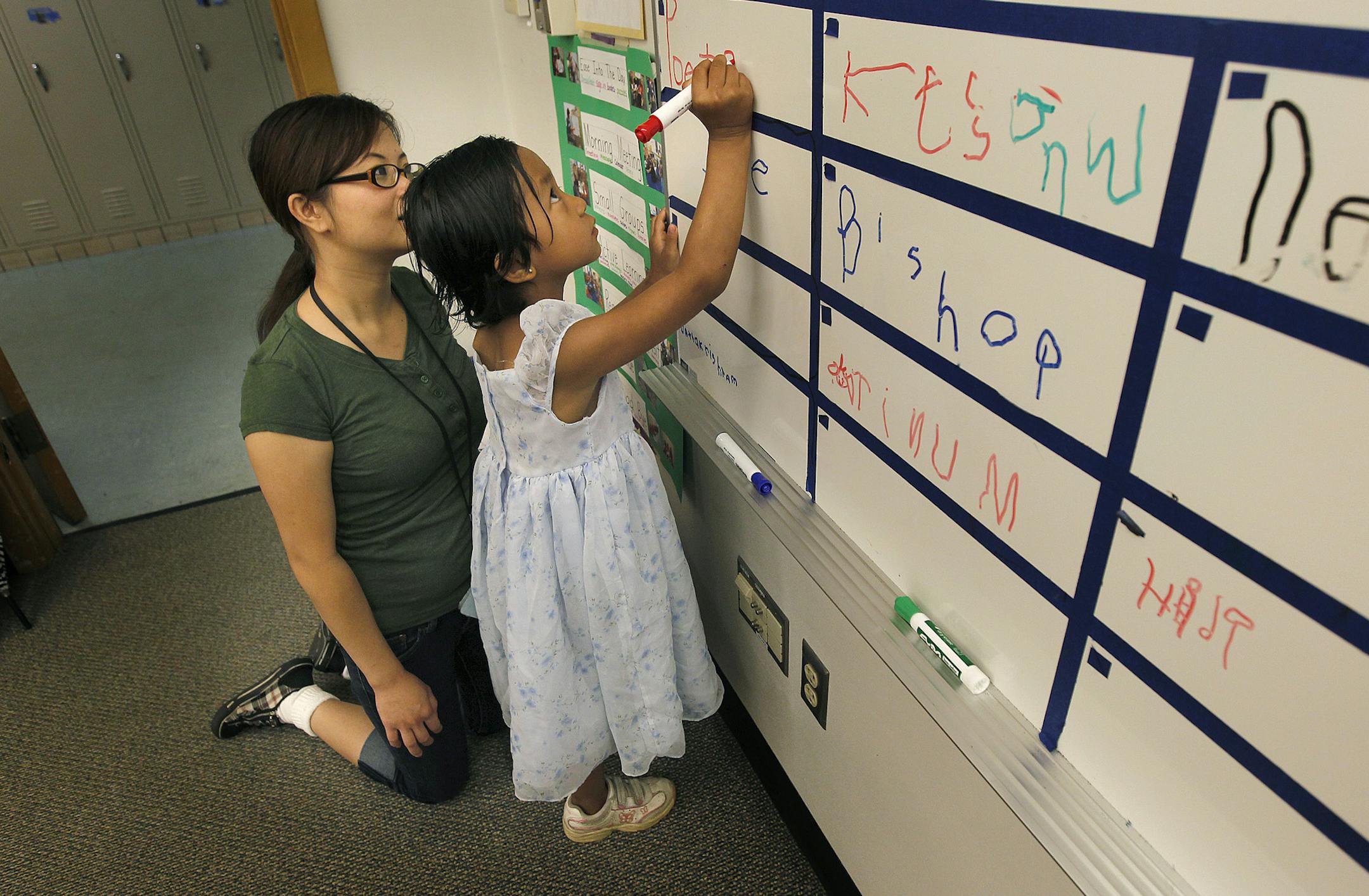
Pre-school teaching assistant Kia Vang, left, watched as Poe Tha Puh wrote her name on a board before class started at Eastern Heights Elementary School, Tuesday, July 9, 2013 in St. Paul, MN.
Preschool teaching assistant Kia Vang, left, watched as Poe Tha Puh wrote her name before class started. For the first time in six years, the St. Paul school district is offering summer school to preschoolers. (Star Tribune/The Minnesota Star Tribune)
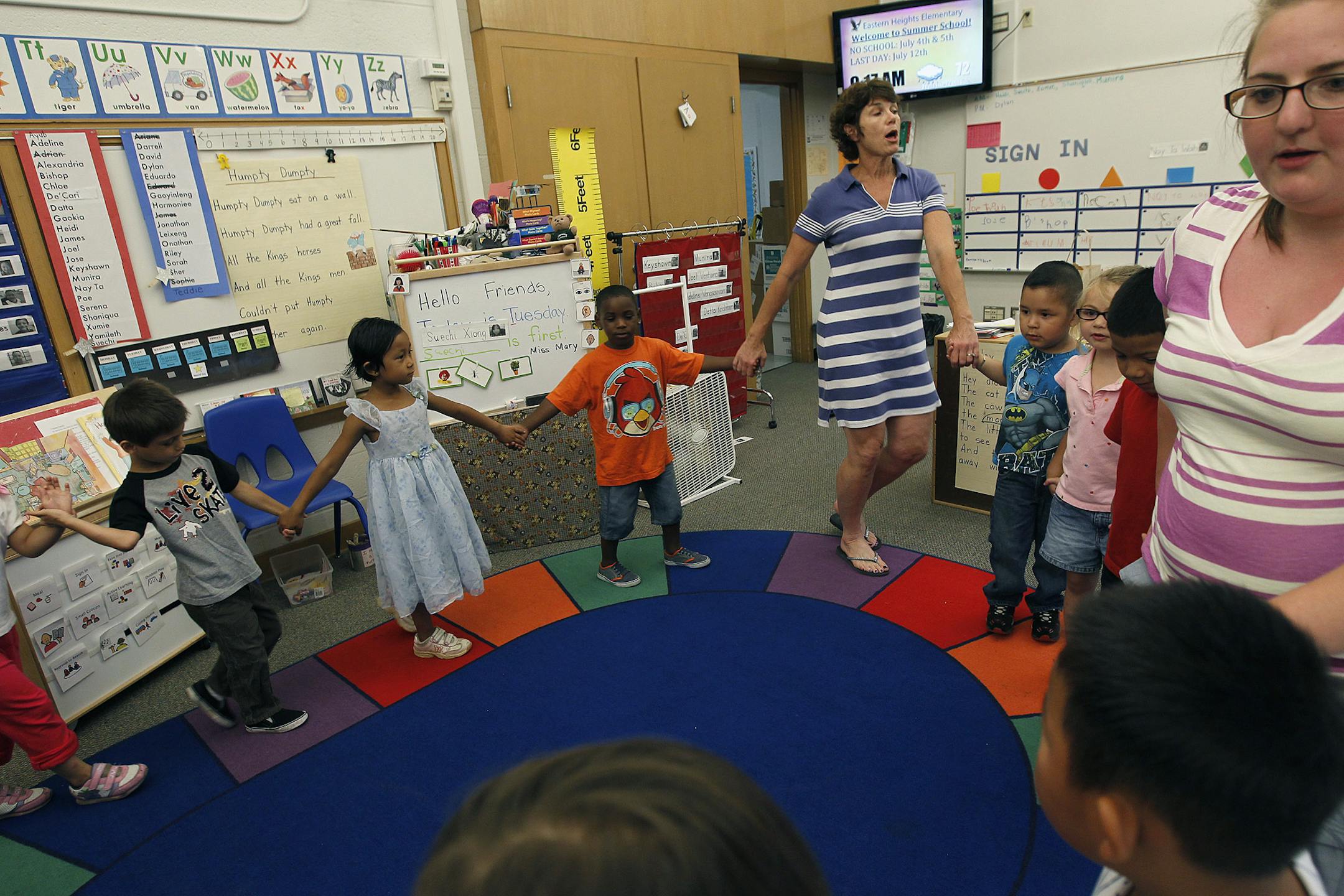
Pre-school teacher Mary Harris, center, led her class in a morning exercise at Eastern Heights Elementary School, Tuesday, July 9, 2013 in St. Paul, MN. (ELIZABETH FLORES/STAR TRIBUNE) ELIZABETH FLORES • eflores@startribune.com
Preschool teacher Mary Harris, center, led her summer-school class in a morning exercise at Eastern Heights Elementary School on Tuesday. (The Minnesota Star Tribune)
about the writer

about the writer

Anthony Lonetree

Reporter

Anthony Lonetree has been covering St. Paul Public Schools and general K-12 issues for the Star Tribune since 2012-13. He began work in the paper's St. Paul bureau in 1987 and was the City Hall reporter for five years before moving to various education, public safety and suburban beats.

See Moreicon

More from No Section

See More
FILE -- A rent deposit slot at an apartment complex in Tucker, Ga., on July 21, 2020. As an eviction crisis has seemed increasingly likely this summer, everyone in the housing market has made the same plea to Washington: Send money — lots of it — that would keep renters in their homes and landlords afloat. (Melissa Golden/The New York Times) ORG XMIT: XNYT58
Melissa Golden/The New York Times

It’s too soon to tell how much the immigration crackdown is to blame.