

![Dan Jenniges' cattle drank from the Chippewa River after being moved between pastures in mid August. ] (AARON LAVINSKY/STAR TRIBUNE) aaron.lavinsky@startribune.com RIVERS PROJECT: We look at three of Minnesota's rivers, including the Mississippi, Red and Chippewa, to see how land use effects water quality and pollution.](https://arc.stimg.co/startribunemedia/B3UM2YORTZOU22OBX47ELP5SHA.jpg?&w=1080)
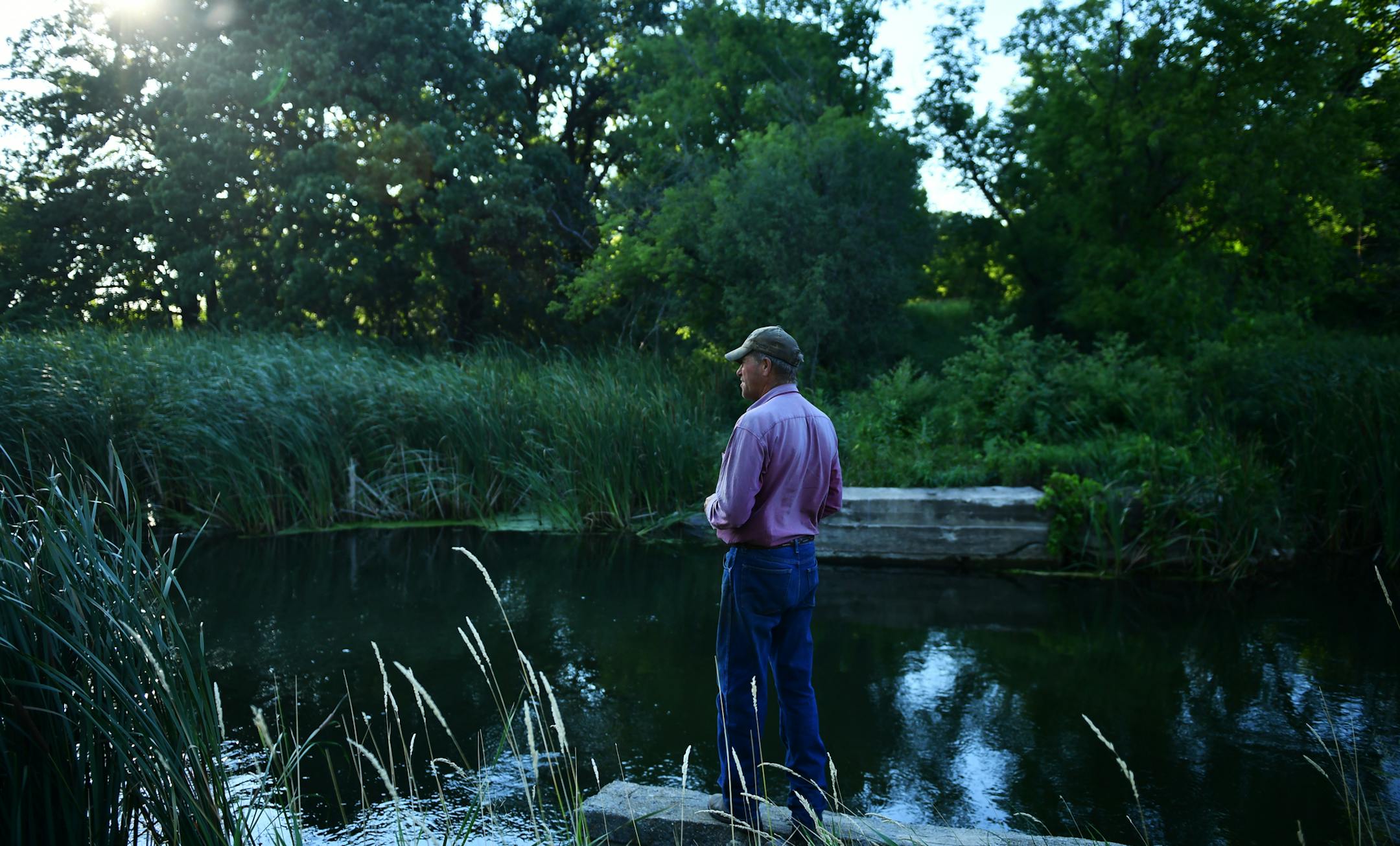
TERRACE, MINN. – Truth be told, Dan Jenniges doesn't think much about whether his farm helps or hurts the Chippewa River, which curls slowly around his fields here in Pope County.
Nevertheless, as he stood on a rise amid a group of taciturn neighbors on a hot day in July, he was a shining example on a grassy hill of a farmer who's doing everything right for clean water — and making money to boot. Telling the group how he manages grazing, he said it comes down to one of the oldest equations in agriculture: cattle and grass.
"It is nice," he said, "to finally admit that grass is a natural resource in Minnesota."
Jenniges is participating in a deceptively simple experiment here in western Minnesota known as the Chippewa Ten Percent Project. The idea, launched five years ago by local leaders and conservation groups, is to help farmers grow more grass, trees, alfalfa, oats, wheat and the like — all of which are much kinder to water than chemically intensive crops like corn and soybeans.
Raising the amount of land planted in such perennials by just 10 percentage points — from 24 percent to 34 percent of the Chippewa watershed's 1.3 million acres — would be enough to tip the river from polluted to clean.
Some 25 landowners now participate, and if they can prove its premise — that a farmer can make money without polluting the Chippewa — they could be a model for protecting threatened rivers all across the Midwest.
But progress has been excruciatingly slow — a sign of how hard it is to change farmers' thinking and to thwart the economics that dictate their decisions. After five years in which high commodity prices drove most Minnesota farmers to plant more corn, the Chippewa watershed has gained about 13,000 acres of grass and other perennials.
Or about 10 percent of the 10 percent.
![Dan Jenniges, of Glenwood, Minn., scanned the horizon for a missing bull on one of his rented pastures, one of only two pastures he uses that is not rotationally grazed. ] (AARON LAVINSKY/STAR TRIBUNE) aaron.lavinsky@startribune.com RIVERS PROJECT: We look at three of Minnesota's rivers, including the Mississippi, Red and Chippewa, to see how land use effects water quality and pollution.](https://arc.stimg.co/startribunemedia/P4MS7M5IS2MUCMONBDMEJURV3I.jpg?&w=1080)
![Waiting on name confirmation - AL ] (AARON LAVINSKY/STAR TRIBUNE) aaron.lavinsky@startribune.com RIVERS PROJECT: We look at three of Minnesota's rivers, including the Mississippi, Red and Chippewa, to see how land use effects water quality and pollution.](https://arc.stimg.co/startribunemedia/4LR5NLG7NB2JN4ZWDXQPSBEIT4.jpg?&w=1080)
![Waiting on plant ID - AL ] (AARON LAVINSKY/STAR TRIBUNE) aaron.lavinsky@startribune.com RIVERS PROJECT: We look at three of Minnesota's rivers, including the Mississippi, Red and Chippewa, to see how land use effects water quality and pollution.](https://arc.stimg.co/startribunemedia/SQC3MUBTZAK4CGDI7NWWPUYQ2I.jpg?&w=1080)


