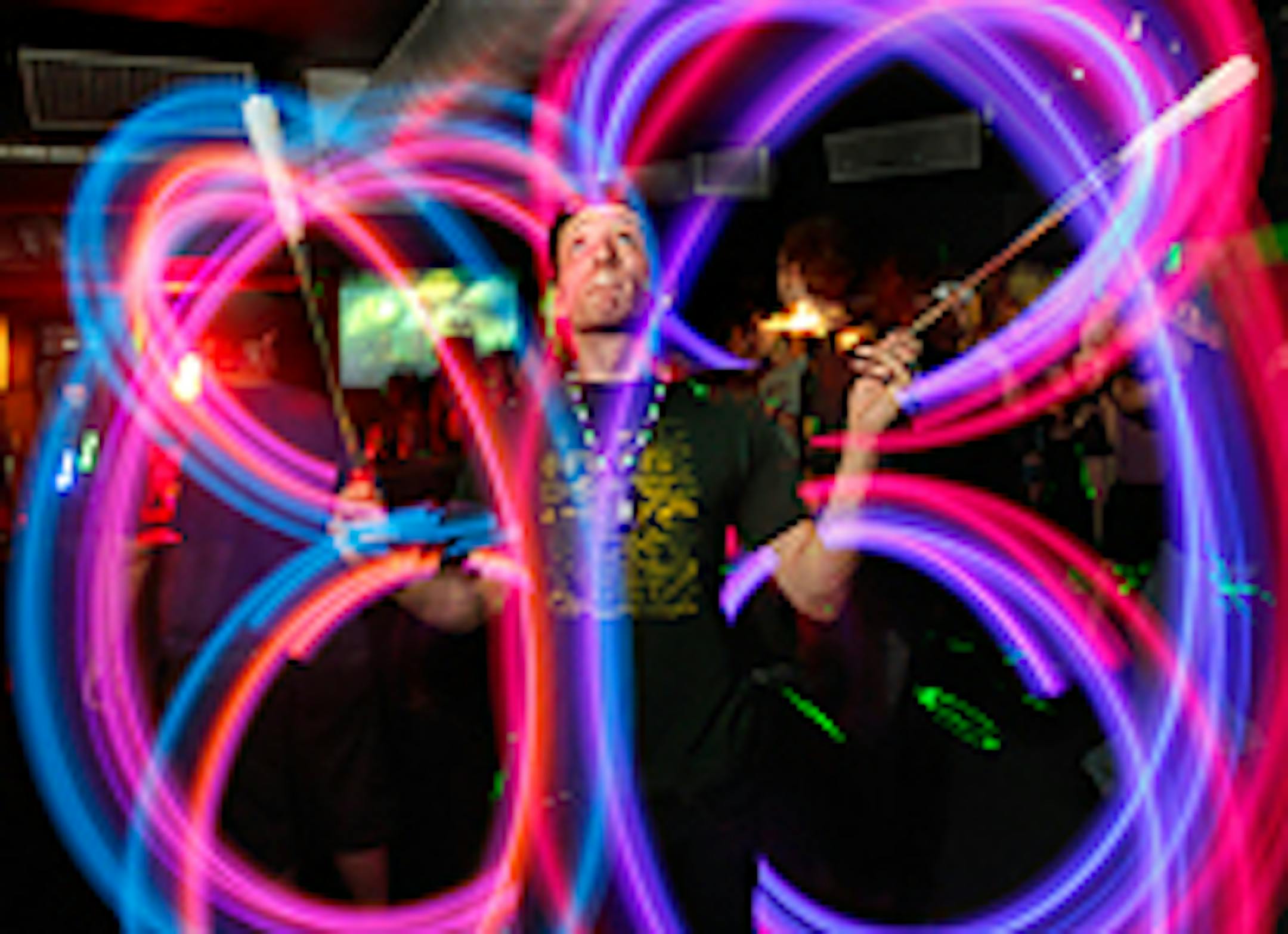
It's 11 p.m. on a Wednesday, and walking up the metallic staircase into First Avenue's Record Room, you can feel the bass reverberating beneath your feet. Inside, you can feel it rippling through your entire body, rattling your organs, as DJ Blaze One kicks off his set at Konkrete Jungle -- the biweekly drum and bass/dubstep night. He attentively tweaks knobs on a mixer and eyes an open laptop while banging a throbbing cut from the new Bassnectar record. The intimate dance floor is a blur of flailing limbs and synchronous swiveling hips.
Over the past five years, dubstep has seen a rapid growth in popularity, locally and internationally. With Konkrete Jungle celebrating its fifth anniversary Wednesday, a weekly dubstep night Tuesdays at Bar Fly and regular visits from touring artists thanks to local promoters TC Dubstep and Sound in Motion, Twin Cities fans have ample opportunities to get their bass fix. Like just about every dance-music genre, dubstep has splintered into many different subgenres, yet all remain beholden to one deity -- bass.
"[In dubstep] the beats are really slaves to the bass line, unlike other music where the beat carries the song and the grooves," said South African producer Martin Folb, who performs at the Loft at Bar Fly on Friday under his MartyParty moniker. "It's all about the bass, man."
MC Hyde, one of Konkrete Jungle's originators, said attendance has increased significantly since they began booking dubstep artists. The Minneapolis faction began as an offshoot of the long-running New York drum and bass night of the same name.
Contributing to dubstep's proliferation is the relative ease by which the music can be created and disseminated. All one needs is a computer and a program like Ableton Live (readily available via bootleg) to start whipping up tracks. Folb, a 41-year-old dot-com-executive-turned-DJ who holds a computer science degree, claims to have written and released 180 songs since 2005 and can complete a track in a single day.
"People don't really understand that modern producers in dubstep are all nerds," he said. (Google "Skrillex pics" if you want some proof.) "We're all just straight-up nerds because we spend 16 hours in front of a computer every day."
While a low-end love has united many a dance floor, dubstep has been incredibly polarizing in its few years of existence.
The genre, largely characterized by its wobbly bass sound, was hatched out of the darker side of the U.K. two-step garage scene (see Oris Jay) and popularized in the mid-aughts by artists like Digital Mystiks, Skream and Kode9. From there, the unfortunately named "brostep" subgenre emerged, causing a fan rift between dubstep -- which emphasizes the sub-bass -- and brostep's midrange, robotic fluctuations and metal-esque aggression. Purists also complain that many brosteppers are ignorant of the genre's origins and don't recognize its forefathers as dubstep.