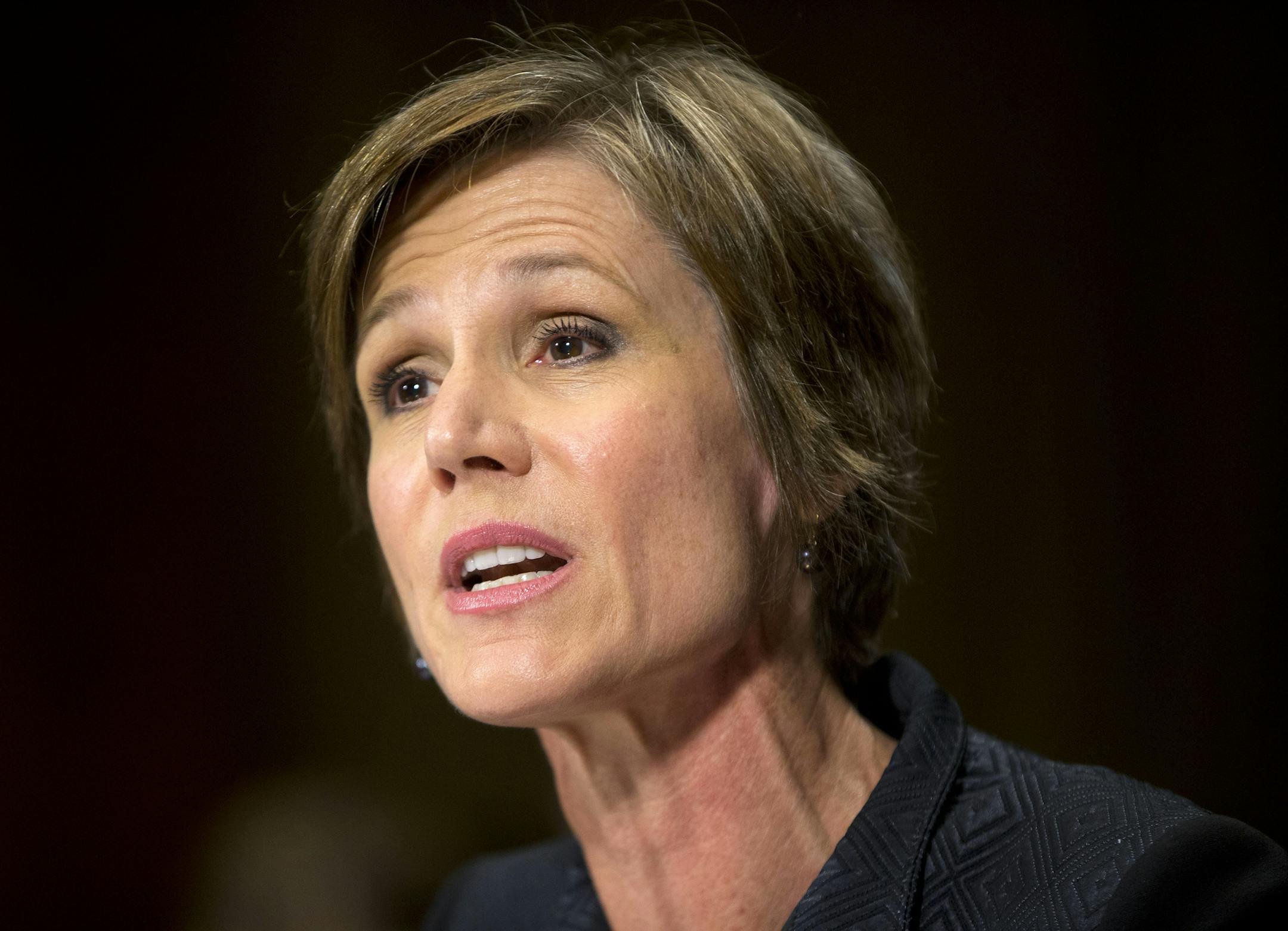
Over the weekend, when I was on a birthday-induced news fast, President Donald Trump's executive order on migrants from seven Middle Eastern countries turned into a fiasco in that sweet spot where incompetence and malevolence overlap. I missed most of the general frenzy. But I certainly didn't miss the turmoil that ensued on Monday, when Acting Attorney General Sally Yates issued a letter ordering the Department of Justice not to defend the order. And then Trump, quite predictably, fired her. That is, after all, what he's famous for.
This martyrdom was very well received by people who opposed the order. Paeans were written to the duty of public officials to stand up against illegal and immoral orders from above. Comparisons were made to the Saturday Night Massacre, in which a series of officials were ordered to fire the special prosecutor investigating President Nixon. It looks to me much less heroic: The left finally has its very own Kim Davis.
Davis was the Kentucky county clerk who was sent to jail in contempt of court when she refused to issue marriage licenses to same-sex couples. (Because her position was elected — and because the Kentucky state legislators had no appetite for removing her against the wishes of their voters, she could not simply be fired.) I believed that Davis had every right, and perhaps a moral duty, to refuse to issue a document she found morally abhorrent. What she didn't have a right to do was to refuse while continuing to hold a job in which issuing such documents was a legal requirement. She chose her principles, and faced the consequences.
Yates, of course, served at the pleasure of the president, and no longer holds that job; she was quite easy to fire, so the comparison to Davis is not perfect. But as with Davis, the appropriate action for her to take was to resign a position she could not in good conscience carry out, not to brazenly defy her boss.
But wait. Isn't Yates's ultimate duty to the Constitution? OK, sure. But if her stance were in defense of the law, she would have cited … you know … the law. Instead, in her letter telling the department to not enforce the executive order, she wrote: "At present, I am not convinced that the defense of the Executive Order is consistent with these responsibilities nor am I convinced that the Executive Order is lawful." That sounds awfully like legal weasel words for "It's probably lawful, but I don't think it should be."
Someone in her position who was standing on the law — an acting attorney general who has had several days and a large staff with which to consider this question — would cite legal authority in raising her concerns.
Jonathan Adler of the Volokh Conspiracy and Jack Goldstein of the Lawfare Blog were equally unimpressed. Yates's grandstanding is, as Goldstein writes, a marked departure from the standards that the attorney general has historically used to decide whether to defend a policy in court, including during Yates's own time:
"The longstanding DOJ view is that DOJ will defend a presidential action in court if there are reasonable arguments in its favor, regardless of whether DOJ has concluded that the arguments are persuasive, which is an issue ultimately for courts to decide. DOJ very often — typically — defends presidential action in court if there is a reasonable legal basis for the action, even if it is not supported by the "best view" of the law. Indeed, that happened a lot in the Obama administration, as it does in all administrations."