

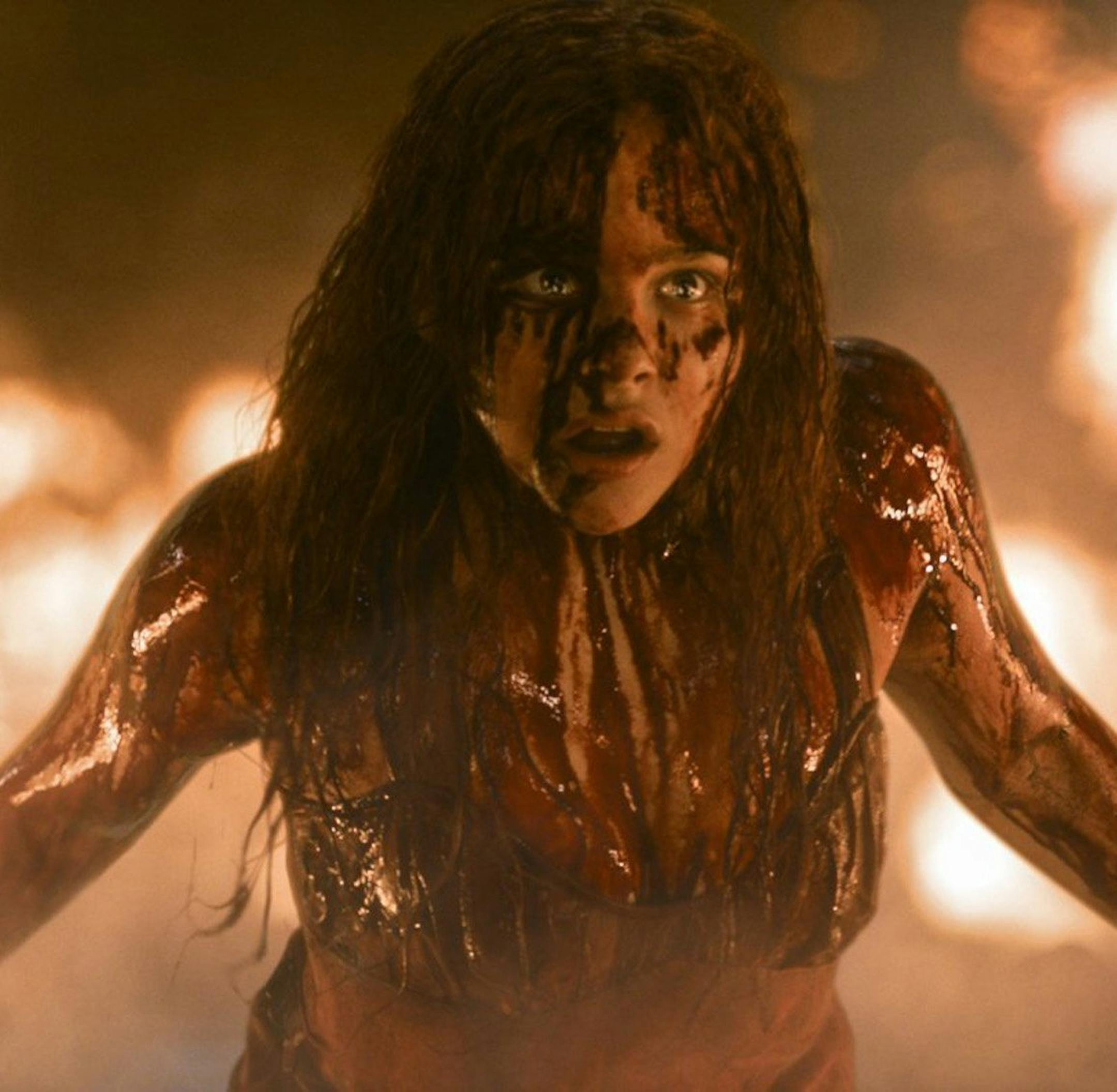
With adaptations of "Carrie," the blood literally comes in buckets. For the newest version, director Kimberly Peirce was determined to get the climactic drop of pig's blood just right. As she described it in a recent New York Times Magazine profile, she tried 3-gallon, 4-gallon and 5-gallon buckets, and she tried a 3-foot drop, a 4-foot drop and a 5-foot drop. Trying all these different configurations required take after take after take. When she asked Brian De Palma, director of the classical original "Carrie" (1976), how many takes it took him, he apparently replied, "What do you mean? We did one."
Movie gore has come a long way since the first "Carrie." What pumps through our veins hasn't changed a drop, but what goes in those buckets has been reformulated again and again.
Fake movie blood — sometimes called "Kensington Gore," after the London street — began evolving long before 1976. For black-and-white films, when blood was permitted at all (censorship guidelines didn't much allow it), filmmakers used something quite simple: chocolate syrup. On black-and-white film, it made a starker contrast than red blood, and no one in the theater would ever know it was just Hershey's.
At first, technical advances were modest. For "Psycho" (1960), employing state-of-the-art makeup design didn't mean using a new kind of blood, just a new method of delivery: the plastic squeeze bottle. It was brand new with Shasta chocolate syrup. As makeup supervisor Jack Barron explained it, "This was before the days of the 'plastic explosion,' so that was pretty revolutionary. Up to that time in films, we were using Hershey's, but with the squeeze bottle you could do a lot more."
Color presented new challenges. Starting at least as early as "The Curse of Frankenstein" (1957), the first color film from the schlockmeisters at Hammer Film Productions — a British studio, exempt from the Hays code — blood began to splatter the silver screen in Technicolor. But horror filmmakers were still unaccustomed to working in color, so the blood didn't look right: In Hammer films like "The Curse of Frankenstein" and "Horror of Dracula" (1958), it was cartoonishly bright. The so-called "Godfather of Gore," Herschell Gordon Lewis, knew this was a problem. While working on what became the first splatter film, "Blood Feast" (1963), he "realized how purple the fake blood at that time was because it had been prepared for black-and-white movies." To avoid using these substandard materials, he got his blood custom-made.
The bright red blood wasn't a problem for everyone. Jean-Luc Godard used a bright, unnaturalistic red for movies like "Pierrot Le Fou" (1965). This suited Godard's more abstract, self-conscious approach to the movies.
But the man who revolutionized movie blood — and the rest of movie makeup — was Dick Smith. For groundbreaking and bloodletting movies like "The Godfather" (1972), "The Exorcist" (1973) and "Taxi Driver" (1976), Smith perfected the recipe for fake movie blood:
• 1 quart white corn syrup, which served as the base.


