

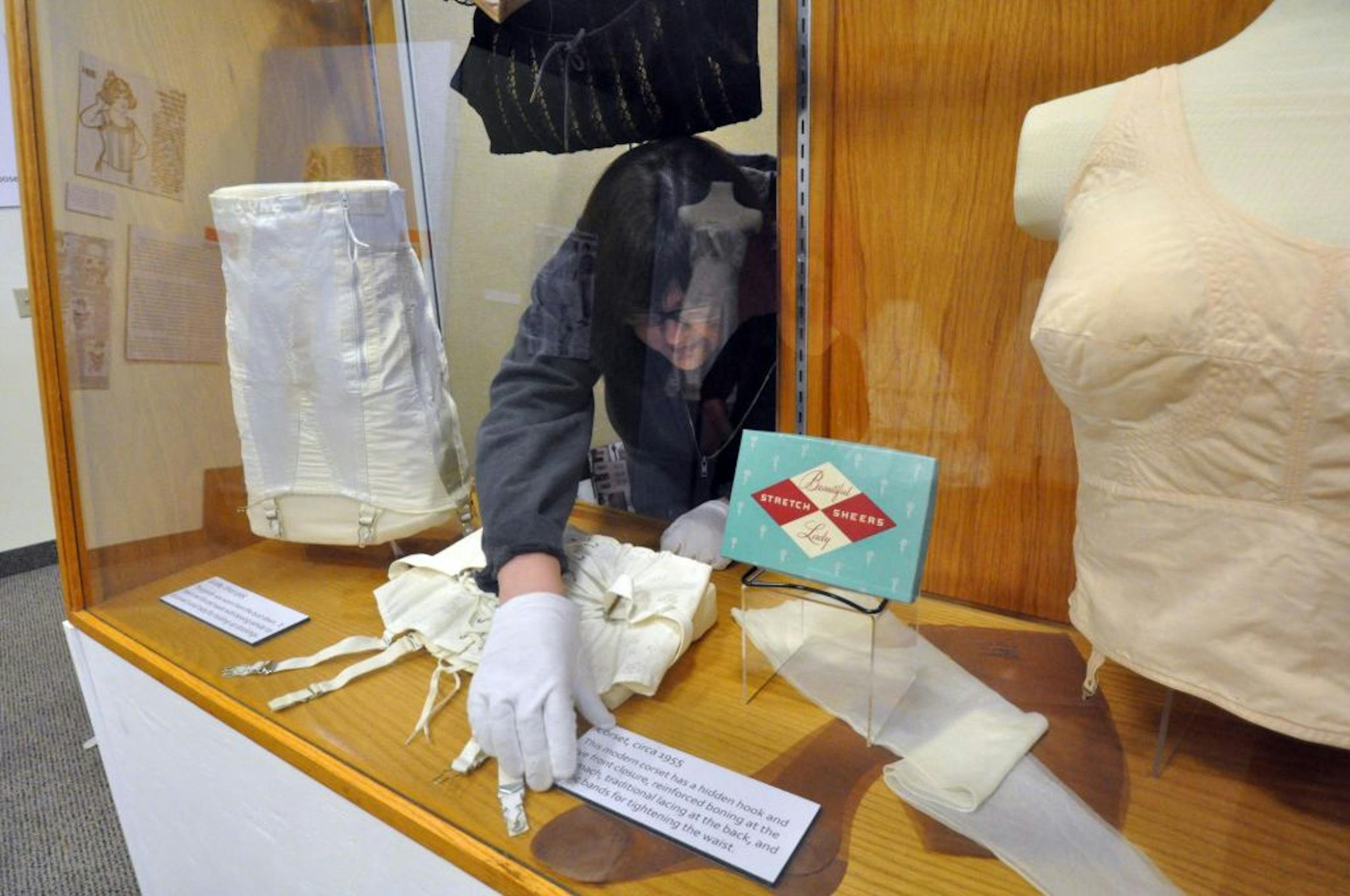
Scarlett O'Hara's 17-inch waist didn't come without its drawbacks.
"Smelling salts and fainting couches, all that came about because corsets were so tight that people couldn't breathe properly," said Kathleen Klehr, executive director of the Scott County Historical Society. As shown by historic ads featured at their new exhibit, even children of the 19th century wore corsets to train their figures into that coveted elegant hourglass shape.
The new exhibit at the Stans Museum in Shakopee, "Under Where? Unmentionables Exposed," traces the rather quickly shifting history of undergarments, from metal-cage crinolines, bustles and other convoluted contraptions that compressed women's bodies, to the barely-there underwear of today. Underwear, said Klehr, is "a fairly new phenomenon. It's only a few hundred years old."
When the exhibit opens on Thursday, Klehr -- who holds a degree in women's and gender history from the University of York in England -- will discuss the history of underwear and how it reflects social status, perceptions of beauty and the changing roles of women.
"Underwear can start to tell you a little about the times," she said. "It exposes a lot more."
The exhibit's underwear history starts with the 16th century "farthingale," a costly undergarment worn only by women of the upper classes. Middle-class women who couldn't afford one sewed their own version, called a "bum roll," a crescent-shaped pillow stuffed with leaves or hay and fastened about their waists. "It was somewhat reminiscent of an airplane pillow," said Theresa Norman, curator of exhibits and collections at the museum. It achieved the same desired effect, bumping the skirt out and making the waist appear thinner.
In the 18th century, women wore panniers, akin to saddlebags on bicycles, and in the 19th century, fashion shifted to the bell-shaped whalebone or metal crinolines and bustles that bumped out the backs of skirts. Upper-class women were expected to wear the various kinds of hoop skirts on a daily basis, Klehr said, something not expected of women of the lower classes. "If you were out washing clothes, the whalebone would poke into you. It'd be very uncomfortable."
In addition to the restrictive nature of undergarments, the number of layers -- stockings, garters, corsets, underskirts, hoop skirts, overskirts -- made the process of dressing rather involved, and women had to constantly worry about simply trying to sit down in cumbersome hoop skirts without exposing themselves.


