

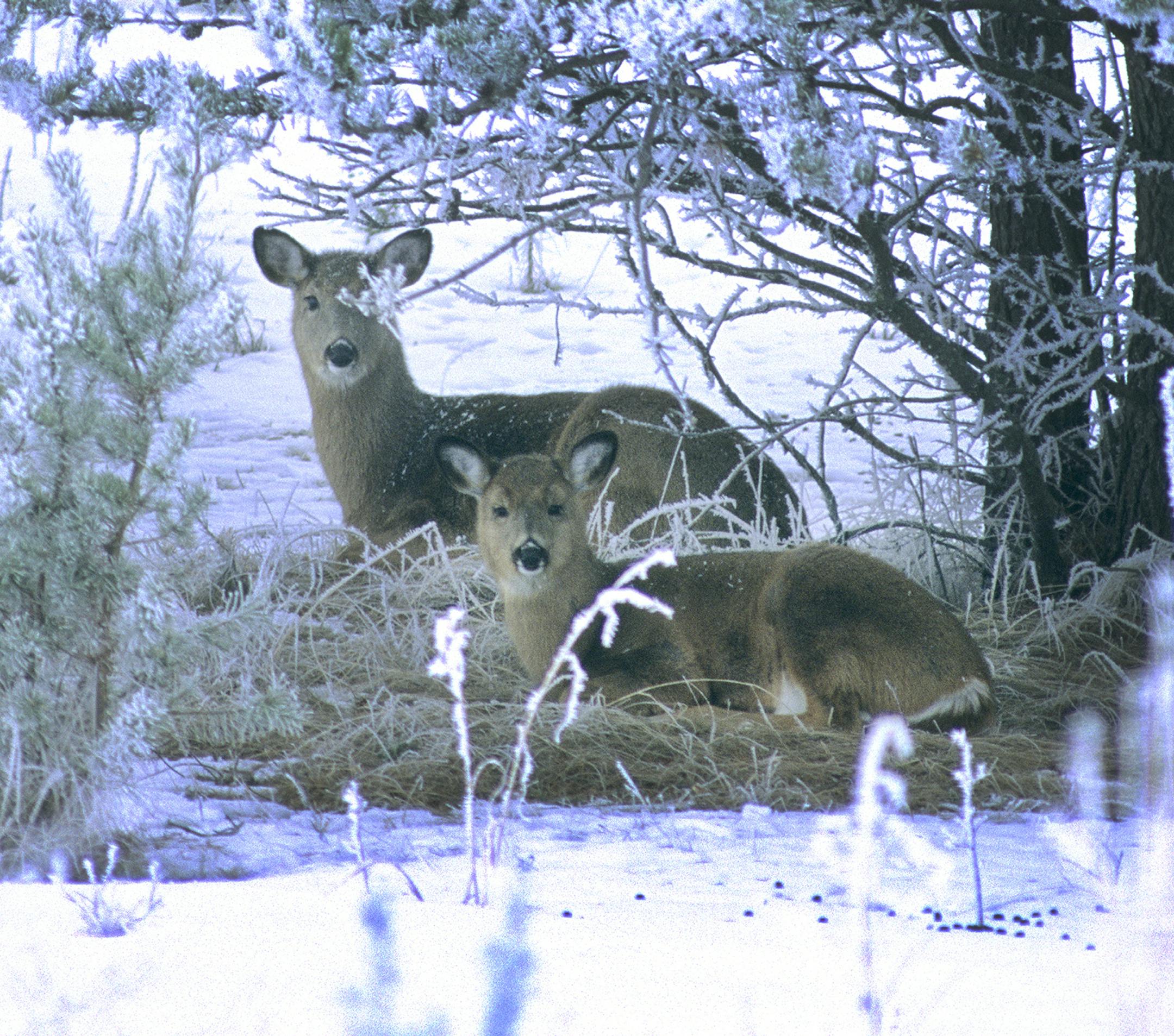
Say you were a deer living last week near Orr, Minn., about halfway between Duluth and International Falls. You've had a tough few days, weather-wise. Beginning Sunday, the temperature lows were minus-29, minus-29, minus-20, minus-20, minus-35 and, on Friday, minus-33.
Looking for relief in daytime? Forget it. High temperatures never rose into positive territory.
Yet it's unlikely many, if any, deer in the area died because of the frigid temperatures, in part because this most recent cold snap has been fairly short in duration and in part because deep snow hasn't been a problem: Only 6 inches or so is on the ground in Orr, according to the National Weather Service.
Thanks to their unique physiology and behavior adaptations, deer can survive such severe weather. Consider:
• Throughout summer and fall, deer increase their fat reserves, which are critical to winter survival. Fawns born in spring and early summer spend too much energy contributing to skeletal and muscle growth to add much fat, making them more susceptible to dying in winter than does or bucks. Bucks, meanwhile, endure risks because they expend so much energy during breeding season, and also forget to eat while chasing does. So they, too, are at higher winter survival risk.
• A deer's coats are engineered to help him or her endure extreme cold. Their guard hairs, which make up their outer coats, are long and hollow, allowing them to trap air, which acts as insulation. These hairs also shed water readily, thanks to a gland's oily secretions. Providing most of a deer's insulation, however, as any hunter learns when field-dressing a whitetail, is a thick mat of shorter, dense hairs that lie beneath the guard hairs.
• To survive cold weather, many deer will migrate to wintering areas typically dominated by conifers and ideally located near areas where browse, or food, can be obtained. Conifers offer warmth to deer lying beneath them, and because less snow reaches the ground in thick conifer stands, deer can more readily devise trails and escape routes in these areas than in deciduous tree stands. If available, nearby clearings give deer a chance to soak up sunshine in daytime. In northern Minnesota, such deer "yards" often hold many deer, which can increase an individual deer's chances of survival if wolves are present.
• Notwithstanding the migrations, which often are prompted by weather severity and which sometimes are reversed if winter weather moderates, deer generally move less and eat less in winter. Both are natural responses triggered by shorter daylight periods.


