
Advertisement

Envoy helped nurture Libyan democracy

Diplomat had long experience in Mideast when he arrived by cargo ship for wartime mission to rebels.

The Washington Post
September 13, 2012 at 1:58AM
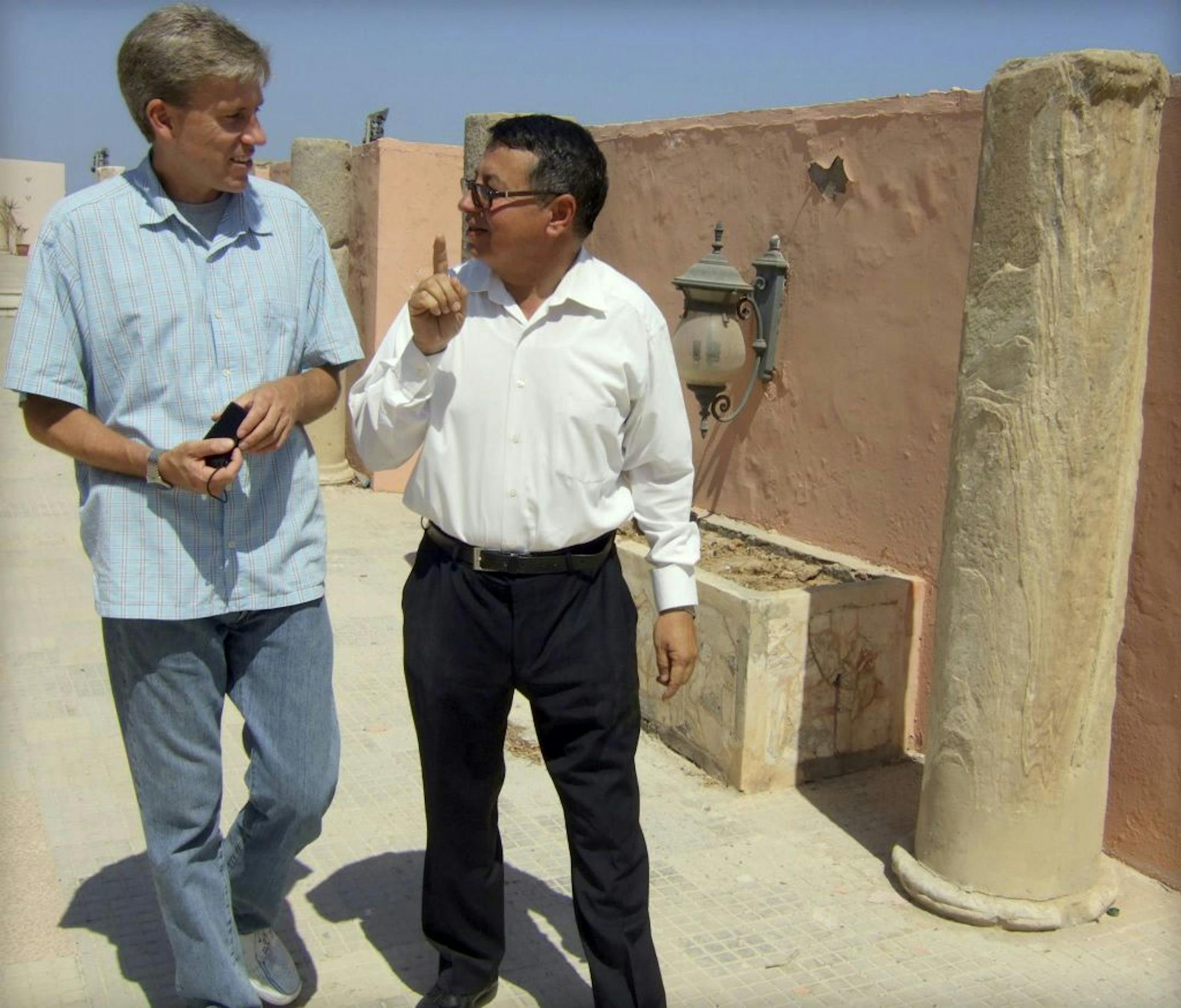
Ambassador Christopher Stevens, left, spoke with a translator during a tour in Tripoli, according to an August Facebook post.
Ambassador Christopher Stevens, left, spoke with a translator during a tour in Tripoli, according to an August Facebook post. (U.S. Embassy in Tripoli via Associated Press/The Minnesota Star Tribune)
Advertisement

John Christopher "Chris" Stevens, 52, the American ambassador killed Tuesday in an attack in Benghazi, was a career diplomat with a Mideast focus whose last mission supported a democratic transition in post-Gadhafi Libya.

"It's especially tragic that Chris Stevens died in Benghazi because it is a city that he helped to save," President Obama said in a tribute at the White House. With Secretary of State Hillary Rodham Clinton beside him, Obama praised Stevens' work as the U.S. envoy to the Libyan rebels last year.

"He worked tirelessly to support this young democracy. And I think both Secretary Clinton and I have relied deeply on his knowledge of the situation on the ground there," Obama said. "He was a role model to all who worked with him."

In a State Department briefing last year, Stevens described arriving in Benghazi in April 2011, when the city was in rebel hands but the war with Moammar Gadhafi's forces was not over. His mission was to set up a U.S. diplomatic mission in Benghazi, a strong U.S. show of support for the rebels.

"There weren't any flights, so we came in by a Greek cargo ship," Stevens said.

When he and his American colleagues reached the city, they were greeted by Libyans carrying U.S., British, French and Qatari flags in the courthouse square. Stevens said he and the other Americans found that they had no place to sleep, so they bunked that first night back on the ship.

After months as envoy to Libya's Transitional Government and the death of Gadhafi, he was nominated in January as ambassador in Libya. The Libya posting marked a high honor for Stevens. He had served as the No. 2 diplomat at the U.S. Embassy in Tripoli from 2007 to 2009, when Gadhafi was in power.

Stevens, an Arabic speaker and longtime Mideast expert, had served previously in Jerusalem, Cairo and Saudi Arabia.

Advertisement

Speaking with a reporter in June, Stevens acknowledged a rise in violence, especially among small Islamist groups in Libya.

"It's a function of there being a lot of freedom and desire to express views and agendas. When people cross the line, it's also a function of a lack of strong state and police to enforce the law," Stevens said then.

Stevens was the first U.S. ambassador killed on duty since Adolph Dubs was kidnapped and slain in Kabul, Afghanistan, in 1979.

Arash Babaoff, a friend of Stevens since the 1990s, described him as passionately committed to his work as a diplomat. "It was his life," Babaoff said. "He was just someone who really had his heart in this, and he really felt like he was making relationships and headway."

Stevens was a native of Northern California and a graduate of the University of California, Berkeley, and the University of California's Hastings College of the Law in San Francisco. Before entering the diplomatic corps in 1991, he had served as an international trade lawyer. In the early 1980s, he taught English as a Peace Corps volunteer in Morocco. He never married and had no children.

The New York Times and Bloomberg News contributed to this report.

Advertisement
about the writer

about the writer

ANNE GEARAN

Advertisement