

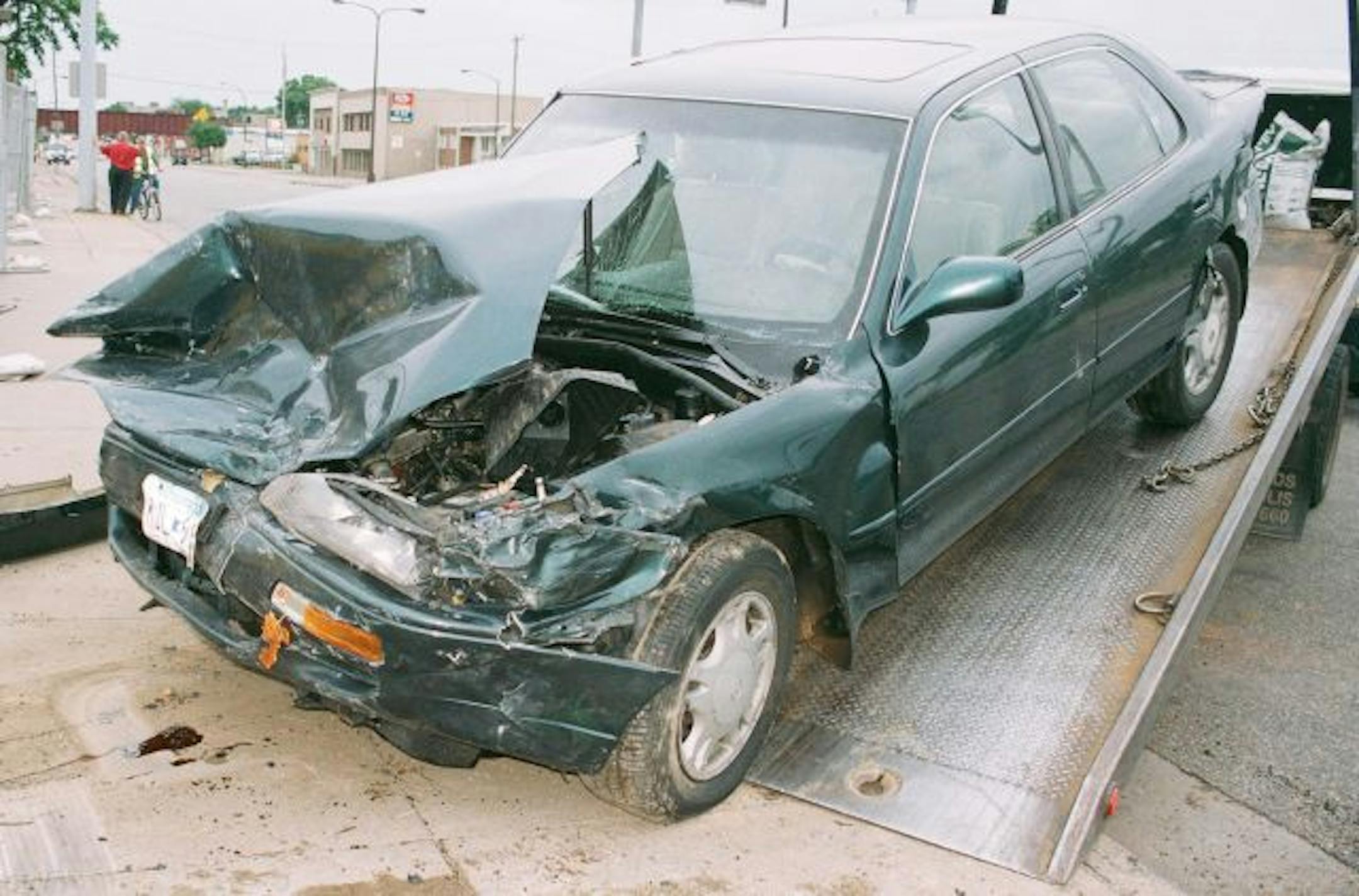
Is a Minnesota man serving an eight-year prison sentence for a deadly accident primarily caused by a car defect? Information now coming to light about sudden acceleration in Toyota Camrys certainly raises that troubling possibility.
The accident happened on June 10, 2006, on the Snelling Avenue off-ramp from Interstate 94 in St. Paul. Koua Fong Lee, now serving time in Lino Lakes, and his family were returning from church in Minneapolis in their green 1996 Camry. Instead of slowing down on the off-ramp, Lee's car sped up, reaching a speed estimated at 75 to 90 miles per hour. The sedan rocketed through the intersection at the end of the ramp, sideswiping several vehicles before obliterating a 1995 Oldsmobile Ciera driven by Javis Adams Sr., 33. Adams and his son Javis Jr., 10, were killed. Three others in the car were seriously injured; 7-year-old Devyn Bolton later died.
From the beginning, Lee, now 32, steadfastly maintained that he stepped repeatedly on the Camry's brake pedal and that it didn't work. And while authorities considered that, they concluded that Lee, who'd been licensed for about a year and had a clean record, had pumped the gas pedal instead of the brake. A mechanical inspection of the damaged vehicle by a St. Paul city mechanic found no evidence of brake failure or other possible mechanical causes. A Ramsey County jury ultimately agreed and convicted Lee in 2007 of two counts of criminal vehicular homicide. As Lee's former defense attorney Tracy Eichhorn-Hicks put it this week: "We just did not have an explanation for what had happened other than human error."
While Toyota recalls have been limited to more recent Camry models, the carmaker's widening problems with sudden acceleration offer up a plausible alternative. This week the New York Times reported that Camrys outside the recall have had a comparable number of speed-control problems as the recalled models. A search of the National Highway Transportation Safety Administration database yields about 20 sudden-acceleration complaints about the 1996 Camry. Often, no mechanical explanations were found. While there are similar complaints about other manufacturers' cars from the same year, the Times' analysis showed that Toyota had more speed-control complaints involving crashes over the past decade than any other manufacturer.
The Ramsey County Attorney's office held onto Lee's Camry because of the accident's severity. Experts hired by lawyers representing the victims' family, as well as Toyota, will likely get a chance to examine it soon. Whether they'll find proof of sudden acceleration is uncertain given the vehicle's damage. That could create a disturbing scenario. The Toyota recalls may have been enough to create reasonable doubt among jurors when Lee was tried. But without new mechanical evidence from the car, the recalls may not be enough to meet the legal threshold for a new trial.
The judge who will rule on the issue, as well as the prosecutors who will weigh in, face a challenging situation. Their highest priority no matter what: to ensure beyond a doubt that Lee isn't paying the price for Toyota's mistakes.


