
East Ridge students practice for medical field

Biomedical course is designed to increase interest and challenge students.

February 13, 2011 at 2:38AM
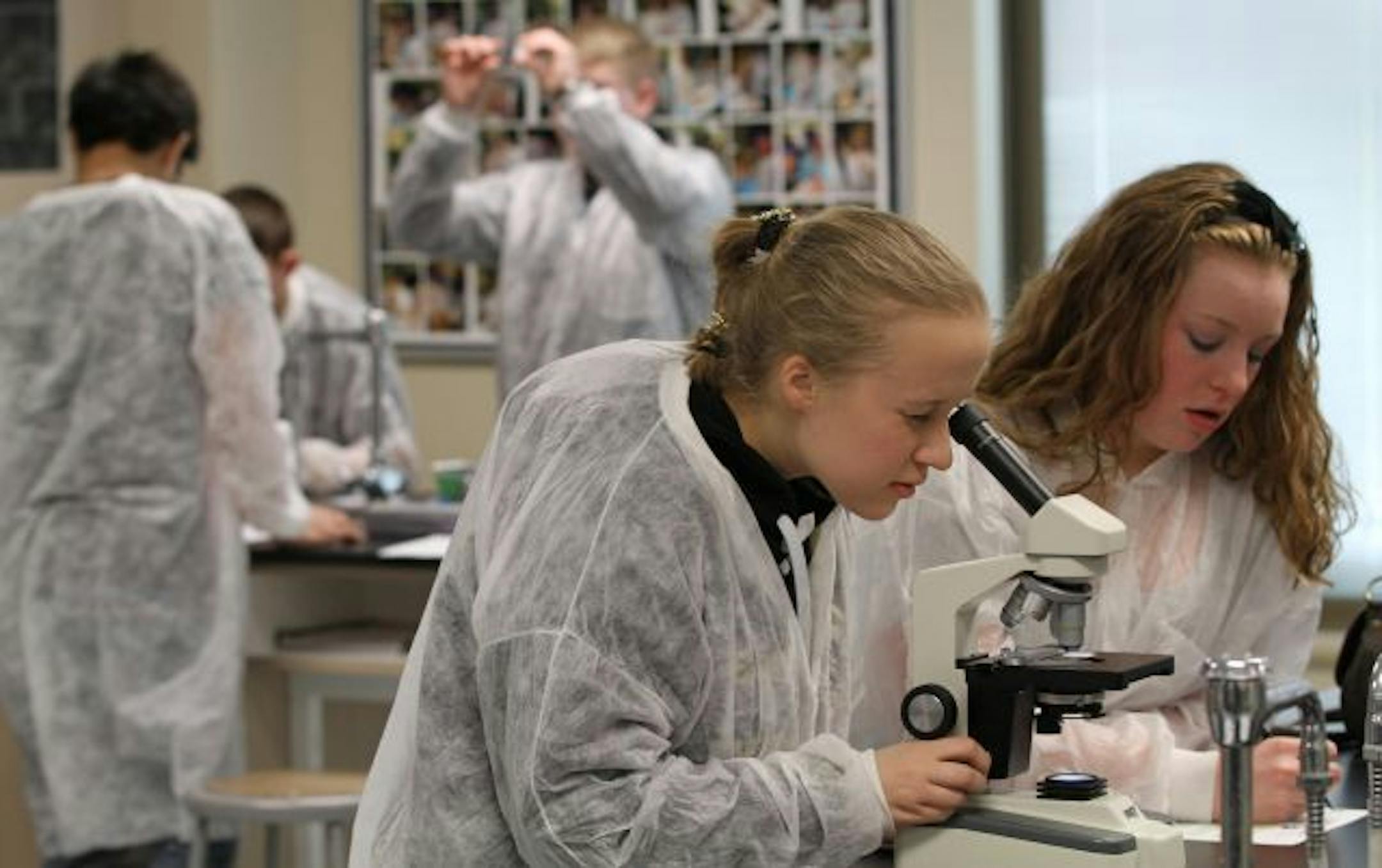
East Ridge High School students (center) Emily Benson and (right) Taylor Johnson used a microscope to look at slides of sickle cell anemia and healthy cells during Nancy Berg's Principals fo Bio-Medical Science class. The course, one of the first in the nation, offers students the opportunity to learn about medicine and is funded by 3M.
East Ridge High School students Emily Benson, center, and Taylor Johnson, right, used a microscope to look at slides of sickle cell anemia and healthy cells during Nancy Berg's Principles for Bio-Medical Science class. The course, one of the first in the nation, offers students the opportunity to learn about medicine and is funded by 3M. (Star Tribune/The Minnesota Star Tribune)

Students at East Ridge High School are using high-tech equipment to isolate DNA and break down chemical compounds in common foods such as milk, Cheerios, potato chips and grapes.

They're conducting experiments that help them understand the root causes of disease, from diabetes and heart disease to sickle cell anemia.

They're analyzing data to identify health problems in the community and then figuring out ways they might address those problems.

It's all part of a course in its second year known as "Project Lead the Way Biomedical Sciences," and it's one of the first of its kind in the state.

The idea is to get more students interested in the biomedical fields and pursuing careers as doctors, nurses and researchers.

There should be ample job opportunities in those fields in the near future: With today's aging population, about 15 percent of new jobs are in the health field, said Nancy Berg, a teacher at the Woodbury school.

The course challenges students with college-level biology, environmental science and math.

Using pig, cow and sheep cadavers, students test to see why some diseases may be more common in certain communities.
They also consider how to diagnose and even treat those diseases.

"This is an inquiry-based class," Berg said. "Students ask and answer the questions."

"It's a good, practical way to learn about the field," said Myape Kalambata, a 14-year-old sophomore who wants to become a pediatrician. "There's a lot of hands-on and interaction with the labs."

"We definitely have to do more high-level thinking in this class," said Hannah Pignato, a 15-year-old sophomore who hopes to be a neonatologist.

The program is partly funded by a grant from 3M and the Kern Foundation, which helped purchase the curriculum and software used for the course.

Berg, whose undergraduate degree is in biology, went through an intensive two-week boot camp in Indiana to teach the course.

The program is composed of four courses that can be completed in a year.

It has grown in popularity, with 100 students now registered. Administrators are looking at offering more courses in the future and making it possible for students to receive college credit.

Daarel Burnette II • 651-735-1695

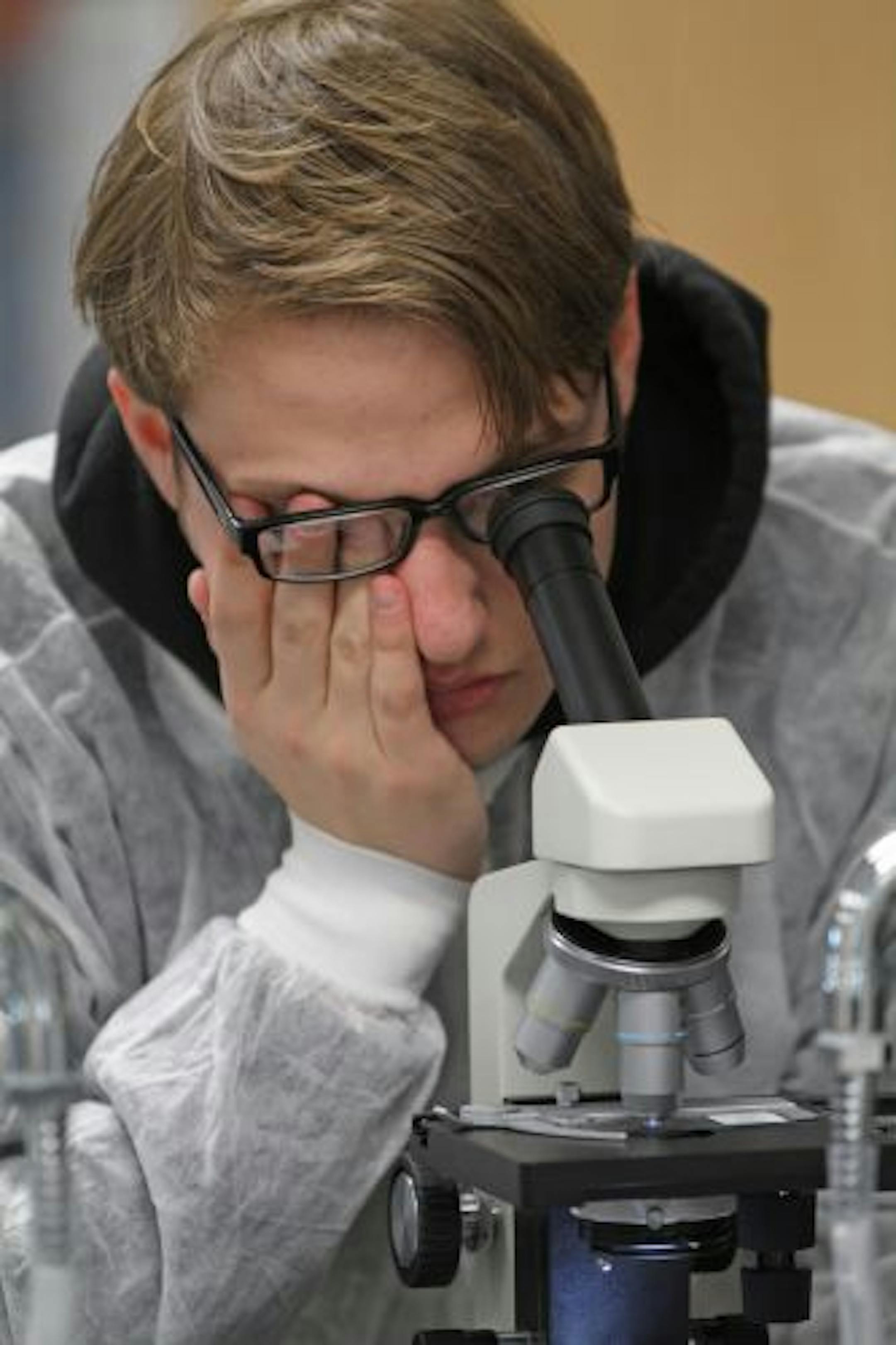
(left to right) East Ridge High School student Jack Lambert covered his one eye, as he used a microscope to look at slides of sickle cell anemia and healthy cells during Nancy Berg's Principals fo Bio-Medical Science class. The course, one of the first in the nation, offers students the opportunity to learn about medicine and is funded by 3M.
East Ridge High School student Jack Lambert covered his one eye as he used a microscope to look at slides of sickle cell anemia and healthy cells during Nancy Berg's class. (Star Tribune/The Minnesota Star Tribune)
about the writer

about the writer

DAAREL BURNETTE II, Star Tribune