
Earthquakes in Minnesota? Yes, but no great shakes

July 27, 2019 at 7:44PM
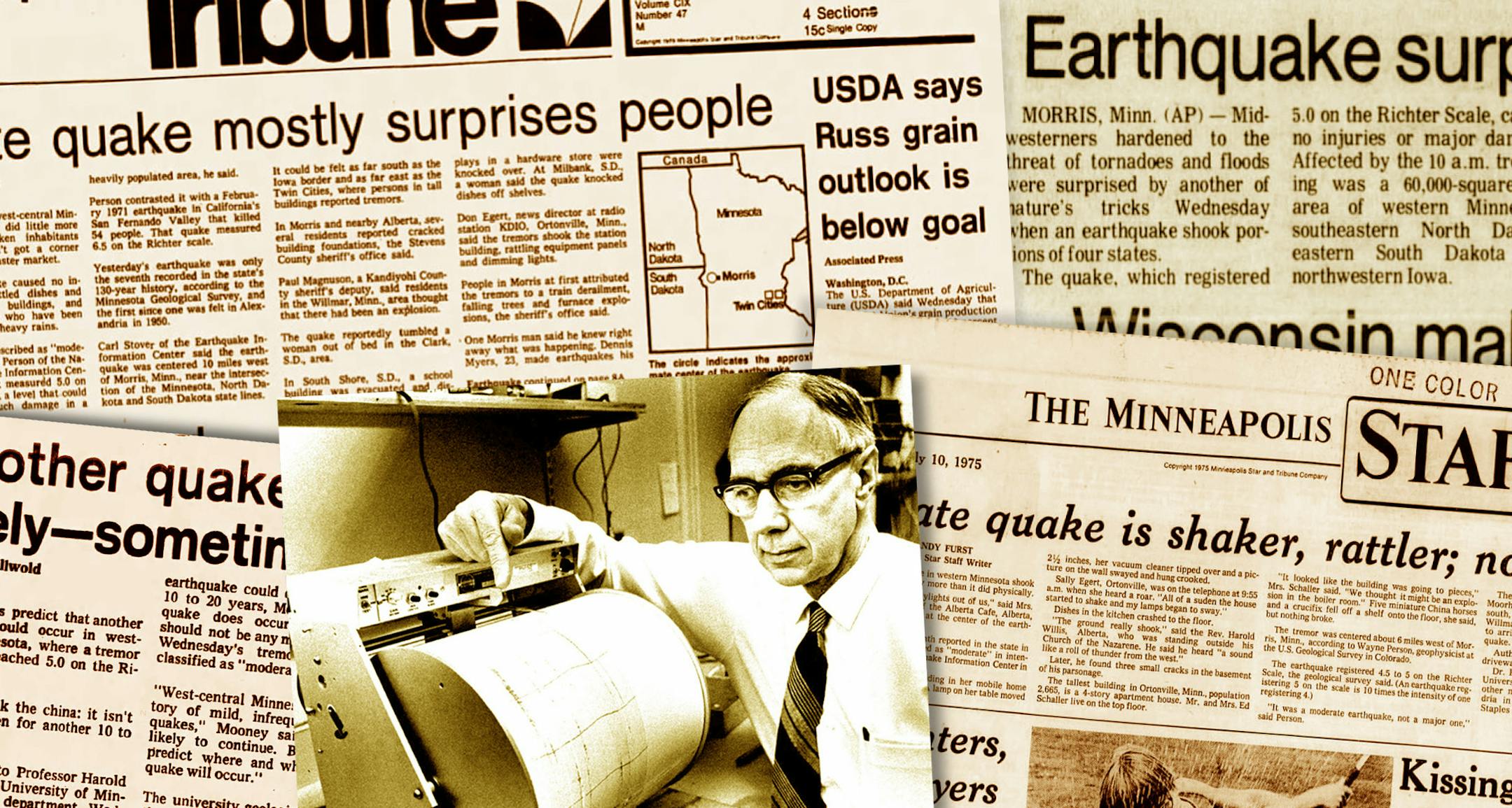
Newspaper pages and archival images tell the story of the July 1975 earthquake near Morris, Minn. (The Minnesota Star Tribune)

Ward Voorhees was sitting on an outdoor bench during a coffee break one July morning when he felt the jolt, a loud rumbling in the ground that lasted just a few seconds.

Later that day, it was the talk of the town. The year was 1975, and an earthquake had struck the western Minnesota city of Morris.

Voorhees, who now serves as board president of the Stevens County Historical Society, said he didn't immediately realize what had happened.

"We don't expect earthquakes out here," he said.

More than four decades later, many Minnesotans are still surprised to learn about the Morris quake. Residents of the North Star State will persevere through the toughest blizzards, of course, and kids are drilled to take shelter away from windows during tornadoes. But earthquakes?

The Star Tribune looked into the state's seismic history for our Curious Minnesota project, a community-driven series of articles fueled by questions from readers. This week's submission asked: Are there earthquakes in Minnesota?

As longtime Morris residents like Voorhees know from experience, the answer is yes. Though Minnesota is one of the least seismically active states in the country, at least 20 earthquakes have jolted the state in the last 160 years, according to the Minnesota Geological Survey.

All were relatively minor. At an estimated 4.6 to 4.8 magnitude on the Richter scale, the 1975 Morris earthquake was the largest recorded with modern instruments in Minnesota. In contrast, the two earthquakes that rattled Southern California earlier this month — cracking buildings, causing fires and accompanied by a wave of aftershocks — were magnitudes 7.1 and 6.4, according to the Associated Press.

The destructive earthquakes making the headlines often happen when tectonic plates, massive pieces of the Earth's crust and upper mantle, grind together or slip past one another. The Pacific and North American plates, for instance, meet at California's San Andreas Fault, which stretches hundreds of miles and has triggered some of the country's largest tremors.

Minnesota doesn't lie on or near any plate boundaries. Earthquakes in the state could be a result of land rising after being depressed for centuries by sheets of glacial ice, said Paul Caruso, a geophysicist for the U.S. Geological Survey.

The process is called isostatic rebound. Caruso likened it to placing a rock on a sponge.

"You pull the rock off and gradually the sponge comes back to its old shape," he said. "The ice sheets were very heavy, and so they were pressing down on the earth. But since those ice sheets have melted, the earth is gradually springing back."

Val Chandler, a senior scientist at the Minnesota Geological Survey, wrote in 2014 that he thinks Minnesota earthquakes are likely caused by the slow westward drift of the North American plate, activity that reactivates the state's ancient faults created during the formation of the continent.

The first earthquake recorded in Minnesota, which struck Long Prairie in central Minnesota in the early 1860s, is believed to be one of the largest in state history, with an estimated magnitude of 5. However, historical accounts, not modern technology, were used to assess that tremor.

Katie Galioto • 612-673-4478

about the writer

about the writer

Katie Galioto

Reporter

Katie Galioto is a business reporter for the Minnesota Star Tribune covering the Twin Cities’ downtowns.

See Moreicon

More from Minnesota Star Tribune

See More
card image
J. SCOTT APPLEWHITE, ASSOCIATED PRESS/The Minnesota Star Tribune

The "winners" have all been Turkeys, no matter the honor's name.

In this photo taken Monday, March 6, 2017, in San Francisco, released confidential files by The University of California of a sexual misconduct case, like this one against UC Santa Cruz Latin Studies professor Hector Perla is shown. Perla was accused of raping a student during a wine-tasting outing in June 2015. Some of the files are so heavily redacted that on many pages no words are visible. Perla is one of 113 UC employees found to have violated the system's sexual misconduct policies in rece