
Driverless ride-sharing company Waymo expanding to Minneapolis

Testing began Thursday morning. No date has been set to start offering rides to passengers.

The Minnesota Star Tribune
November 21, 2025 at 3:28PM
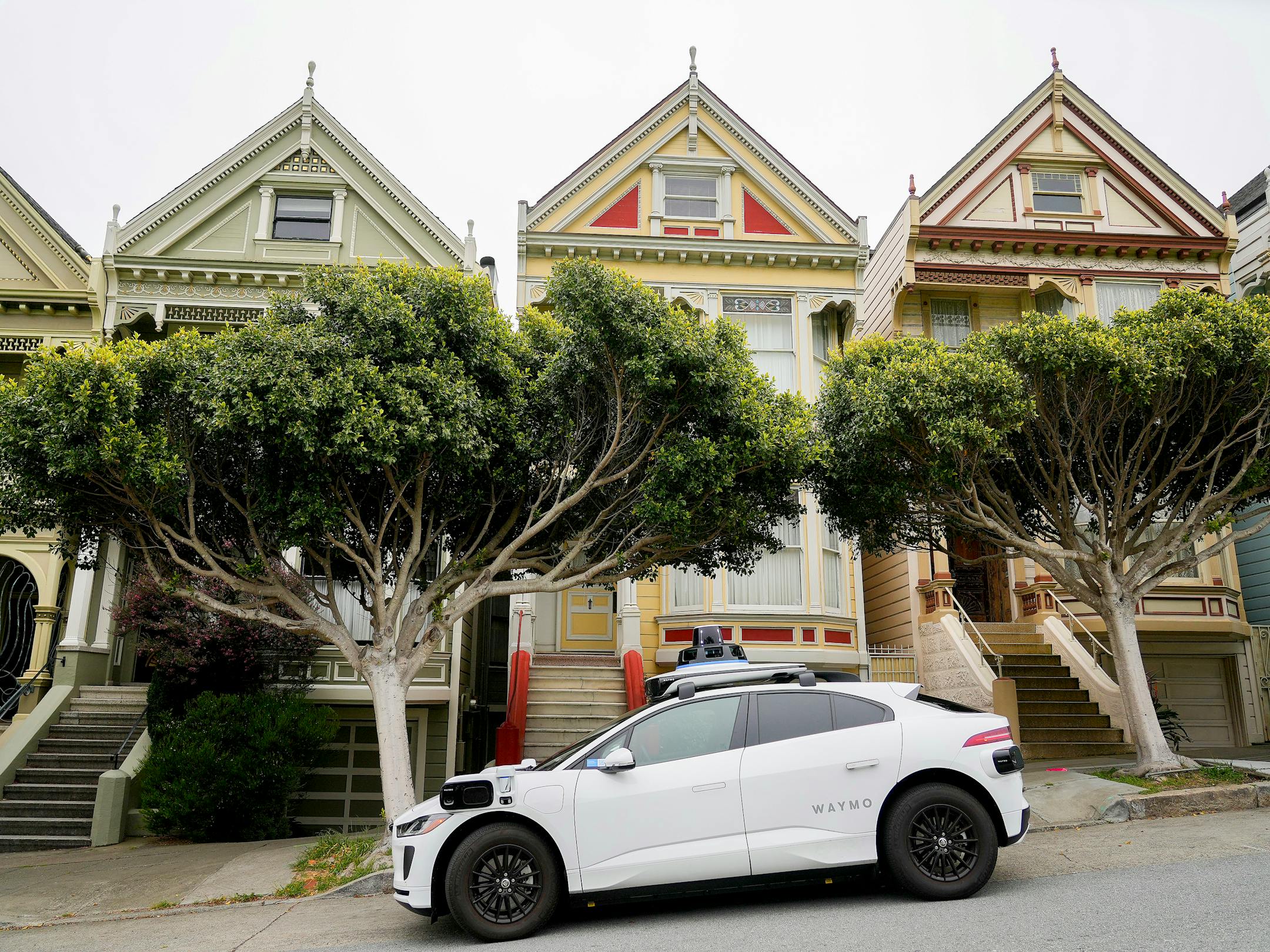
A Waymo driverless robotaxi is parked on a street in San Francisco on May 16, 2024. (JIM WILSON/The New York Times)

Waymo, the driverless ride-hailing company, is bringing its fleet of autonomous electric vehicles to Minneapolis.

Testing of the signature white Jaguar I-Pace SUVs and Zeekr RT vehicles was set to begin Thursday, but it will likely be several months before passenger service will begin.

“We are here and telling you what we are doing,” said Chris Bonelli, product communications manager for the Silicon Valley-based company owned by Alphabet, the parent company of Google. “We intend to offer ride-hailing in Minneapolis. We are not just coming for testing.”

But the president of an organization that represents the interests of thousands of Uber and Lyft drivers in the state said he has “urgent concerns” about Waymo’s pursuit of Minneapolis for its vehicles.

Testing with a human driver behind the wheel will begin by collecting data and mapping the city, Bonelli said. Cars are equipped with sensors, cameras, radar, and lidar, or light detection and ranging, to create a 360-degree view of its surroundings. Once that is complete, a driver will remain behind the wheel as the vehicle drives the routes, only taking the steering wheel should the need arise, Bonelli said.

At that point, the “future of transportation” that “does not get drunk, tired or distracted” as the company describes it, would be would be ready for Waymo to give rides in its fully autonomous cars.

Testing in Minneapolis will start in the urban core before moving away to a broader area, Bonelli said.

Eid Ali, president of the Minnesota Uber/Lyft Drivers Association, said that “driverless cars could lead to significant job loss among drivers who rely on ride-share income to support their families. The association also stresses that decisions about [driverless vehicle] deployment are being made without input from the communities most affected.”

Ali also contended that driverless-vehicles technology “is not proven safe for Minnesota’s harsh winters, icy roads and complex urban traffic. … Minnesotans should not be used as live test subjects without strong oversight and transparent safety data.”

An Uber spokesperson declined to comment. Lyft corporate officials have yet to respond to a request for comment.

Waymo already has a fleet of its robotaxis shuttling passengers around warm-weather cities such as Los Angeles, Phoenix and San Francisco. The company also is partnering with DoorDash to deliver grocery and meal orders to customers in the Phoenix area.

Waymo recently expanded to Austin, Texas, and Atlanta in partnership with the Uber app. And it has Washington, D.C., Miami, Dallas, Houston, Las Vegas, San Diego, San Antonio, Seattle, Nashville, Orlando and Tampa, Fla., on its radar.

Billing itself as world’s first autonomous ride-hailing service, Waymo also recently announced it would set up shop in cold-weather cities of Boston, Detroit, Denver, New York City and Buffalo, N.Y.

“It’s exciting tackling a big city with winter weather,” Bonelli said. “Cars can work in dry sunny Arizona, but snow and weather is the big question.” He added that extensive testing has shown the vehicles are capable, and “we’re looking forward to proving our autonomous performance in winter weather.”

Minneapolis certainly can provide adequate testing ground.

“We continue to validate Waymo’s sixth-generation AI and cleaning mechanisms to sustain fully autonomous operations in snow and ice,” Bonelli said.

But Minneapolis also checked another box on the company’s list of expansion criteria. It is a dense urban area and “we want to help add to that infrastructure,” Bonelli said.

Waymo touts its safety record in the realm of crash reduction. Compared to the average human driver over the same distance in cities with outposts, the driverless cars were involved in 304 fewer injury crashes and 35 fewer pedestrian crashes with injuries. On average, about half of crashes result in minor damage.

State law neither prohibits nor specifically authorizes automated vehicles to conduct testing on streets in Minnesota, said Anne Meyer with the Minnesota Department of Transportation.

“We expect this to come up during the next legislative session and look forward to being included in those discussions,” Meyer said.

Waymo’s arrival comes with some questions, but with acknowledgement that self-driving cars are part of the future.

“Cities need to be able to work with operators to keep our streets safe and traffic efficient,” said city spokesman Allen Henry. “As a city with a strong legacy of technological leadership, we look forward to continuing the conversation with Waymo as they begin testing their vehicles with human drivers.”

There are no current plans to bring Waymo to St. Paul, Bonelli said.

Waymo won’t be the first to try autonomous vehicles for transportation in Minnesota. SouthWest Transit debuted driverless vehicles last year on its on-demand microtransit service, Prime.

The agency serving Eden Prairie, Chaska and Chanhassen is still in the testing phase with a driver sitting behind the wheel, but the operator isn’t actually driving.

“So far so good,” said SouthWest CEO Erik Hansen. “It’s gone pretty much to plan.”

Though it might be a little disconcerting to see a steering wheel turn without human hands guiding it, 96% of those who have taken a trip on the self-driving Prime have given a thumbs-up, according to results of a recent customer survey.

Since their arrival last fall, riders have taken more than 17,000 trips in the autonomous vehicles, accounting for 25% of all on-demand trips, Hansen said.

“Only one person has balked about it,” he added, noting 85 riders have taken 50 or more trips in the driverless vehicles.

Minneapolis City Council Member Katie Cashman, whose ward includes the Loring Park and Downtown West neighborhoods, has mixed feelings about Waymo coming to town.

One on hand, she likes the idea Waymo cars could reduce crashes and reduce the reliance on parking and garages. On the other hand, she has concerns about the technology still not fully identifying human beings.

“We also have to ask how necessary this is,” Cashman said. “We have public transit to provide transportation without driving ourselves. What impact will this have to our transit ridership return?”

While still in its infancy, self-driving technology has potential to offer safe travel, according to a 2024 study from the University of Central Florida.

“It is anticipated that the automation of systems will significantly reduce the number of accidents, as human errors contribute up to 90% of accidents,” the authors wrote. But, they added, there is a “scarcity of real-world autonomous vehicle accident data.”

Bonelli, of Waymo, said the company is excited to bring “successful ride-hailing to Minneapolis. We are ready to serve people in more places.”

Paul Walsh and Jeff Hargarten of the Minnesota Star Tribune contributed to this story.

about the writer

about the writer

Tim Harlow

Reporter

Tim Harlow covers traffic and transportation issues in the Minneapolis-St. Paul area, and likes to get out of the office, even during rush hour. He also covers the suburbs in northern Hennepin and all of Anoka counties, plus breaking news and weather.

See Moreicon

More from Minneapolis

See More
card image
card image