
Advertisement

Drainage is good for crops, bad for crappies

Farmers tiling their fields can start planting earlier in the season, but the resulting water runoff can be costly to fish and wildlife.

December 6, 2009 at 4:01PM
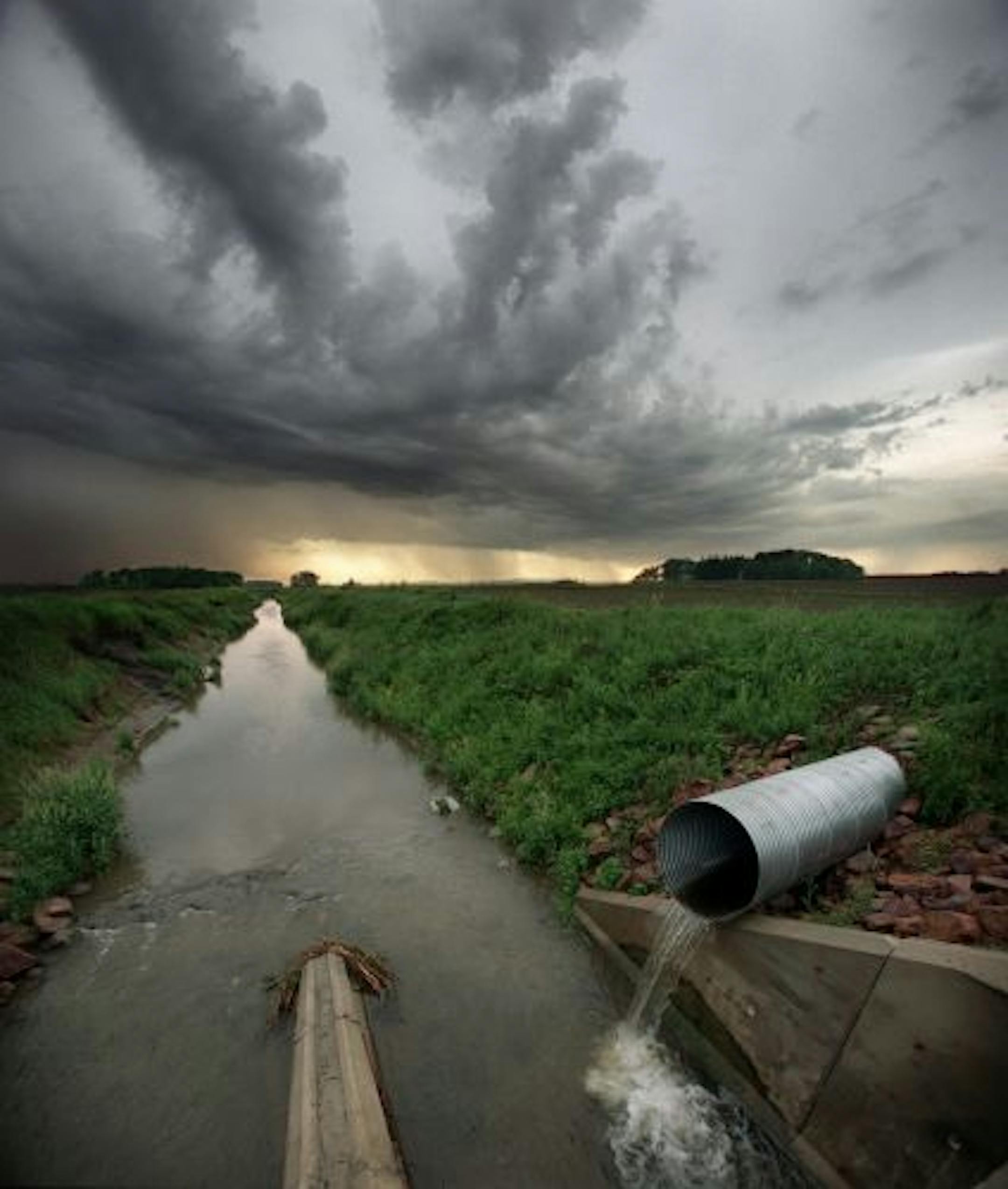
The Minnesota River basin, once a healthy, balanced ecosystem now functions like an overloaded and unstable drainage ditch for farms and a toilet for rural Minnesota. Barely recognizable as a natural stream, the Middle Branch of the Rush River West of Le Sueur has been straightened and drain tiles have been installed creating a system that flushes water from the fields in record time carrying with it tons of sediment, fertilizer, manure and human waste that have contributed disproportionately to
The Minnesota River basin, once a healthy, balanced ecosystem now functions like an overloaded and unstable drainage ditch for farms and a toilet for rural Minnesota. Barely recognizable as a natural stream, the Middle Branch of the Rush River West of Le Sueur has been straightened and drain tiles have been installed creating a system that flushes water from the fields in record time carrying with it tons of sediment, fertilizer, manure and human waste that have contributed disproportionately to the ìDead Zoneî in the Gulf of Mexico. (Star Tribune/The Minnesota Star Tribune)
Advertisement

IN SOUTHWEST MINNESOTA - Sunday morning might have been chilly hereabouts if you were leaving church. But with a scattergun in your hand, walking for pheasants amid a crisp breeze and temperature in the 30s, everything seemed about right.

I had brought a couple of dogs with me, a yellow Labrador named Pete and a black running mate of his who goes by Bobbi. They could have traveled in the back of the truck, these dogs, covered as it was by a topper, and it would have been warm enough for them. But the day had begun early, in the dark, and it seemed somehow more fitting that they ride alongside me. Anyway, I was alone, and Pete and Bobbi soon curled up tightly and were fast asleep -- unaware, finally, when I angled from the freeway onto two-lane blacktop, and from it onto a gravel road.

My first walk produced not a whole lot; a few hens, no roosters. But OK, I thought, it's late season and there are fewer birds around this year because of last winter's prolonged cold and deep snow. Also, the day is young. I'll keep walking, the dogs out ahead. Something will happen.

Something did.

In a plowed field nearby, shorn now of corn, a pickup full of drain tile was parked next to a backhoe, with the business end of that machine hooked about a foot deep in soil. This was the second tiling operation I had seen already, and mid-morning was yet to pass.

The incentives for farmers to lay drain tile -- and still more drain tile, and still more -- are many. Crop yields are increased on drained lands, something most modern-day combine operators can tell by watching harvest calculators in their cabs while gathering crops. Also, in spring, low spots that once held sheet water from melting snow or April rains dry out more quickly when tiled, allowing producers to get into their fields earlier.

For taxpayers and the citizenry at large, however, farm tiling often amounts to a giant rip-off. Water is water, and it's going to go somewhere. Tiling doesn't make it disappear. Rather, tiling facilitates its rather much quicker exit from the land, first, usually, to a ditch, often carrying topsoil or silt, and from there to a creek, stream or river.

Lost in the process are various fish and wildlife habitats. Ducks no longer have the sheet water in spring from which to gather important invertebrates to aid their flights north and, later, to nest. Fish spawning areas are washed out. And aquatic vegetation such as sago pondweed and wild celery can't grow when water levels rapidly rise 2 or 3 feet following heavy rains or spring snowmelts.

Advertisement

Historically, federal and state governments have responded by doing nothing, or nothing much. Allowing farmers to improve the productivity of their lands, largely unregulated, through drainage, at the expense of the public and public resources has become so much the norm that to challenge the practice has become to most policymakers the political equivalent of touching the third rail. So, yes, there are fewer muskrats than there once were on Minnesota's farmlands, also red-winged blackbirds, and pheasants and, particularly, ducks.

Which is bad enough. What's worse, and more costly still, is that the government -- rather than effectively regulating farmland drainage up front -- often throws money at the problem after the fact, trying to clean up the mess it leaves behind.

Example: Earlier this year, U.S. Secretary of Agriculture Tom Vilsack announced a plan that will disperse $320 million to 12 states, including Minnesota, with the intent of cleaning up the Mississippi River.

The goal is to reduce excessive nitrogen and phosphorus runoff from farm fields as far north as Minnesota, so life might again be breathed into the 3,000-square-mile "dead zone" that has been long identified at the mouth of the Mississippi.

A good idea. Just as, later Sunday, it was a good idea for me to walk for pheasants with my friend Will Smith of Willmar and his son, Matthew, 15.

By then I already had seen three tiling rigs in farm fields, most working in what appeared to be minor depressions on lands that only a few weeks ago held soybeans or corn. Winter was not yet here, and advantage by these farmers was being taken while advantage was at hand.

Advertisement

Minnesota is a state blessed with prairies, forests and, not least, water. And blessed also with residents who, generally, want a better, cleaner state, with diverse habitats that sustain over the long haul a wide variety of life, ours included.

But the public's vast storehouse of goodwill in these matters rarely manifests itself as political muscle.

So the beat -- and drainage -- goes on.

In the dim light of late afternoon, Will, Matthew and I put up some beautiful long-tailed roosters; hearty and floridly wild creatures that can still be found in Minnesota thanks to our best conservation intentions.

Or despite them.

Advertisement
about the writer

about the writer

Dennis Anderson

Columnist

Outdoors columnist Dennis Anderson joined the Star Tribune in 1993 after serving in the same position at the St. Paul Pioneer Press for 13 years. His column topics vary widely, and include canoeing, fishing, hunting, adventure travel and conservation of the environment.

See Moreicon
Advertisement