

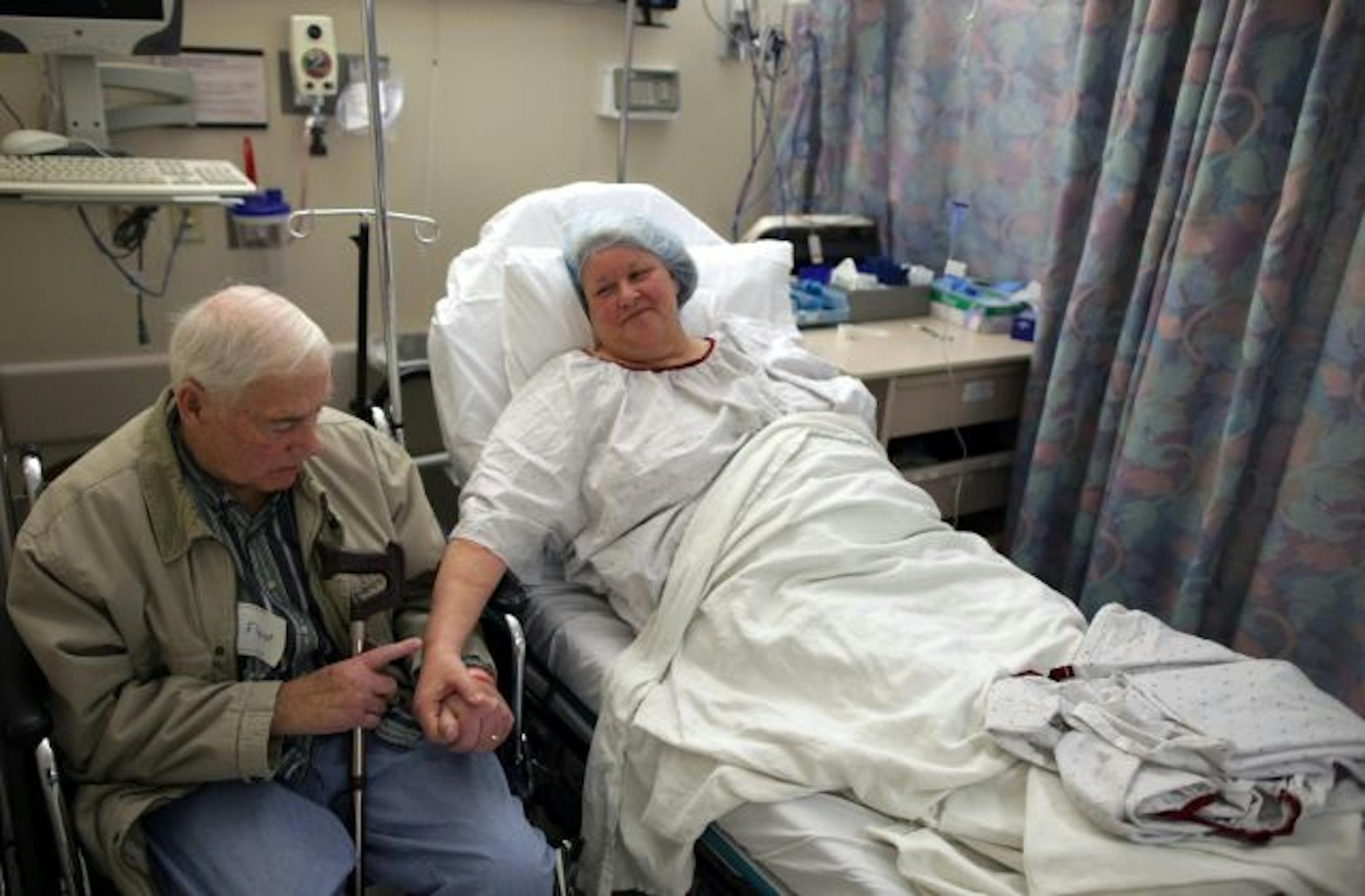
At 6:45 a.m. Thursday, the surgeon in Maryland called Eugenia Steffens with an anxious question: How's the weather out there in Minnesota?
Don't worry, said Steffens, a transplant coordinator at Hennepin County Medical Center: The airport won't close.
With four surgeries and two lives in the balance, it's no wonder the two of them were watching the forecast.
At 1 p.m., a Northwest Airlines flight took off from the Twin Cities with precious cargo: Kathie Blomstrand's kidney, destined for a transplant patient in Baltimore. Meanwhile, a flight was leaving Baltimore for Minneapolis carrying a kidney that would be transplanted Thursday night into Blomstrand's husband, Floyd Johnson.
The two-way kidney swap between HCMC and the University of Maryland Medical Center this week was a dramatic example of the next best idea in transplant medicine: A highly choreographed computer exchange that matches living donors with people in kidney failure across the country. It promises to save millions of dollars in medical costs and end the ordeal facing many of the 80,000 kidney patients on the nation's transplant list, who face a wait of five years or more to get an organ from a deceased donor.
"If this paired exchange hadn't taken place, I don't think I would ever have gotten a kidney," a grateful Johnson, 73, said before he went into surgery on Thursday. "I'm too old."
Nor would the transplant patient in Maryland have gotten a kidney, said Dr. Matt Cooper, director of kidney transplantation at the Maryland medical center. Very few people in the general population would have been a match for his patient, he said.
Only a large, computerized data base of potential donors could find her that "needle in a haystack," he said.


