

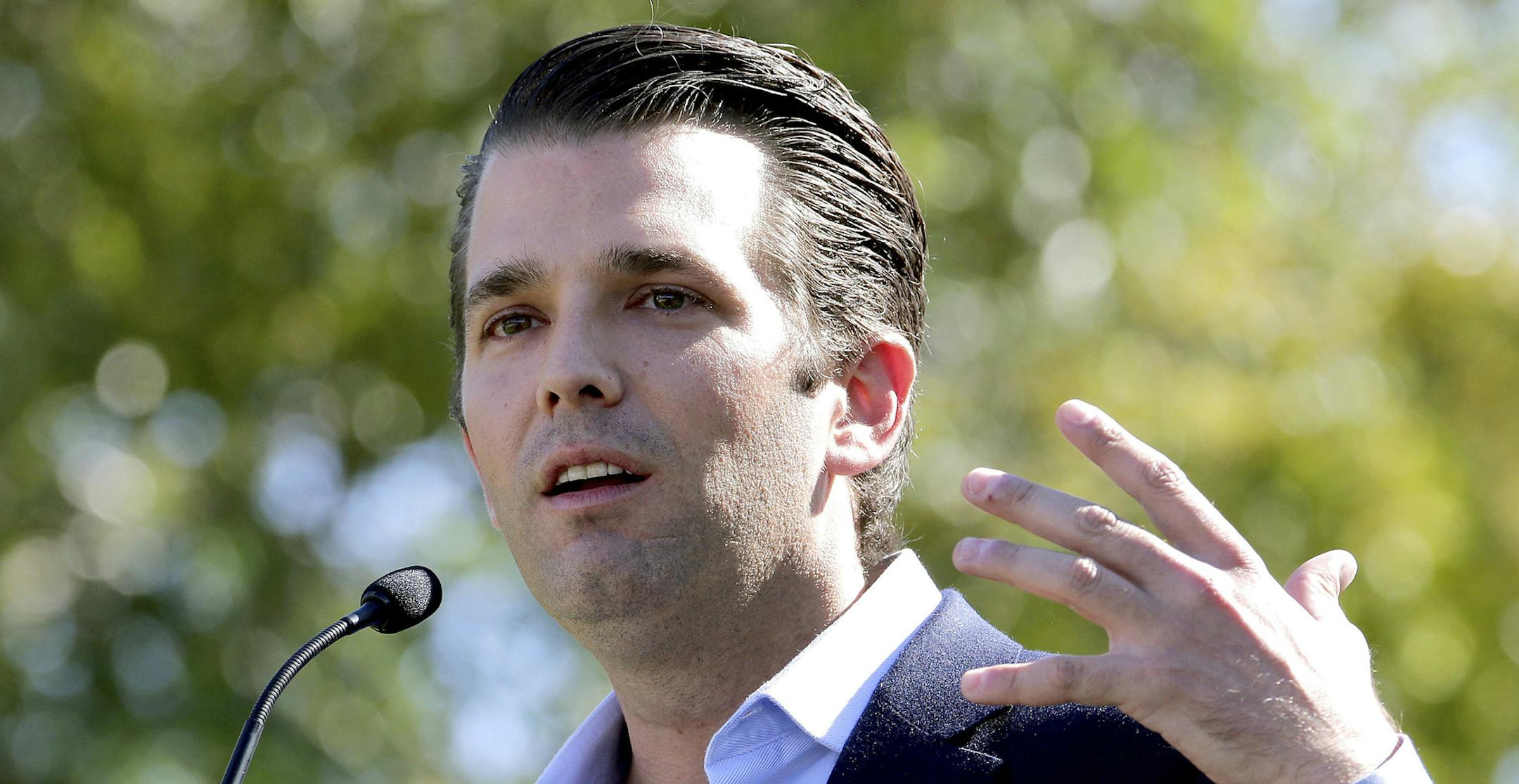
We now know that Donald Trump Jr., a high-level adviser to his father's presidential campaign, attempted to obtain opposition research from the Kremlin. To Trump's opponents, this finally proves explicit collusion between Trump's campaign and the Russian government.
Still, it was astonishing to see the defeated candidate for the vice presidency of the United States, Sen. Tim Kaine, argue that the son of the incumbent president may have committed "treason." He was not the only one to make the allegation, which proliferated on social media; journalists bombarded White House spokeswoman Sarah Huckabee Sanders with questions about "treason."
Assume everything that is being alleged against Donald Trump Jr. is true: that is, he knowingly met with a representative of the Russian government for the purpose of obtaining information, probably illegally obtained, that was harmful to the campaign of Hillary Clinton. Is this treason against the United States?
As a legal matter, no, and not even close. Article 3 of the U.S. Constitution limits the crime of treason to two specific offenses: levying war against the United States, and adhering to their enemies, giving them aid and comfort. It was deliberately crafted to exclude a wide variety of political offenses, such as criticizing the government.
None of the Trump Jr. allegations suggest conduct analogous to levying war against the United States, which generally requires some use of force in an attempt to overthrow the government. Nor does it amount to adhering to the enemy; for purposes of the Treason Clause, an enemy is a foreign nation or group with which the United States is in a state of war, either declared or actual. We are not in a state of war with Russia.
In the 1950s, Julius and Ethel Rosenberg were executed for espionage, not treason, because the Soviet Union, although an implacable adversary, was not technically an enemy. We were formally at peace with the Soviet Union then, and we are formally at peace with Russia now.
So for purposes of American treason law, the details of Donald Trump Jr.'s relationship with Russia are irrelevant. He could be a paid foreign agent of Russia; he could take an oath of allegiance to Russia; he could bug his father's White House bedroom on behalf of Russian intelligence. None of those actions would amount to treason in the narrow sense that our Constitution defines it.
Nonetheless, Trump Jr.'s alleged conduct raises serious questions under other provisions of federal law, all of which will be closely evaluated by Robert Mueller's investigative team. A determination that Trump Jr. did not commit treason is a far cry from finding his actions to be legal. It is against the law, for instance, for U.S. political campaigns to accept anything of value from foreigners.


