

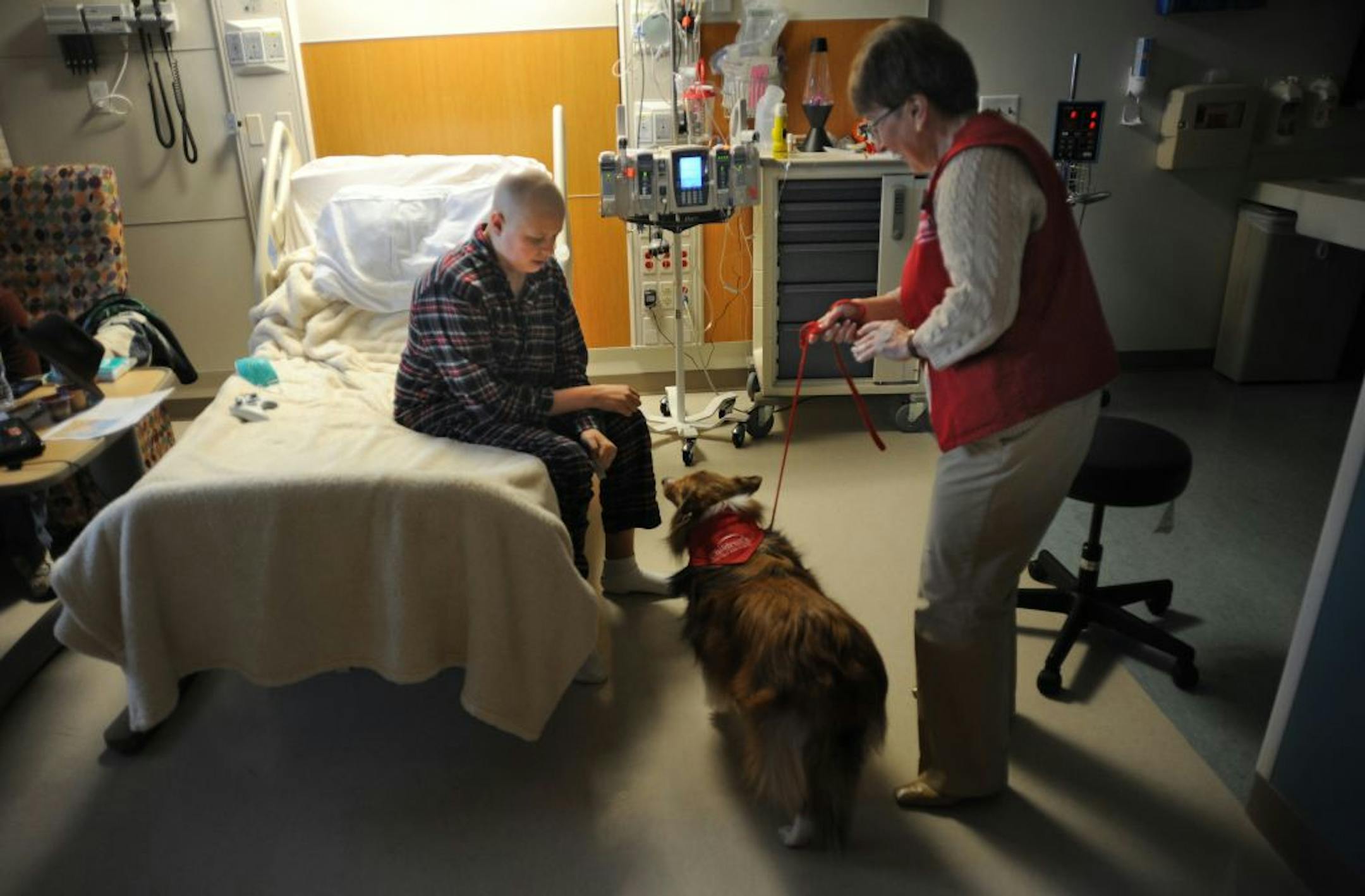
When Murray, a 3-year-old sheltie, is at home, he's a typical dog -- running in the yard or playing with the family's 6-year-old sheltie, Molly.
But it's a different story when Murray and handler Ardie Arko visit patients at Methodist Hospital in St. Louis Park or work with children going through rehabilitative treatment at Children's Hospital in St. Paul.
Then Murray wears a vest with zippers and snaps that a child can manipulate. "Anytime he is wearing this vest, he knows he is working and knows how to behave," said Arko, who lives in Eden Prairie. "When we are with a child in rehab, Murray will calmly sit next to the child while she's petting him or brushing his fur. These movements help to get the hand moving the way it's supposed to move."
As part of North Star Therapy Animals (NSTA), they are making an impact on people of all ages who find comforting reassurance in a gentle pet. Founded in 2007, the nonprofit NSTA is one of several local animal-assisted therapy groups. The pets visit schools, libraries, nursing homes and assisted-living sites, as well as hospitals. Many of these organizations, particularly health care facilities, require the therapy dog and its owner to be certified by Delta Society, a national organization dedicated to service and therapy animals.
Basic requirements
Is your pet suited as a therapy animal? First the dog must pass a basic obedience class. From that point, there are specific animal-assisted therapy training classes offered by the Animal Humane Society and other organizations. Among the skills the dog must master are staying in place and walking through a crowd or next to a wheelchair, and not responding to loud noises. The animal and handler must pass a test certifying those abilities.
The most important characteristic for a therapy animal is a willingness to be around people, says Wendy Hitch, whose golden retriever Pookha was a therapy animal for six years.
"Pookha would do anything asked of her and she loved being with kids," said Hitch, who lives in Minnetonka. "We visited so many schools over the years and spent a lot of time with developmentally disabled children. Kids would read to her, dress her up or just cozy up next to her. They loved Pookha."


