

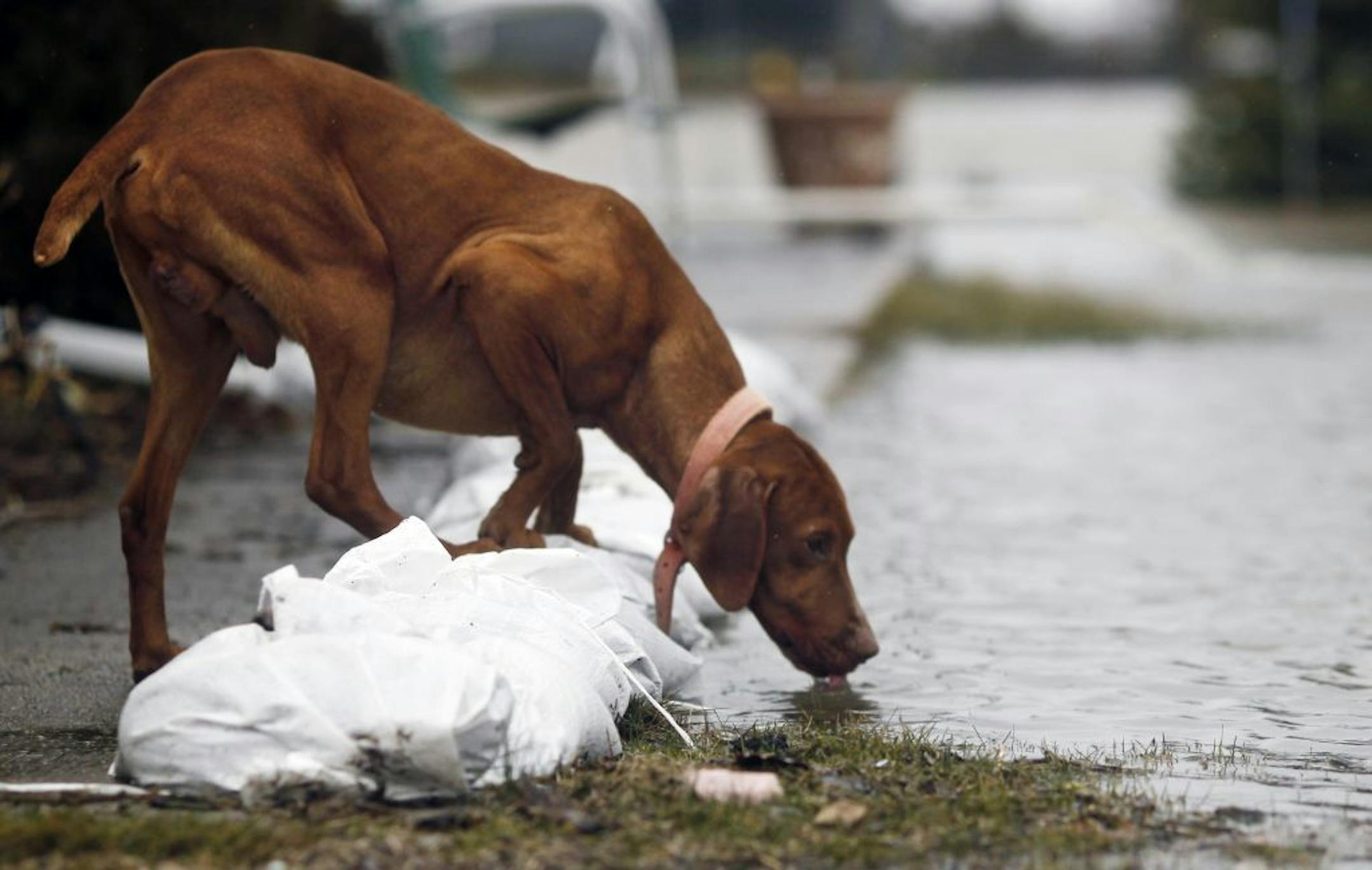
Dogs aren't known to be the most graceful of drinkers — place a bowl of water in front of a thirsty canine and you're likely to see much of its contents splattered across the floor. But researchers who have studied the exquisite lapping strategy of the cat have found that even though dogs seem sloppy when they have a drink, they have a clever strategy of their own.
The findings, described at the American Physical Society's Division of Fluid Dynamics meeting in San Francisco, provide fresh insight on this basic and yet still mysterious animal behavior.
When it comes to getting a mouthful of water, different animals have distinct strategies, said research co-author Sunghwan Jung, an assistant professor at Virginia Tech.
Some, like humans, employ suction with our cheeks. Carnivores, including those from the canine and feline families such as wolves and lions, lack complete cheeks. That's great for opening their mouths wide to attack their prey, but it means they can't close their lips fully to create suction.
Using a tongue to get a little water into your mouth may seem far less efficient than simply sucking it in, but cats, at least, have an unexpectedly effective way of using their tongues to drink water.
Cats extend their tongues in a J shape, barely flick the surface of the water and then quickly move their tongues upward, pulling a column of water up into the air and then closing their mouths over part of the column. This innate mastery of fluid dynamics is the secret to their efficient drinking.
Dogs, however, extend more of their tongues to whack the water with a much wider surface area, then use their tongues to pull the water upward into a column at a blazing rate — hitting an acceleration of roughly five to eight times that of gravity when changing direction from downward to upward. That's much faster than cats, Jung said. And while cats barely flick the water, dogs use a wide cross-section of tongue to plunge into the liquid.
But dogs and cats, it turns out, time one key movement in the same way: Just before the column of water is about to collapse, they close their mouths around the airborne liquid, maximizing their water intake. "Dogs use a very smart [mechanism] to optimize their drinking," Jung said.


