

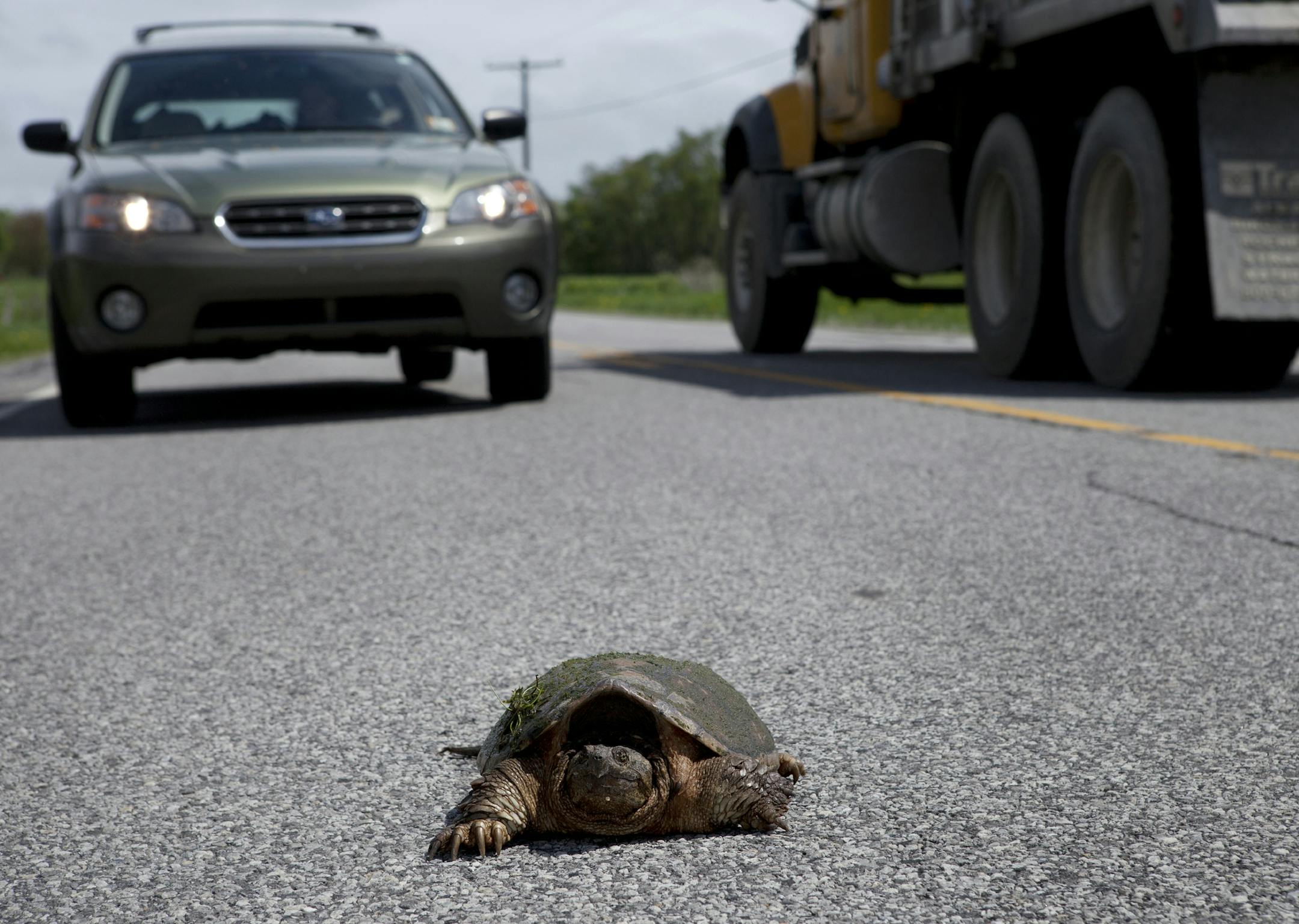
A snapping turtle paused on the center line of the highway. Vehicles whizzed by. It was in front of the Department of Natural Resources forestry station where I work. Two female bicyclists stopped, alerted me to the crisis, and urged: "Do something!" Anyone who works for a natural resources agency understands that the public holds them personally responsible for all facets of Nature.
I once spent 15 minutes on the phone with an elderly woman who'd been startled by a wolf spider in her kitchen. She called the DNR for resolution. I counseled peaceful coexistence, lauding the spider as a predator of other troublesome bugs. She was silent. Sensing that arachnid-detente was unacceptable, I described a catch-and-release tactic involving a jar and a stiff sheet of paper. She was unconvinced, but didn't want to kill the spider, either. I had no other ideas, and she was clearly disappointed in me. Perhaps with state government in general.
As for the snapping turtle, I was sympathetic, and more confident of furnishing satisfaction. I've often pulled over along a roadway to portage a turtle across. I understand you can safely lift a snapper by it's alligator-like tail. Really. It infuriates them, and they will lunge and attempt to bite, but better that than road kill. So I picked up the turtle and carried it to the grass where it was apparently headed. The taxpayers were pleased.
A few days later, a friend reported that he saw a large snapper traversing another local road. He was in the right lane, the turtle in the left, and there was a pickup truck just ahead of him. He watched that driver swerve left, smash the snapper, then cut back into the right lane.
My friend was enraged — had an impulse to follow the villain, pull him over and … do what? It's possible the murdered turtle was one I'd helped across the road some previous year, and I shared my friend's anger.
I read of a recent study where a researcher placed a "realistic but fake small animal" on the edge of a road. He recorded that 6 percent of motorists purposely steered to hit it. I was cynically surprised the number was that low. But still: who are these people?
The kindest interpretation, resorting to sociobiology, might be that given our hunter/gatherer ancestry, we humans harbor a genetic instinct to kill animals for food. I once inadvertently achieved this with a truck. A ruffed grouse burst from cover at the margin of a rural byway, and smacked the grill before I could react. The impact was relatively dainty, so I stopped, dressed out the unfortunate bird, and brought it home for dinner. Most purposeful road-killing is, of course, not conducted and concluded that way.
Is it that some drivers, their situational awareness blurred by modern technological influences, subconsciously view driving as an extension of video gaming, with road kill a source of "points,"or a demonstration of hand-eye coordination? It's unlikely these performers would flinch at squashing a wolf spider.


