

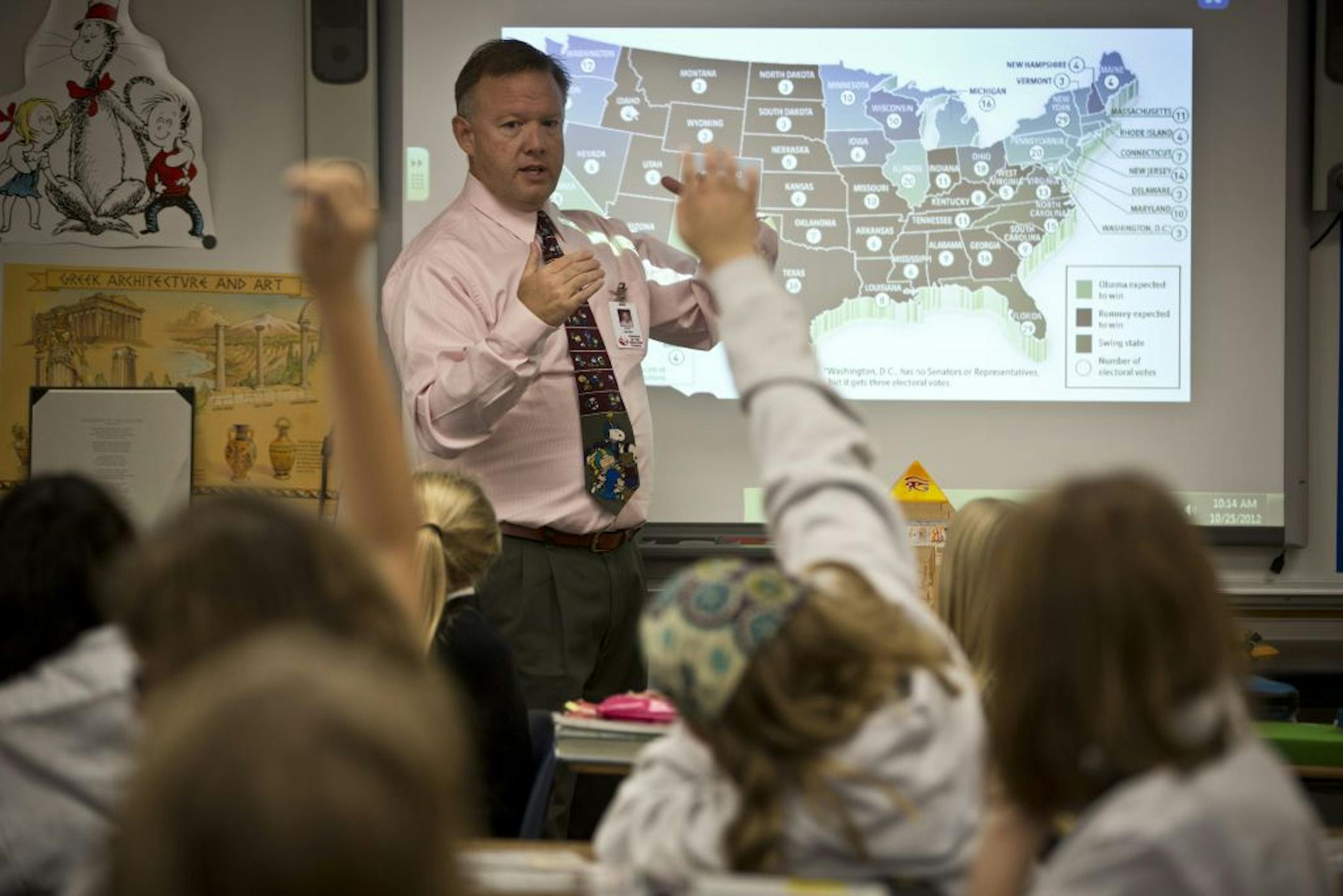
As the election approaches, Curt Zander, a sixth-grade teacher at Visitation School in Mendota Heights, expects a fairly common question from students: "Who are you going to vote for, Mr. Zander?" It's a teachable moment that allows him to explain about the privacy of the voting booth in the United States.
While teachers steer clear of talking politics in the classroom, the election season does offer an opportunity for students to learn about the democratic process. Recently, Zander has been teaching a series of lessons based on curriculum from Scholastic Magazine that's focused on basic facts about the presidential candidates; simple tutorials about the House of Representatives and the Senate; weighing whether the voting age should be lowered; simplified versions of where both candidates stand on the economy, health care and education, as well as a discussion about the Electoral College.
This week Zander also plans to address the value of good sportsmanship in an election season in which adults weren't the only ones exposed to negative ads. "At this age, kids typically are interested in a candidate based on who their parents are voting for," said Zander, who has taught for 26 years. "Respecting the outcome of the election and moving forward if their candidate didn't win is a topic I'll bring up with my students."
Kids are watching
Parents, too, can teach kids about respecting election results, no matter which candidate is chosen.
"Parents are role models for their children and are big influences on their kids' opinions," said Laura Barclay, president and founder of Tampa/Minneapolis Civility and Etiquette Centres. "That's why it's valuable for them to have conversations with their children about the election, be responsive to their questions and to be careful not to devalue or dismiss their thoughts."
Interest in elections tends to intensify once students enter high school and are closer to voting age, but younger students can begin to process some of the key points about choosing a president. Steve Wright, a fifth-grade teacher at Visitation, has his students write essays about the qualities that make a great leader. "They write about someone they know -- a parent, sibling, grandparent, friend, coach -- and why they think that person has the type of qualities needed for a good president," Wright said.
From there, students deliver their essays to classmates as a political "speech" about their hand-picked candidate and are rewarded with an "I Voted" sticker.


