
Disaster in Japan could signal a new era since post-World War II rebirth

Some predict renewal, but a declining population and the scale of rebuilding will test the nation.

The New York Times
March 20, 2011 at 2:39AM
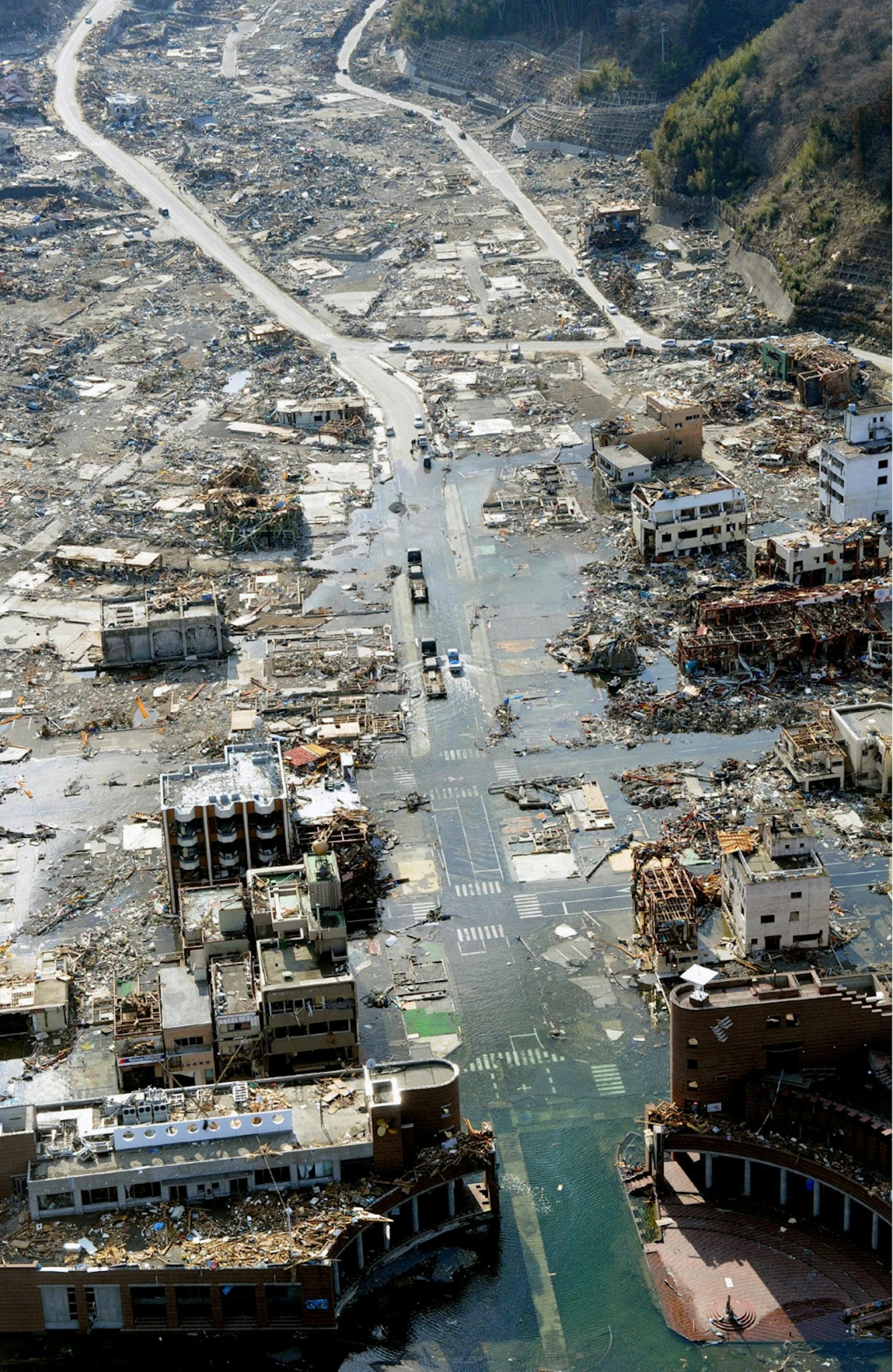
Flood water stays in the middle of the tsunami-stricken town of Onagawa in Miyagi Prefecture Saturday, March 19, 2011, eight days after the town was slammed by a powerful quake-triggered tsunami. (AP Photo/Kyodo News) JAPAN OUT, MANDATORY CREDIT, NO LICENSING IN CHINA, HONG KONG, JAPAN, SOUTH KOREA AND FRANCE
Flood water stays in the middle of the tsunami-stricken town of Onagawa in Miyagi Prefecture Saturday, March 19, 2011, eight days after the town was slammed by a powerful quake-triggered tsunami. (AP Photo/Kyodo News) JAPAN OUT, MANDATORY CREDIT, NO LICENSING IN CHINA, HONG KONG, JAPAN, SOUTH KOREA AND FRANCE (Associated Press - Ap/The Minnesota Star Tribune)

TOKYO - Such was the power of the magnitude-9.0 earthquake March 11 that it bent the tip of Tokyo Tower, the 1,093-foot, Eiffel-like structure that has stood as the symbol of Japan's postwar rebirth for half a century. For the first time since it was erected in 1958, the tower no longer points directly upward, the direction that Japan followed for much of its history after World War II.

The earthquake, whose epicenter was more than 200 miles north of Tokyo, and the resulting nuclear crisis, will change this nation. The open question is how -- and how much. Will it, along with the bent Tokyo Tower, be a final marker of an irreversible decline? Or will it be an opportunity to draw on the resilience of a people repeatedly tested by calamity to reshape Japan -- in the mold of either the left or the right? This disaster, like the 1923 Tokyo earthquake and the 1995 Kobe earthquake, could well signal a new era.

Among the concerns raising questions are the shrinking, starting in 2005, of Japan's population, the country's loss to China last year of its vaunted status as the world's second-largest economy and the aggressive pursuit of nuclear power.

Japan's economy is likely to suffer, at least in the short term, as power disruptions hobble its industries. If the reactors do melt down, in the worst case, or even if there is a steady release of radioactive vapor, there are implications for public health; on Saturday, the Japanese government announced that some foodstuffs from farms near the nuclear plant contained elevated levels of radiation. Japan's reputation -- and its self-image -- as an efficient, prosperous and smoothly functioning society has been dealt a blow.

"It's not an exaggeration to say that we will think of Japan in terms of pre-earthquake and post-earthquake because it has already fundamentally changed Japanese society," said Yasuyuki Shimizu, a 39-year-old who has drawn attention in Japan for the work of his organization, Life Link, in preventing suicides. "The values of postwar Japan, and the postwar feeling of security, also now lie in ruins. Whether Japan will change in a positive or negative way, we don't know yet."

A more limited impact?

But others argue that the long-term impact on Japan will be more limited -- so long as the troubled reactors at the Fukushima Daiichi Nuclear Power Station, about 170 miles north of Toyko, do not suffer a complete meltdown and affect Tokyo, the nation's heart. Despite the psychological shock to the nation, the earthquake and tsunami devastated a thinly populated region far from Tokyo and the nation's other center of gravity, Osaka in western Japan.

"If the nuclear problem doesn't get bigger and there's no panic in the Tokyo area and no curfew that's imposed, I don't think this disaster will be remembered as that significant an incident," said Eiji Oguma, 49, a professor of policy management at Keio University, adding that he thought it would be compared instead with the 1995 Kobe earthquake, which, rather than spurring lasting change, came to be seen as a symbol of the end of Japan's bubble era.

Still others saw the disaster as a moment of change, including Takafumi Horie, 38, an entrepreneur who lost his Internet company, Livedoor, in 2006 on minor charges of securities fraud after brashly challenging the business establishment.

"It's possible that this calamity will rid Japan of its old order," Horie, now one of Japan's most popular authors and bloggers, wrote in an e-mail, adding, "It's an opportunity to build a new Japan."

But first is the rebuilding. There are many factors working against Japan's ability to carry it out as successfully as it has in the past: the absence of strong national leadership, the country's declining economic strength and the simple lack of young people in the northern region.

A different Japan

When Japan resurrected itself after even bigger disasters, like the 1923 earthquake that destroyed Tokyo or the war that ended with the atomic destruction of Hiroshima and Nagasaki, Japan was a vigorous, young and growing country, said Kazutoshi Hando, 80, a historian of the period between the Meiji Restoration in 1868, when Japan began its drive to modernize, and World War II. Today, the population is expected to keep shrinking.

"Just as we were thinking this was a problem we had to tackle now, this catastrophe occurred," Hando said of the declining population. "This has slowed us down. That's the biggest problem. We'll simply run out of workers."

Still, Hando, who survived the American wartime fire-bombings that destroyed much of Tokyo, said that Japan had defied everyone's expectations by rising quickly from the ashes.

"Based on my experience of the war and its aftermath, I think Japan will be all right," he said.

Hando talked of tapping the Japanese people's "hidden strength" -- an expression that has appeared repeatedly in the Japanese news media in the past week, one that politicians have also seized. Implicit in the praise of Japanese traits of endurance, perseverance and grace -- strengths evident in the orderly response to the unfathomable destruction up north -- is a criticism of the perceived values that led to the nuclear accidents: the postwar blind pursuit of material wealth and comfort that put 55 nuclear reactors on some of the world's most unstable land, despite Japan's singular history as the target of atomic bombs.

about the writer

about the writer

NORIMITSU ONISHI