

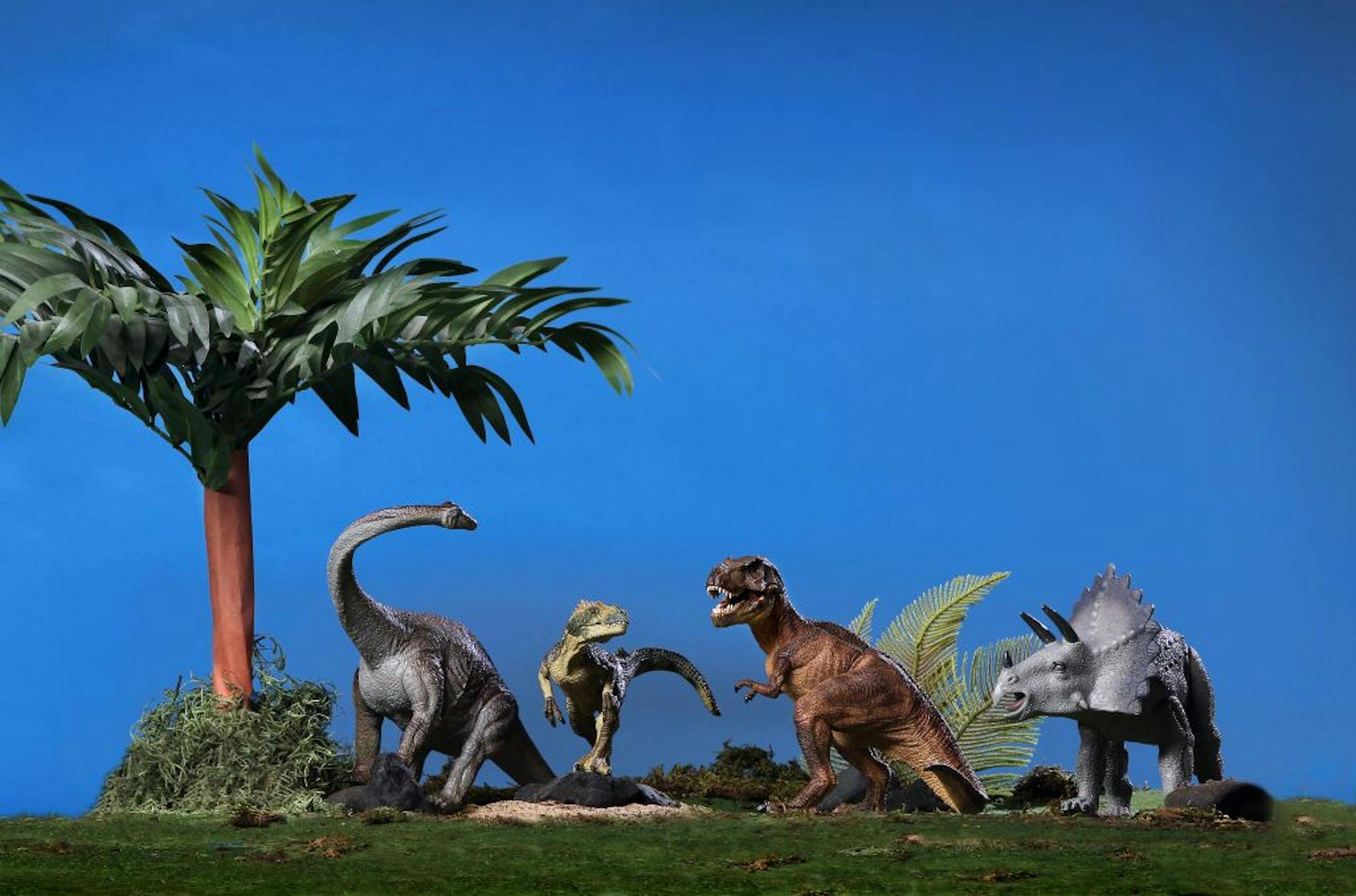
Remember all that cool stuff you learned about dinosaurs in school 20 (or 50) years ago? Well, don't. It's likely to be incomplete at best, incorrect at worst.
In elementary school, when we were all enthralled by dinosaurs, we learned that they were cold-blooded, slow-moving reptiles wiped out because they failed to adapt. Wrong, probably wrong and wrong.
When "Jurassic Park" came out, we gawked at velociraptors hunting in packs, a dilophosaurus spitting venom and a T. rex that couldn't see humans if they stood still -- all of it as big a pile of poop as the triceratops dung in the film.
"Nearly everything that we thought we knew about dinosaurs has changed in the last 20 years," said Macalester Assistant Prof. Kristi Curry Rogers, one of the nation's foremost vertebrate paleontologists. "They were not cold-blooded and slow-moving but almost certainly active, warm-blooded biological superlatives."
Turns out the little ones taking in the Minnesota Zoo's "Dino-Saurs" exhibit this summer know more about these animals than do their parents or grandparents, thanks in part to the PBS show "Dinosaur Train" and the continuing work of Curry Rogers and her peers.
"The kids are pulling Mom and Dad through the exhibit and telling them everything they know," said Christine Ness, the zoo's interpretive naturalist. "They're telling our volunteers how to pronounce the names, because they know."
What all of us understand about these animals is evolving even more quickly than they did during 160 million years of roaming the Earth. Starting with the fact that they did evolve, and thrive, across what began as the planet's sole land mass, Pangea, before it morphed into today's continents.
"The public has had this perception that [dinosaurs] were failures," Curry Rogers said, "that they were outcompeted or outdone by us, the mammals. Now there's a realization that dinosaur diversity was almost at its highest at the moment that dinosaurs went extinct.


