

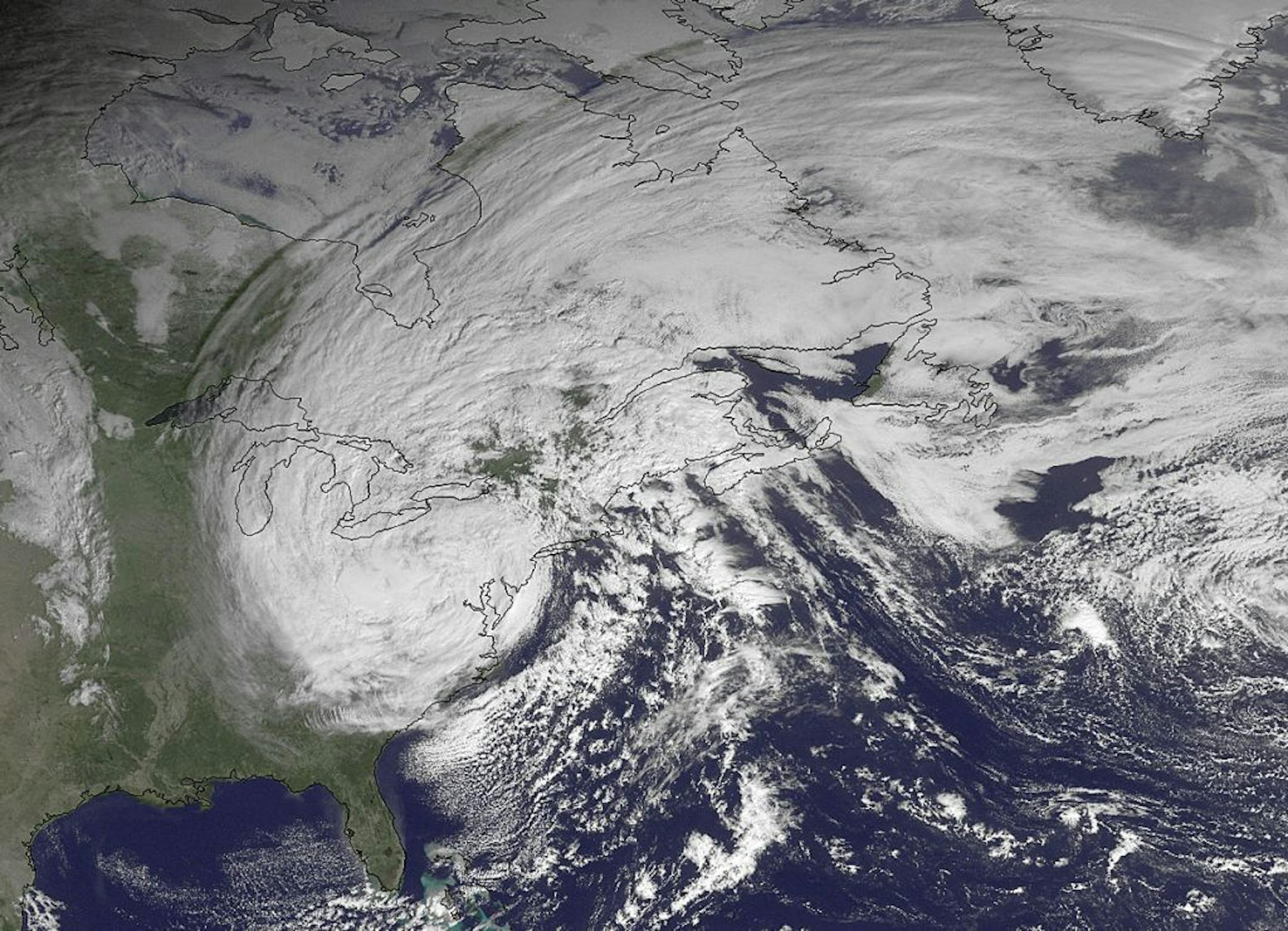
From the darkened living rooms of Manhattan to the wave-battered shores of Lake Michigan, the question is occurring to millions of people: Did the scale and damage from Hurricane Sandy have anything to do with climate change? ¶ Scientists offered an answer that is likely to satisfy no one. They simply do not know if the storm was caused by global warming. ¶ They do know, however, that the storm surge was almost certainly intensified by decades of sea-level rise linked to human emissions of greenhouse gases.
And climate scientists emphasized that Sandy, whatever its causes, should be seen as a foretaste of trouble to come as the seas rise faster, the risks of climate change accumulate and the political system fails to respond.
"We're changing the environment -- it's very clear," said Thomas Knutson, a research meteorologist with the government's Geophysical Fluid Dynamics Laboratory in Princeton, N.J. "We're changing global temperature, we're changing atmospheric moisture, we're changing a lot of things. Humans are running this experiment, and we're not quite sure how it's going to turn out."
'Hasn't done its homework'
By the time Sandy hit the Northeast coast on Monday, upending lives across the Eastern half of the country, it had become a freakish hybrid of a large, late-season hurricane and a winter storm more typical of the middle latitudes. Though by no means unprecedented, that type of hybrid storm is rare enough that scientists have not studied whether it is likely to become more common in a warming climate.
"My profession hasn't done its homework," said Kerry A. Emanuel, a climate scientist at the Massachusetts Institute of Technology. "I think there's going to be a ton of papers that come out of this, but it's going to take a couple of years."
Scientists note that a warmer atmosphere can hold more water vapor, which in principle supplies more energy for storms of all types. The statistics seem to show that certain types of weather extremes, notably heat waves and heavy downpours, are becoming more common.
But how those general principles will influence hurricanes has long been a murky and contentious area of climate science. Most scientists expect that the number of Atlantic hurricanes will actually stay steady or decline in coming decades as the climate warms, but that the proportion of intense, damaging storms is likely to rise.


