Dennis Anderson: Weather and economy are dual threats

As snow piles up, so do concerns for shooting preserves and game farms, which already took a hit from the struggling economy.

February 15, 2010 at 11:37PM
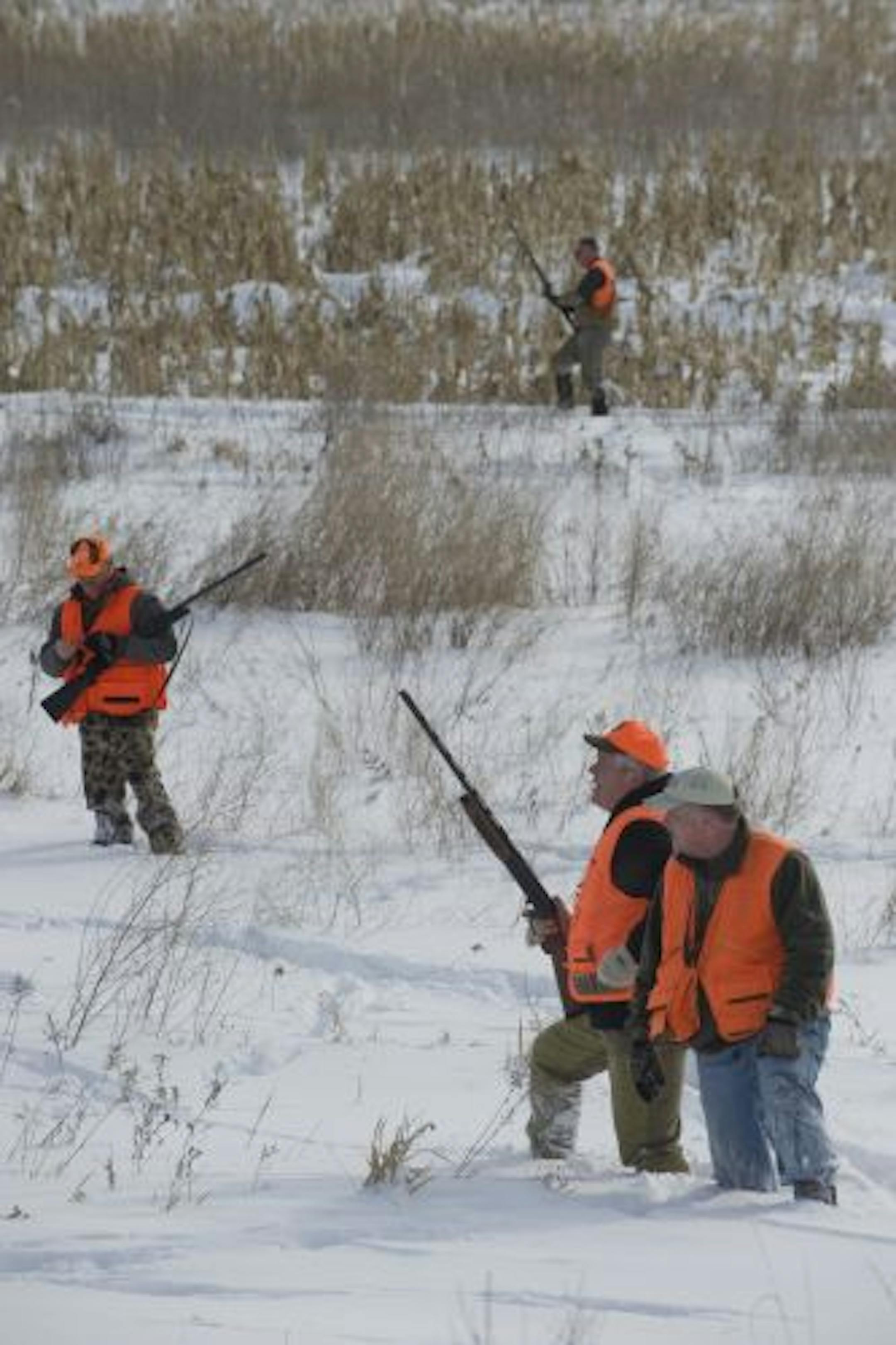
Knee-deep in snow, Scott Beckmann of Waseca, Minn., brought down a pheasant just flushed by a hunting dog named Ruby.
Knee-deep in snow, Scott Beckmann of Waseca, Minn., brought down a pheasant just flushed by a hunting dog named Ruby. (Star Tribune/The Minnesota Star Tribune)

LE CENTER, MINN. — Jeff Traxler, an Army veteran, looked out the clubhouse window at his hunting preserve and saw the enemy: snow.

"We've got 24 hunting fields," he said Thursday afternoon. "We're using three of them."

With another 11 inches of the white stuff falling last week, Traxler's Hunting Preserve and the southern Minnesota farmlands that surround it resemble a white moonscape. Except for a latticework of snowmobile tracks weaving atop the crusted drifts, the snow appears drifted by an angel's hand -- silky smooth and endless.

But the snow is smothering many of the state's licensed shooting preserves, and with them the rancher-producers of millions of game birds raised here each year to be shot at "hunting clubs," as shooting preserves also are known.

At shooting preserves, farm-raised game birds such as pheasants, chukkar partridge and bobwhite quail are released in given areas to be pursued by wingshooters and their dogs in much the same way wild birds are hunted.

Some shooting preserves, such as Traxler's, are private, requiring annual membership fees. Others are open to the public.

Either way, daily fees vary, depending on how many birds are released, with pheasants, for example, costing upwards of $20 apiece.

One of Minnesota's elite shooting preserves, Traxler's is weathering the storm perhaps better than most. Its restaurant is renowned for wild game and other fare, and its facilities are more akin to a corporate retreat than a place where leather boots and blaze-orange shirts are de rigueur.
Other shooting preserves have gone upside down altogether. From 2006-2008 the Department of Natural Resources licensed 82 such businesses in Minnesota. Last year there were 70.

Now, the snow is so deep at many of the state's remaining preserves that hunters and their dogs are finding the going too tough to weather. Worse, some birds when freed skitter atop the snow and fly away far out of shotgun range, while others bury themselves deep in drifts, refusing to fly.

Snow isn't the only problem. When the economy headed south a couple of years ago, corporations cut back on entertainment. Shooting preserves, like golf clubs, felt the pinch. In suburban St. Paul, for example, Wild Wings of Oneka, founded in 1956 and the state's oldest such club, for the first time this season exhausted its membership waiting list and went looking for customers.

"And members who do hunt now often ask for fewer birds to be released than they did a few years ago," said Gary Schulte of Wild Wings.

Traxler's Shooting Preserve once had about 425 members who shot as many as 39,000 released birds. This year, membership ($425 annually) is about 300, and between 25,000 and 35,000 birds will be released.

"We began to feel the effects of the economy a year ago," Traxler said. "Still, last fall began very strong. Then the snow came. This is the worst snow we've seen in 22 years. On top of the slow economy, it's tough."

• • •

Historically, many Minnesota shooting preserves raised their own birds, pheasants in particular, in large netted "flight pens." Purchased as day-old or week-old chicks in spring or summer, the birds were placed in the ballfield-size nets to protect them from predators and raised until their release for hunting in fall or winter.

Today, most shooting preserves avoid the risk and expense of raising birds and instead order adult fowl on an as-needed basis from one of Minnesota's many game-bird producers.

Largest among these, perhaps, is Oakwood Game Farm in Princeton.

"We sell about 200,000 pheasant chicks around the country and raise about 100,000 pheasant adults," said Scott Meyer, Oakwood's manager.

Big shooting preserves, Meyer said, manage their bird inventories carefully, sometimes ordering 1,000 or more birds for a weekend, expecting that any leftovers will be released for clients the following week.

Smaller clubs might order only a few hundred birds for a weekend.

But when phones don't ring at shooting preserves, they also don't ring at game farms.

"Business definitely has slowed up in recent years," Meyer said. "People just aren't spending money like they used to. My gut feeling is that some of the smaller shooting preserves are starting to drop out or having to gear way back."

Ironically, many pheasants raised in Minnesota are shipped to South Dakota, where they are marketed as "wild" birds by commercial operators whose clients include ... Minnesota hunters.

"We started out great last fall," said Jared Anderson of Woodland Acres Hatchery near Fairmont, Minn. "We raise mostly bobwhite quail. But this year we also raised 15,000 pheasants, and it was the first year I can remember we were sold out by Thanksgiving."

Heavy rains in South Dakota in October were one reason for the windfall, Anderson said.

"Hunters out there kept complaining to outfitters they couldn't get into fields and couldn't find wild birds," he said. "So the outfitters kept ordering birds to release."

But since December, business has slowed. "It's the economy, and the weather has been the icing on the cake," Anderson said. "There's just nothing going on."

Doug Starry, owner of Silver Creek Game Birds in Maple Lake, agrees.

"This is as tough as it's been in 12 years for me," Starry said. "If we don't sell the birds we have this winter to shooting preserves, we'll have to keep them over until next year. But that's hard to do. In breeding season, the roosters will kill each other if you don't spread them out."

If the weather warms this month and continues to moderate in March, the season could be salvaged, Jeff Traxler said. Hunter demand fueled growth of the shooting preserve industry in Minnesota, and hunter demand will sustain it, he believes.

But first, some snow has to melt.

"In the meantime, it helps to be diversified," Traxler said. "In addition to bird hunts, we do parties, clay pigeons, and have a rifle range. The only thing we don't do is weddings.

"If I can help it, I don't want to do weddings."

Dennis Anderson • danderson@startribune.com

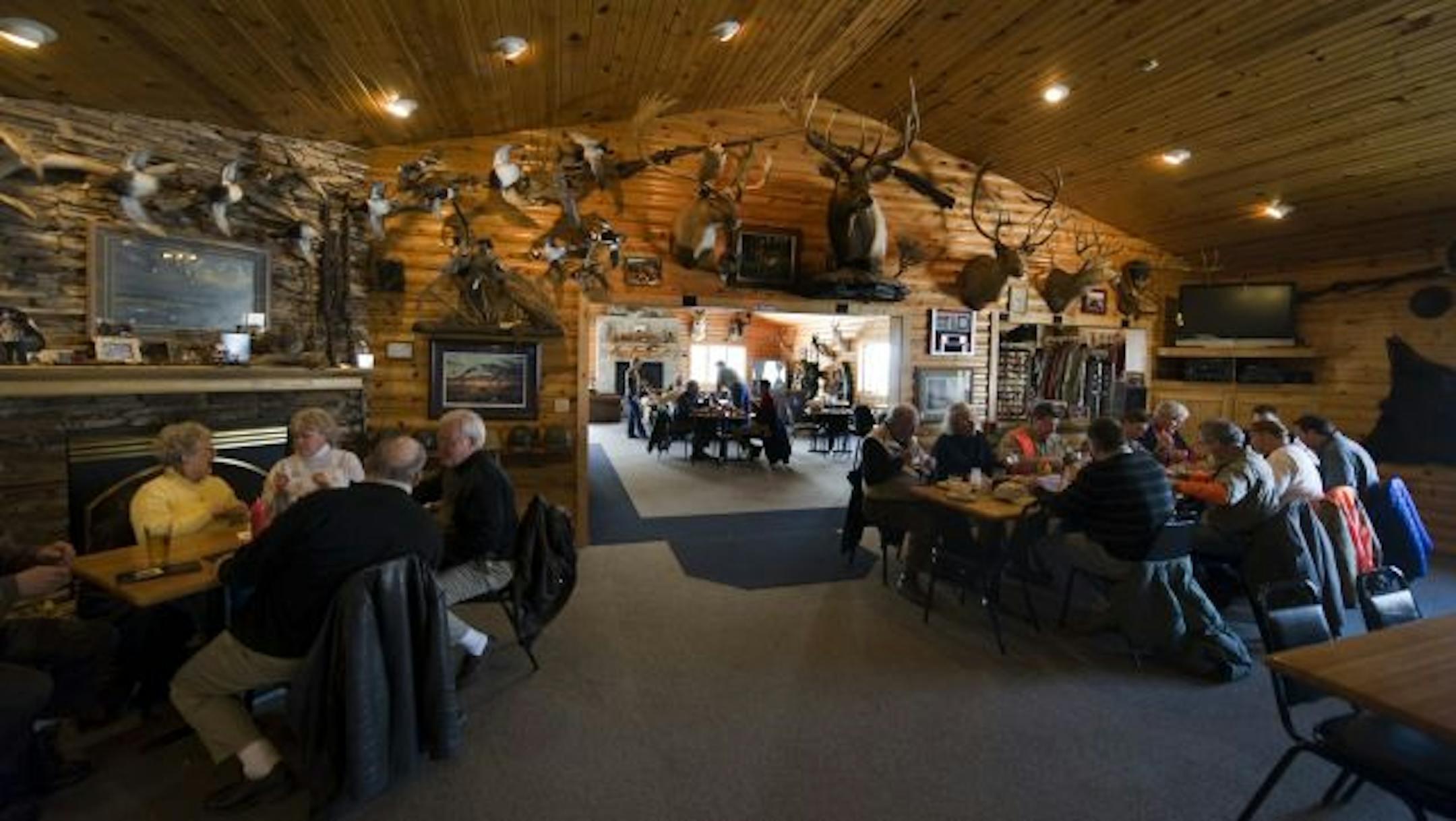
Inside the clubhouse at Traxler's Hunting Preserve guests can have dinner among mounted animals and military displays.
Inside the clubhouse at Traxler’s Hunting Preserve guests can have dinner among mounted animals and military displays. (Star Tribune/The Minnesota Star Tribune)
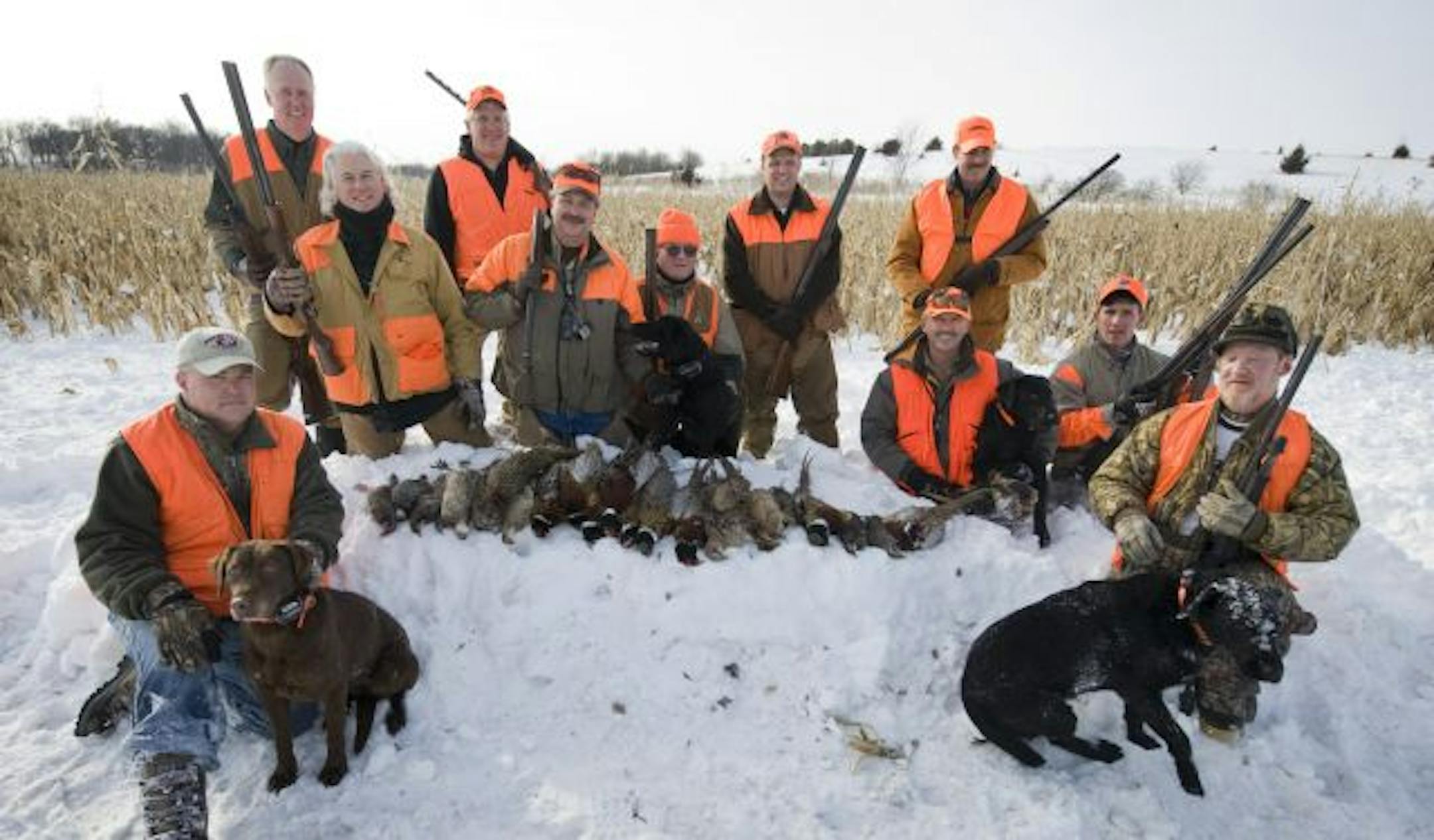
Hunters posed with their day's take. Shown are (front row, from left) Tim Loonan and Terry George, both of Waseca, Minn.; (middle row, from left) Jeffrey Hill of Chicago, Bill Miller of Minneapolis, Mike Dudgeon of Wheaton, Ill., Gene Glynn of Waseca and Steve Wareham of Springfield, Ill.; (back row, from left) Kevin Goulding of Chicago, Scott Beckmann of Waseca, Kelly Dudgeon of Chicago and Bob McCarty of Minneapolis.
Hunters posed with their day’s take. Shown are (front row, from left) Tim Loonan and Terry George, both of Waseca, Minn.; (middle row, from left) Jeffrey Hill of Chicago, Bill Miller of Minneapolis, Mike Dudgeon of Wheaton, Ill., Gene Glynn of Waseca and Steve Wareham of Springfield, Ill.; (back row, from left) Kevin Goulding of Chicago, Scott Beckmann of Waseca, Kelly Dudgeon of Chicago and Bob McCarty of Minneapolis. (Star Tribune/The Minnesota Star Tribune)
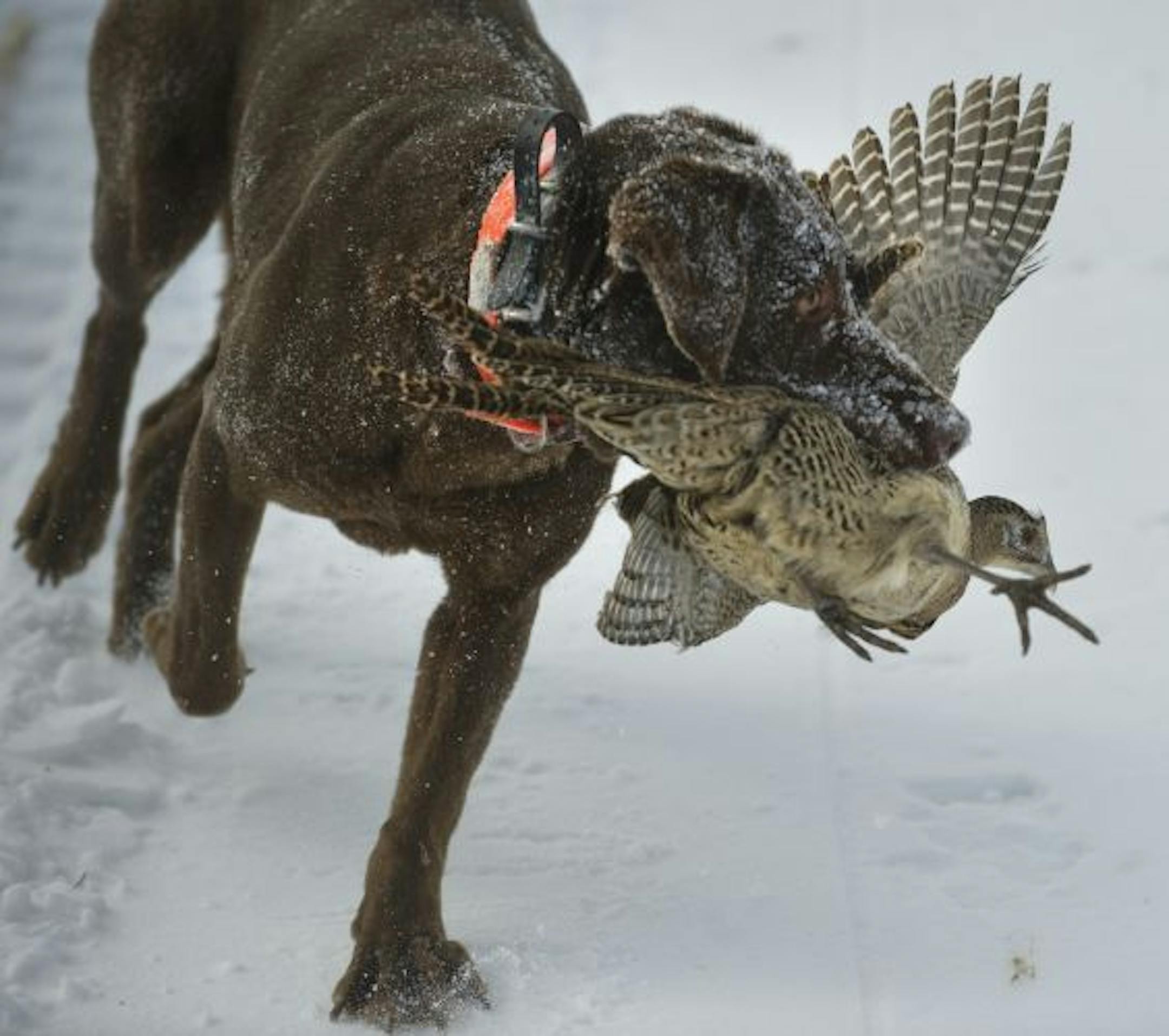
Tinker retrieved a bird.
Tinker retrieved a bird. (Star Tribune/The Minnesota Star Tribune)
Scott Beckmann and Tim Loonan (forefront, from left) forged ahead while hunting a cornfield at Traxler's Hunting Preserve. Gene Glynn (left) and Kevin Goulding (back) also worked the field.
Scott Beckmann and Tim Loonan (forefront, from left) forged ahead while hunting a cornfield at Traxler’s Hunting Preserve. Gene Glynn (left) and Kevin Goulding (back) also worked the field. (Star Tribune/The Minnesota Star Tribune)
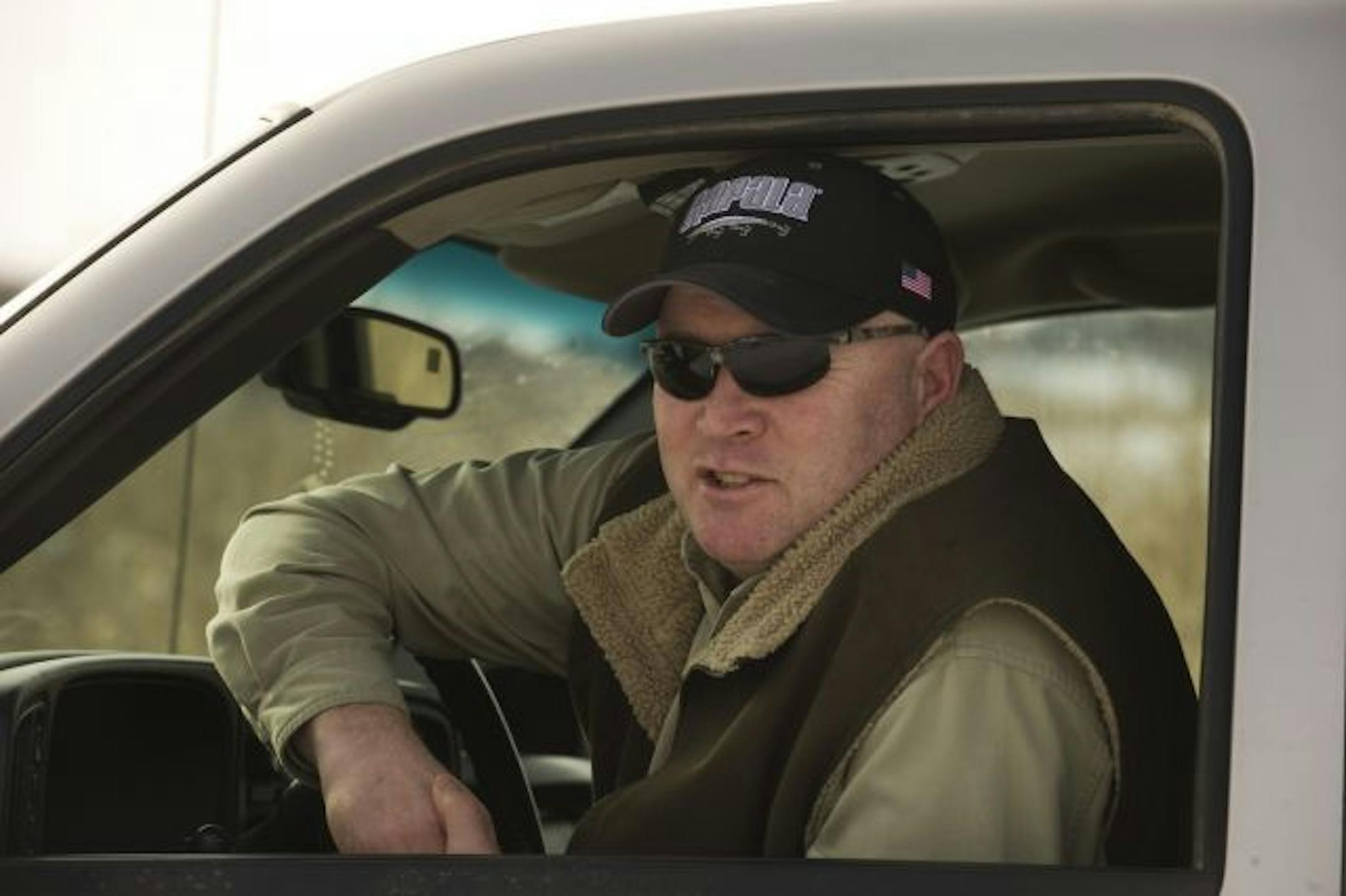
Jeff Traxler stopped between cornfields to check on how things were going with the hunters.
Jeff Traxler stopped between cornfields to check on how things were going with the hunters. (Star Tribune/The Minnesota Star Tribune)
about the writer

about the writer

Dennis Anderson

Columnist

Outdoors columnist Dennis Anderson joined the Star Tribune in 1993 after serving in the same position at the St. Paul Pioneer Press for 13 years. His column topics vary widely, and include canoeing, fishing, hunting, adventure travel and conservation of the environment.

See Moreicon

More from No Section

See More
FILE -- A rent deposit slot at an apartment complex in Tucker, Ga., on July 21, 2020. As an eviction crisis has seemed increasingly likely this summer, everyone in the housing market has made the same plea to Washington: Send money — lots of it — that would keep renters in their homes and landlords afloat. (Melissa Golden/The New York Times) ORG XMIT: XNYT58
Melissa Golden/The New York Times

It’s too soon to tell how much the immigration crackdown is to blame.