1:52
1:52One is a college student, another an aerospace engineer. A third meditates "because it makes you really aware what's coming into your head." A fourth was recruited by the Army out of a small college for his world-class sharpshooting skills.
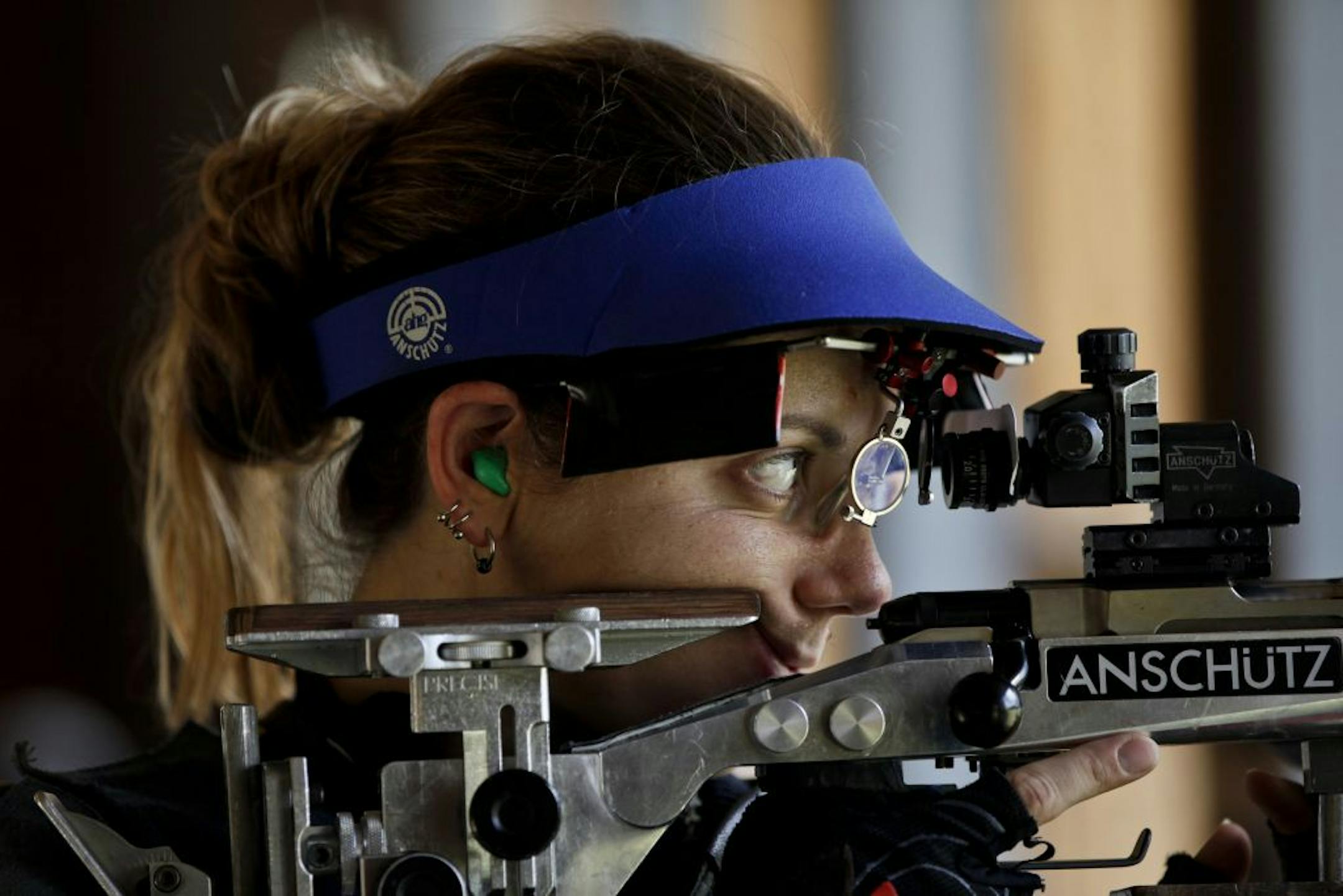
Each is a member of the U.S. Olympic rifle team that arrived without fanfare in the Twin Cities this week to practice at the Minneapolis Rifle Club, whose northwest metro range mimics what the shooters might face later this month in London.
Clad in heavy shooting pants and jackets, special shoes and protective eyewear, and shouldering .22 rimfire rifles capable of sharpening pencil points at 50 meters, the marksmen honed targeting skills that rank them among the best in the world.
"Two members of our current eight member team [four others trained elsewhere this week] were on the very strong team we had in 2008 in Beijing," said coach Dave Johnson of Colorado Springs, himself a former Olympian. "I'm very confident we will do well in London."
Physically and mentally demanding, with some matches lasting three hours, competitive rifle shooting is divided into men's and women's events, and is little understood outside its relatively small circle of participants, coaches and supporters.
Though shooting in some form has been part of most Olympics since 1896, it unfolds in the shadows of the Summer Games' more visible competitions that require, for example, running, jumping and trapeze wizardry.
And unlike those sports, rifle shooting rewards competitors who almost literally can still their hearts -- while rigidly aiming 15-pound rifles at electronic targets that gauge accuracy at otherwise imperceptible gradations.
"I started shooting when I was 11," said Amanda Furrer, 21, of Spokane, Wash. "For me this is almost entirely a mental game. You have to be 100 percent confident going into a match. I tell myself, 'I want this. I need this. I'm going to do it.' "