
Dennis Anderson: Providing small homes on a large scale for birds

The goal is to provide up to 1,100 "hen houses" that make possible high survival rates for mallard broods.

February 20, 2011 at 2:48AM
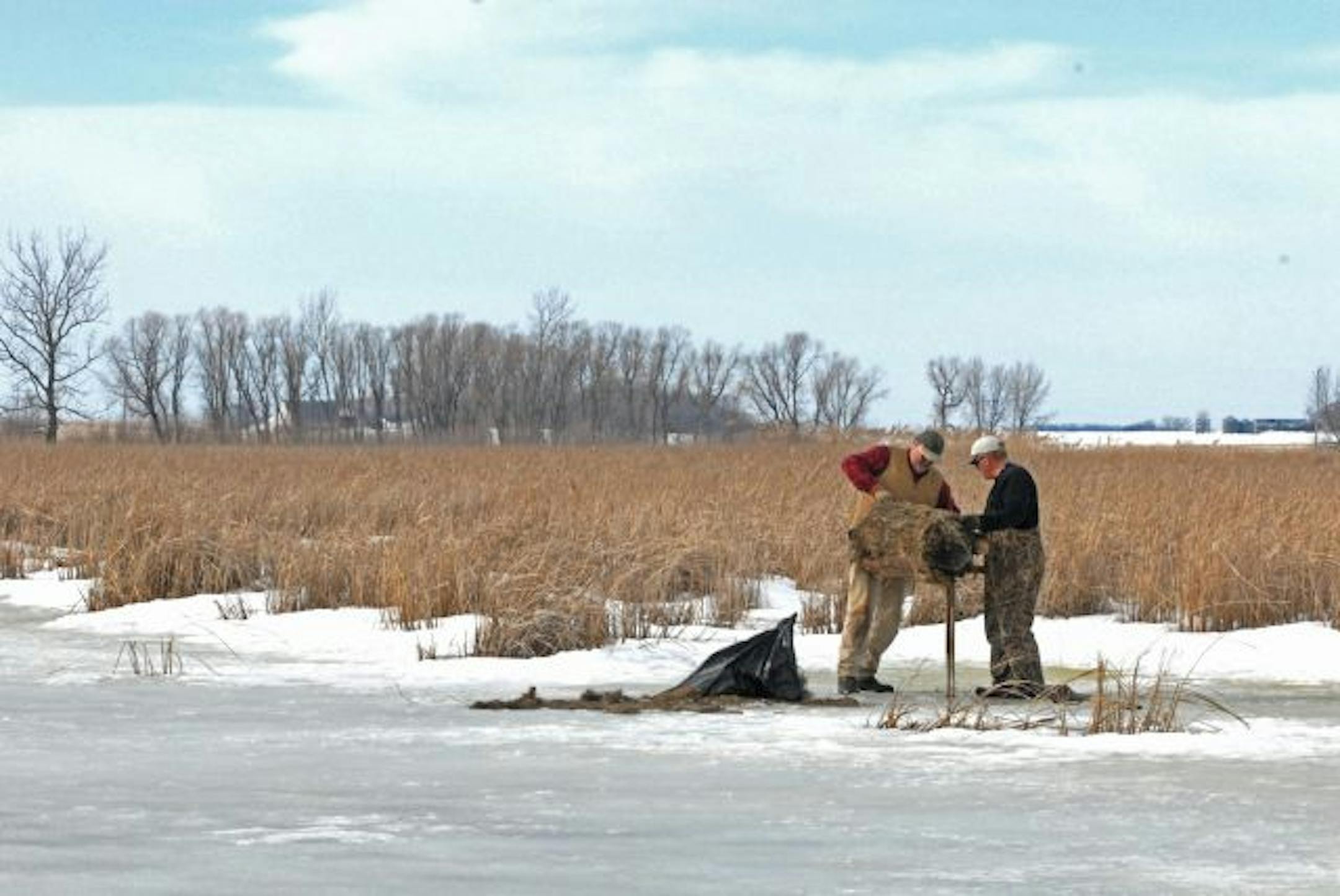
Mike Kroenke and Delta Waterfowl biologist Matt Chouinard repair a nesting cylinder, or "hen house,'' on a western Minnesota state wildlife management area in anticipation of the return in a month or so of mallards and other ducks to Minnesota. Kroenke and Chouinard work as a team, and have been erecting and repairing more than 1,000 hen houses in western Minnesota since January.
Mike Kroenke and Delta Waterfowl biologist Matt Chouinard repaired a nesting cylinder, or “hen house,’’ on a western Minnesota state wildlife management area in anticipation of the return in a month or so of mallards and other ducks to Minnesota. Kroenke and Chouinard work as a team and have been erecting and repairing more than 1,000 hen houses in western Minnesota since January. (Star Tribune/The Minnesota Star Tribune)

MINNEOTA, MINN. — Anticipating the arrival soon of mallards and other ducks from the south, Matt Chouinard pulled the starter cord of his timeworn snowmobile and in the next moment was sledding across the soft ice that blanketed a small marsh near this western Minnesota town.

Helping Chouinard was Mike Kroenke. The two have been passing days like this, together, since January, battling bitter winds, frigid temperatures -- and now, melting ice.

All for ducks, mallard hens in particular.

"We don't like to see warm weather in February," Chouinard said. "We've gotten stuck pretty good a couple of times with the snowmobile."

Chouinard, 36, is a Delta Waterfowl biologist, well trained, and his mission is to have ready as many as 1,100 "hen houses," or nesting cylinders, for nesting mallard hens when they return to western Minnesota.

Mounted on steel posts about 3 feet above wetlands large and small, the cylinders virtually guarantee a hen will bring off a brood without fear her nest and eggs will be robbed by predators -- whether those that fly overhead, such as hawks, or sneak below, such as skunks and coyotes.

"The point of hen houses is to improve nest success," Chouinard said. "If there are significant amounts of grass on the landscape, then mallards and other ground-nesting ducks can nest successfully enough to sustain their populations.

"But in Minnesota, where the habitat is so fragmented, predators can limit nest success to 5 percent in some cases. With hen houses, success can be 80 percent or more."

Tooling along western Minnesota's back roads the other day, Chouinard and Kroenke wouldn't have been confused with anyone, or anything, else.

The pickups they drove were dirty, the snowmobile trailers they pulled were caked with ice, mud or both. These were working men, and their equipment showed it.

The good news: They're on schedule.

By April 1, or thereabouts, mallard hens will be in Minnesota prospecting for nest sites, and awaiting them will be the grassy cylinders that Chouinard and Kroenke have placed on both private and public lands.

Then the two can watch with satisfaction through binoculars as birds settle into their new homes.

• • •

The design of nesting cylinders used by Delta Waterfowl and other conservation groups dates back centuries, to the 1600s. For construction and other information go to www.deltawaterfowl.org.

Much improved from the early models, hen houses placed by Chouinard and Kroenke are of specific length and diameter. Importantly, their bedding is made of flax straw -- which comes from Manitoba -- mixed in smaller proportion with slough grass.

"A lot of the early designs were baskets, like the goose tubs that are made for nesting geese," Chouinard said. "But because they were open at the top, predators could get at the nests more easily. And oftentimes, even though the tubs were meant for ducks, geese nested in them."

Though Chouinard works for Delta Waterfowl, headquartered in Bismarck, N.D., the Minnesota DNR picks up most of the tab for the project through an initiative called Working Lands.

The plan's goal is to work with private landowners -- and also on public lands -- to develop conservation programs with multiple benefits.

"In much of the western and southwestern portion of the state, where most Working Lands Initiative efforts are focused, the percentage of privately owned lands exceeds 90 percent," said Ray Norrgard, DNR wetland wildlife program leader. "We need to find ways to support agriculture and wildlife. The emphasis of Working Lands remains on voluntary, nonregulatory, incentive-based approaches."

Whether the hen house project -- now in its fourth year -- will be funded in future years remains unclear, Norrgard said. The $120,000 contract with Delta Waterfowl is paid by a DNR fund that likely will come under increasing pressure as other state and federal conservation dollars dry up because of the economy.

"We think it's successful, and we'd like to continue it," Norrgard said.

Chouinard, whose master's degree thesis studied the effectiveness of hen houses in the Minnedosa region of Manitoba, knows the cylinders produce ducks.

Last year, the estimated 1,000 hen houses he had scattered in western Minnesota produced about 3,200 ducks. He knows this, he said, because he checked many the cylinders himself in late spring and early summer, either by paddling a small boat to the structures or reaching them wearing waders.

• • •

Midafternoon on Wednesday, and Chouinard and Kroenke were on foot, busting through ice on the edge of yet another wetland, this one on a state wildlife management area.

A short distance from shore, the ice regained strength and supported the two men. Still, Chouinard poked the path ahead with a shovel, looking for soft spots.

Finding none, the two soon reached a hen house about 75 yards away that needed repair. Disassembling the cylinder from its stand, Chouinard and Kroenke quickly rebedded it with flax and slough grass.

Then, comfortable the structure would satisfy the most discriminating hen mallard, they reaffixed it to its stand and shuffled away, testing the ice once more for weakness.

It was their way of hanging out a "Vacancy" sign, and hoping soon a passing mallard hen would see it, bank in midflight, cup her wings and land -- to make a nest.

about the writer

about the writer

Dennis Anderson

Columnist

Outdoors columnist Dennis Anderson joined the Star Tribune in 1993 after serving in the same position at the St. Paul Pioneer Press for 13 years. His column topics vary widely, and include canoeing, fishing, hunting, adventure travel and conservation of the environment.

See Moreicon