
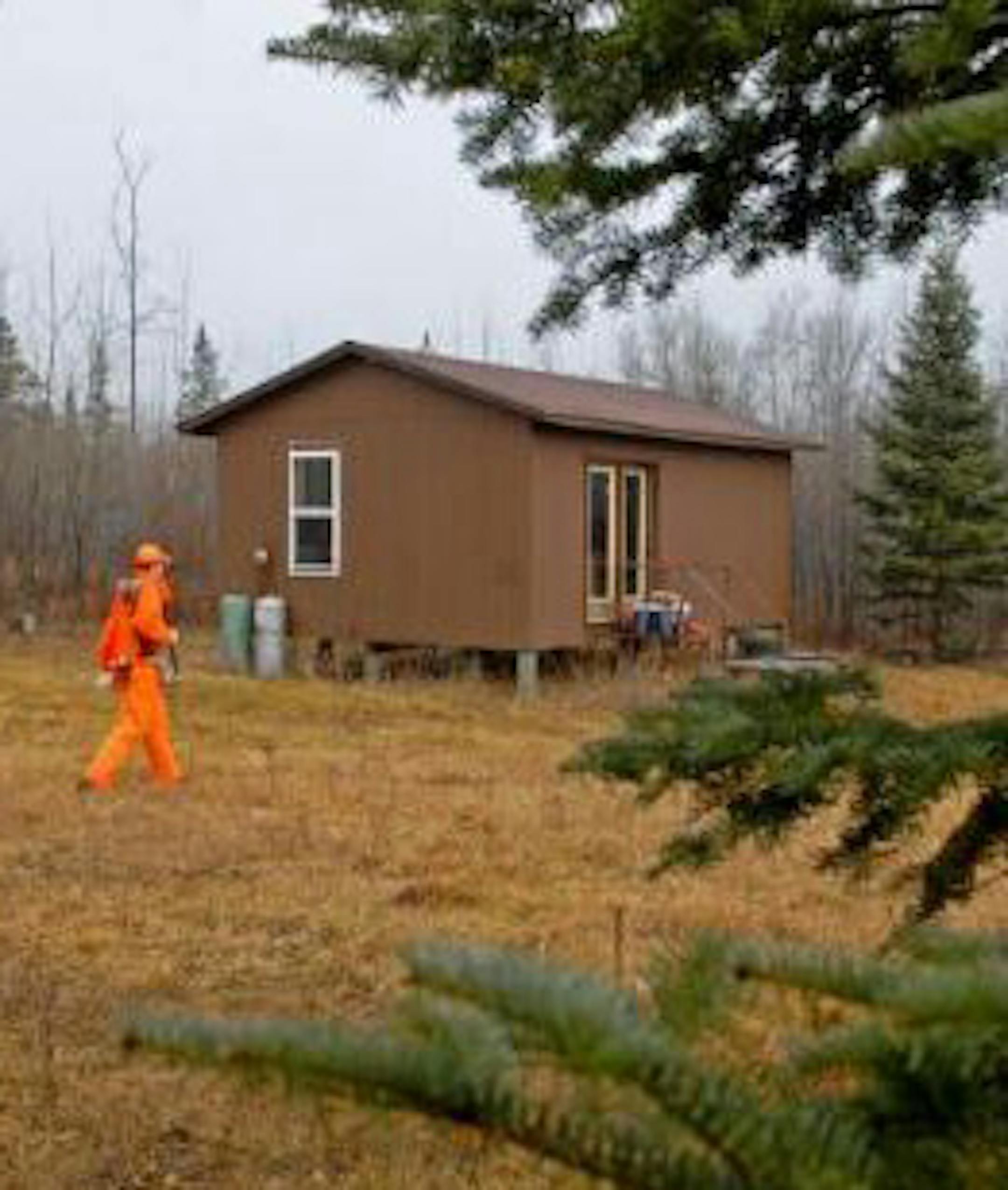
Dennis Anderson: Going back to the shack

Shelter doesn't get much cruder, but that's not the point: The seasonal sanctuary for deer hunters serves just fine as a launch point, warming house and social dining room.

November 23, 2009 at 11:13PM
Deer shacks are simple structures.
Simple structures, deer shacks offer hunters and other visitors respite not only from inclement weather, but from the storms of everyday life. (Stan Schmidt — Star Tribune/The Minnesota Star Tribune)

CUMBERLAND, WIS. - Few things say "made in America" as much as a deer hunting shack, and the one I use during the Wisconsin whitetail season is about as American as a shack gets. Wood-burning stove. Plywood bunk beds. Outhouse. Hang a pair of blaze orange bibs on a coat rack and stand a .270 in a corner, and there you have it. China, eat your heart out.

Pennsylvania and others states to the east claim a long history of deer hunting and the simple structures that accommodate sportsmen during their annual pilgrimages into the woods. True, they've been at it longer than those of us in Minnesota and Wisconsin. But we learn quickly here, and if ever there were a contest over whose shacks hew closest to the red, white and blue ideal of shackdom, we'd win, hands down.

The first deer hunting shack I slept in as a kid was in the Upper Peninsula of Michigan. I was 13 years old, and my dad, older brother and I were invited to hunt with a friend whose two-bit vertical-log shack was a haven for mice, flatulence and, come morning, buttermilk pancakes.

My brother had fixed up a '56 Chevy pickup, and in a moment of weakness Dad had said we could take it to his friend's shack, leaving home at 4 in the morning amid heavy snow. We almost made it, too, before a tie rod let go and we fishtailed headlong into a road ditch, walking the last 3 miles or so and missing most of opening morning. It was one of the few times I ever heard the old man swear.

I thought about that long-ago hunting trip when my alarm rang at 4 Saturday morning. First thing, I stoked the fire with a couple of good oak logs. The temperature outside wasn't cold, maybe 20 degrees, but I had let the coals burn out during the night, and the place had a chill to it. Then I reached for the coffee and turned on the battery-operated radio, hoping to hear "Da Turdy Point Buck."

Wisconsin has a different shack history than Minnesota, a fact perhaps not widely known. Chicago and Milwaukee, being on Lake Michigan and being east of the Twin Cities, were cities long before Minneapolis and St. Paul were. They had railroads first, too, and it was in rail cars that Wisconsin hunters traveled north at the turn of the last century, squeezing themselves together on wooden seats, their .30-30s and, doubtless, bottles of tanglefoot nearby.

In his remarkable, recently published book, Robert C. Willging in "On the Hunt, The History of Deer Hunting in Wisconsin," reports that transporting deer carcasses for their trips south by rail was no easy task. Sometimes journeys of up to 30 miles had to be made by hunters toting their carcasses before they could get to a railway station where the venison-on-the-hoof could be shipped downstate.

Willging described one early Wisconsin deer hunting shack:
"The camp was a two-room log building consisting of cook shack and bunk house. The log walls were chinked in with mud and hammered-in strips of wood. ... The bunks in the bunk house were double-decker, two men to a bunk, with a bench running alongside the bottom bunks where the men could sit in the evening. A stove made from an oil barrel furnished heat for the room. Wood three feet long and properly stoked would keep the fire all night."

• • •

I woke the boys after the gas lights had been lit and the first slices of French toast were coming off the stove. We had sausage, also, and soon then pulled on our jackets, hats and bibs, wondering as we did whether we'd see any deer, the point of it all.

It wasn't just the three of us. Not far away, in our same party, was another gang. Their shack, a converted barn, bears a few conveniences our doesn't. But the point is the same: The structure is unlike any other its inhabitants will sleep in the rest of the year. Warm enough to keep the cold out, yes. And big enough to accommodate all of us for dinner. But it's a shack nonetheless, a shelter from the weather and, no less, from the humdrum of everyday life.

I would hunt in a stand I had hung in a swamp, fantasizing as I did that I would waylay the mythical "swamp buck" for my trouble. I didn't see that kind of animal Saturday. Or, really, any animal, unless you count a fox, Canada geese, black-capped chickadees or my two sons.

The older, Trevor, elected to perch himself in a stand we call "Scope Eye," named for what occurred there some years ago to another young hunter. He got his buck, yes, when he squeezed the trigger that morning now long ago. But he also got his scope in his eye when the rifle recoiled, a bruise that soon became a shiner -- sort of a badge of courage.

Cole, the younger boy, opted for a stand called "Finger Ridge," named by my friend Norb Berg, elder statesman of our hunting group, for a ridge in Korea, where he served long ago.

The upshot is none of us saw anything worth shooting Saturday by midday or so, and about 2 p.m. we gathered again at the shack to make sandwiches.

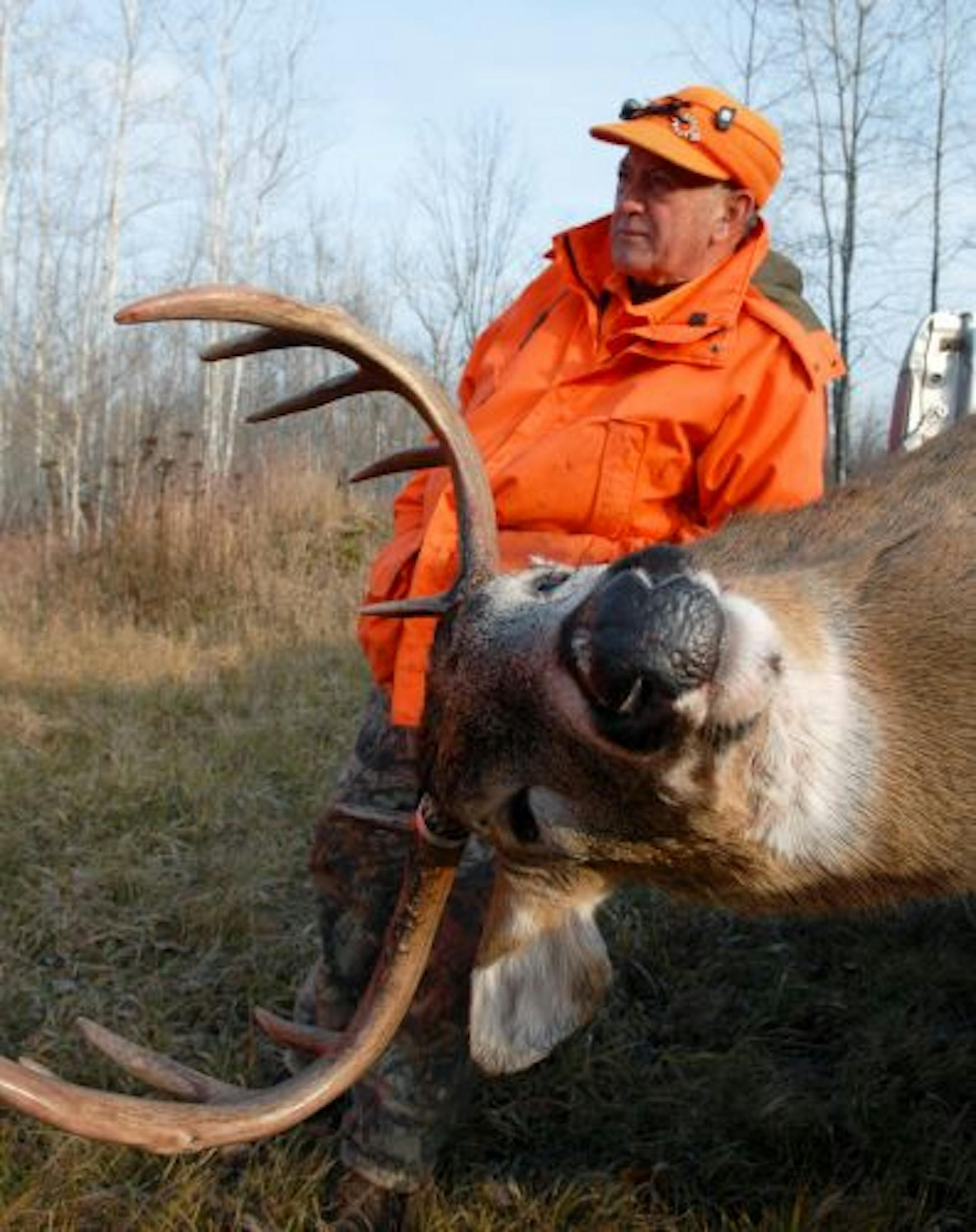
Norb had taken a big 10-point buck early Saturday and with Billy Fergot of Edgar, Wis., had driven to town to register their bounty.

Now they had returned, stopping by at our shack to talk and laugh and to make the most of a day that comes only once a year. We did this outside the shack, but the shack nevertheless was the centerpiece of our chit-chat and, really, the centerpiece of why we were doing what we were doing.

When Norb and Billy left, the boys and I threw another log on the fire. Then we grabbed our guns and fanned out, spokes on a wheel, the shack being the hub.

The shack, in the end, being the thing we would remember long after forgetting who shot what deer, and when.

Norb Berg of Barronett, Wis., with a 10-point buck he shot at a few minutes after 7 a.m. Saturday, opening day of the Wisconsin deer season. The hefty 10-pointer was crossing a swamp.
Norb Berg of Barronett, Wis., with a 10-point buck he shot at a few minutes after 7 a.m. Saturday, opening day of the Wisconsin deer season. The hefty 10-pointer was crossing a swamp. (Star Tribune/The Minnesota Star Tribune)
about the writer

about the writer

Dennis Anderson

Columnist

Outdoors columnist Dennis Anderson joined the Star Tribune in 1993 after serving in the same position at the St. Paul Pioneer Press for 13 years. His column topics vary widely, and include canoeing, fishing, hunting, adventure travel and conservation of the environment.

See Moreicon