

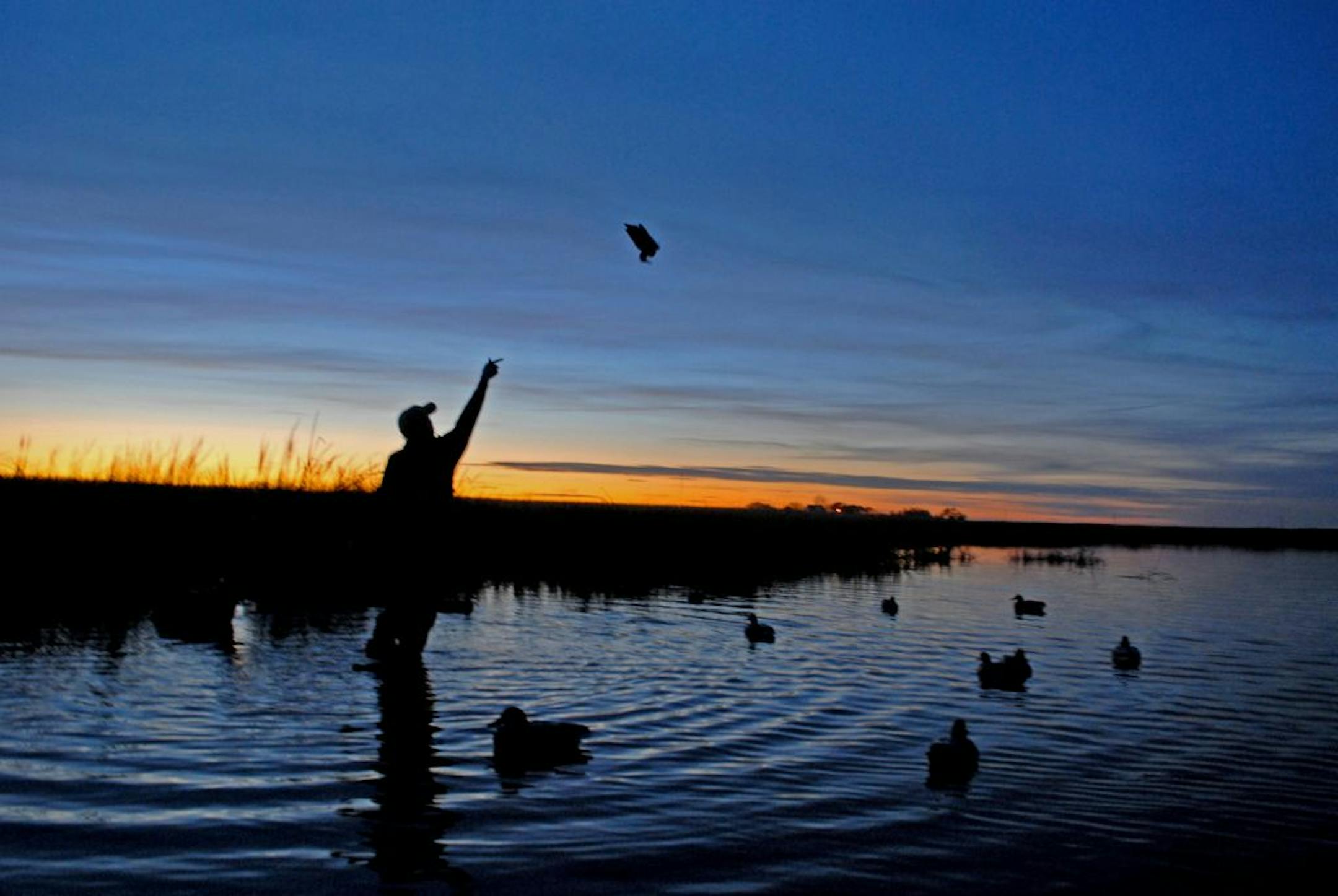
Here on the prairie in late afternoon the few cottonwoods still standing throw ever-longer shadows across bending grass. Sunlight demurs gracefully, and at day's end, land, water, sun and sky galvanize in a blush of reflections. The bystander feels insignificant.I had a young dog with me, or we did, my son and I. This was one evening last week, and we were about to hunt a shallow lake north of Aberdeen. The watery depression had gathered perhaps 200 gadwalls, mallards and pintails, a number we estimated while glassing with binoculars from a nearby gravel two-track.
The afternoon had been bright and clear with little wind. Waterfowlers watch the weather closely, and the previous six days the wind had blown from the north. You can see birds migrate on weather radar, and in the past week, ducks, geese and songbirds rode favorable currents out of Canada and into North Dakota and South Dakota, as well as Minnesota.
So we had ducks. As a bonus, from the road the lake we would hunt seemed a likely roost, and we believed ducks would pile into it before sunset. But reaching it through the sea of standing corn that separated it from the road would be difficult. We would travel lightly: two guns, 18 decoys, two blind bags and cameras.
The young dog's name is Duke. He's 2 years old and except for the part about licking, his training is complete. He licks anything and everybody. Were he starved for affection, his behavior would be excusable. But he's more popular in our family than I am, even though he doesn't dispense allowances, the one card I have left to play.
Visiting the Dakotas in October, as prairies nod toward winter, should be on everyone's to-do list. Undulating gently, the landscape seems endless. Grasses that were green in summer are goldenrod. The sky is bluer now, too, and against it, vast combines gather the harvest. In turn, grain trucks hustle the produce to bulging silos, dust plumes trailing. Everything is in transition, and an incandescent autumn light casts it in a painter's sheen.
It's here, then, that waterfowler meets waterfowl. Many ducks and geese that are hunted are residents. Others begin their journeys in the sub-Arctic or even Alaska. But most arrive from the northern latitudes of the U.S. or Canada. Duck hunters universally want to see mallards over their decoys, but that often doesn't happen in earnest until November. So far this fall among migrants over the Dakotas and Minnesota it's been mostly gadwall, widgeon and pintails, and some divers: buffleheads, redheads, canvasbacks, ringnecks and bluebills.
Our gear ready, my son, Cole, and I hoisted our decoys onto our backs. Eyeballing our destination, we stepped into the corn. Duke the licking dog was at my heel, and little by little he was learning the ways of the vagabond hunter.
Already on the trip he had bagged his first illicit motel room, tiptoeing through a side door of our rental establishment, out of the innkeeper's sight. Also, television broadcasts of the World Series, the sleep aid of choice among tired waterfowlers, seemed easily to knock him out for the night, even with the lights on. So he fit in.


