
Dennis Anderson: Court's ruling helps bring duck lakes back

An Appeals Court ruling appears to be an vital step toward restoring two dried-up lakes, which in turn should help the dwindling duck population.

September 20, 2009 at 1:51PM
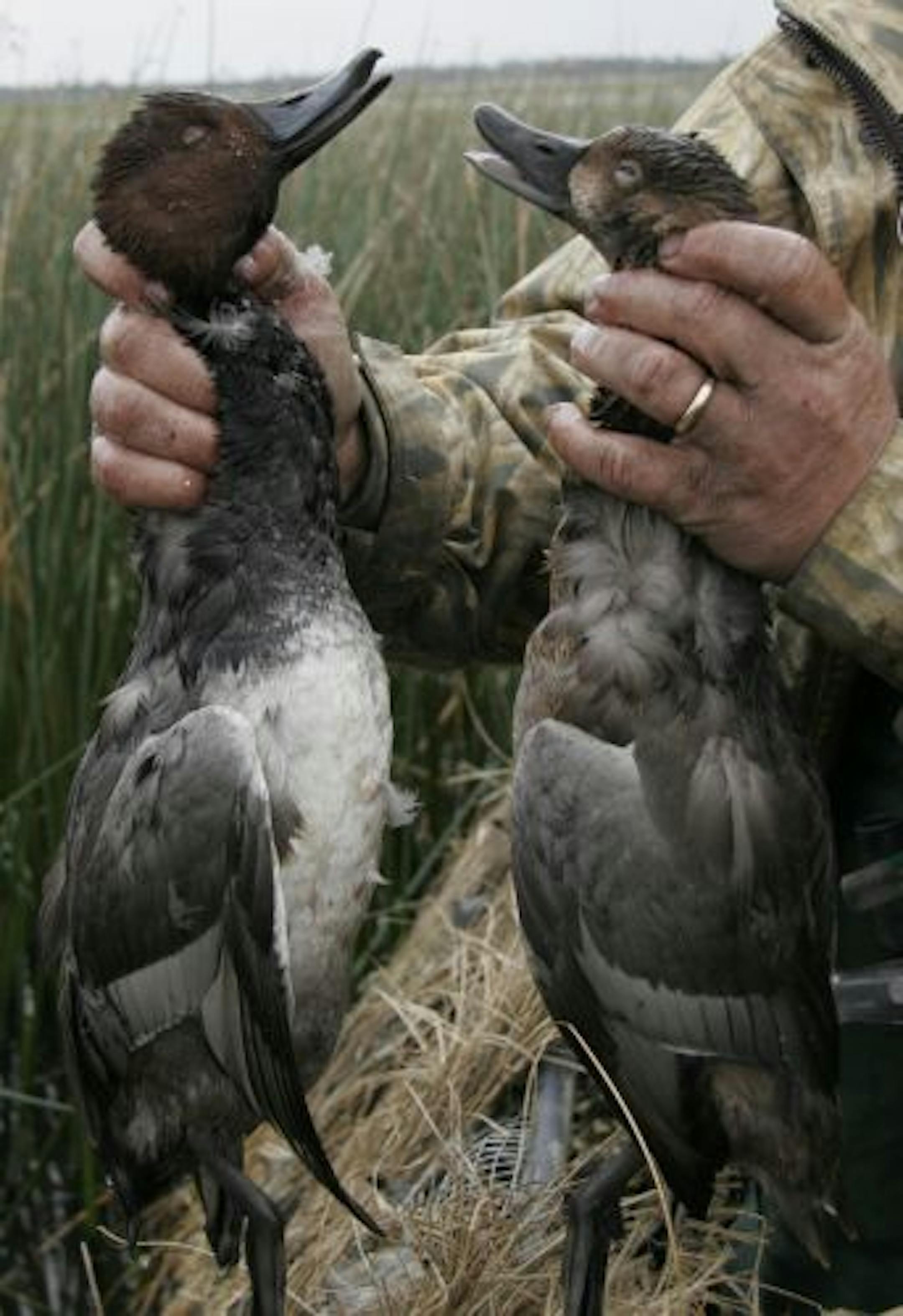
Doug Smith/Star Tribune A drake redhead (left) and a hen redhead (right) were among the ducks bagged by Dennis Simon and his group of hunters on Swan Lake over the weekend.
Swan Lake has long been regarded as one of the top duck lakes in the state, but two neighboring lakes in Nicollet County, Little and Mud, have been dried up after a century of jostling. (Jm -/The Minnesota Star Tribune)

A recent Minnesota Court of Appeals decision stemming from the draining of two important waterfowl lakes in Nicollet County -- not far from the fabled Minnesota duck mecca, Swan Lake -- might be an important steppingstone in state conservationists' attempts to restore duck populations here.

Facts of the case date back a century and involve all the usual players: farmers, a county government whose decisions seem fated to favor farmers, the state's archaic and complex ditch laws, the Department of Natural Resources and -- finally -- a relative handful of stubborn conservationist-hunters who refused to give up.

"This case is so hot down here and has caused so many bad feelings that people try to avoid the subject if they can," said one local resident with conservationist leanings who asked not to be identified.

Carrying the conservation banner -- and paying hefty legal fees (estimated at more than $300,000) over the past six years in an attempt to restore the lakes -- has been the Swan Lake Area Wildlife Association.

Earlier this month, the state Appeals Court largely ruled in favor of the group.

Here's a brief sketch of the very complicated case involving two lakes, Little and Mud (which are connected), which together measure about 800 acres. Or did, until they were drained.

• In 1907, Nicollet County approved the digging of County Ditch 46A and authorized the dredging of Little Lake.

• In 1949, landowners near the two lakes petitioned Nicollet County to improve the ditch. The county agreed and also approved installation of a dam (or weir) at the outlet, at a crest of 973.2 feet above sea level.

• In or about 1966, the dam began to deteriorate and the lakes began to dry up. Subsequently, in 1972, the county asked the DNR, or the forerunner to the present DNR, for permission to install a longer dam. The DNR said OK but required the crest to be 973.8 feet. The DNR also said that "the natural or high-water level of Little Lake is not lower than 976 feet, adding that when the ditch was built it was dredged "at least 1.4 feet deeper and somewhat wider than [the agency] had agreed to."

• The county didn't build a new dam or fix the old one, and both lakes continued to lose water.

• For the next three decades or so, the DNR asked the county to fix the dam. The county didn't. In 2002, the Swan Lake Wildlife Association became involved and offered to pay for the dam. But no one could agree on the dam's elevation.

• Today, the lakes are dry.

• The Swan Lake Area Wildlife Association sued in 2003, saying draining of the lakes violated MERA, the Minnesota Environmental Rights Act, which was enacted in the 1970s.

• In the first decision of the Nicollet County case, the district court ruled in favor of the association, finding that both the county and the DNR violated MERA.

• Everyone involved then filed motions for amended findings or a new trial. The association, in particular, noted that if a 3-foot level of water in Little Lake were to be established, as the district court ordered, the crest level of a new dam would have to be set at 976 feet. In a complicating ruling issued by a second judge (following the death of the judge who ruled initially), the district court amended the original order and deleted the 3-foot depth requirement, instead saying the DNR had sole jurisdiction over the crest level. The judge ordered the county to "complete the outlet control structure in conformity with the 1972 DNR specifications at an outlet elevation of 973.8 feet."

• Everyone again appealed. Importantly, the Swan Lake group argued that the court has jurisdiction under MERA to set the crest level, not the DNR -- an important point because the DNR wanted the original crest level of 973.8 feet upheld (oddly, because it had to know that a crest of that level wouldn't support the desired 3 feet of water).

• • •

Which is where matters sat until Sept. 1, when the Appeals Court issued its most recent decision.

The Appeals Court had two matters to decide: Was the district court in error in its conclusion that it was without jurisdiction to set a crest elevation for the dam on Little Lake? And, was the district court mistaken in finding that the DNR had violated MERA?

The Appeals Court found in favor of the Swan Lake Area Wildlife Association, saying the lower court in fact, under MERA, has jurisdiction over the DNR and could set the crest level for the dam at the outlet of Little Lake.

Reversing the lower court's decision, which said the DNR had sole authority in these matters, the appeals court sent the case back to the district court to determine the proper crest elevation. (The DNR was also cleared of liability in the case; the appeals court said the county alone was culpable under MERA.)

Because at trial, originally, significant evidence was introduced saying that to maximize the lakes' natural resource benefits, their levels would have to be, essentially, 3 feet or thereabouts, the lower court is expected now to -- finally -- give the Swan Lake Area Wildlife Association and, particularly, waterfowl what it and they have long wanted:

Their lakes back.

"This will be considered a landmark decision because now under MERA, any time a unit of government is failing to do its duty -- as the DNR was -- to protect natural resources, individuals or groups can sue under MERA, knowing the court has jurisdiction to protect natural resources and citizens from government failure," said Garry Barnett, a Mankato lawyer who, with attorney William Peterson of Bloomington, tried the case for the Swan Lake Area Wildlife Association.

Added Barnett: "It's been a long time coming."

Dennis Anderson • danderson@startribune.com

about the writer

about the writer

Dennis Anderson

Columnist

Outdoors columnist Dennis Anderson joined the Star Tribune in 1993 after serving in the same position at the St. Paul Pioneer Press for 13 years. His column topics vary widely, and include canoeing, fishing, hunting, adventure travel and conservation of the environment.

See Moreicon