
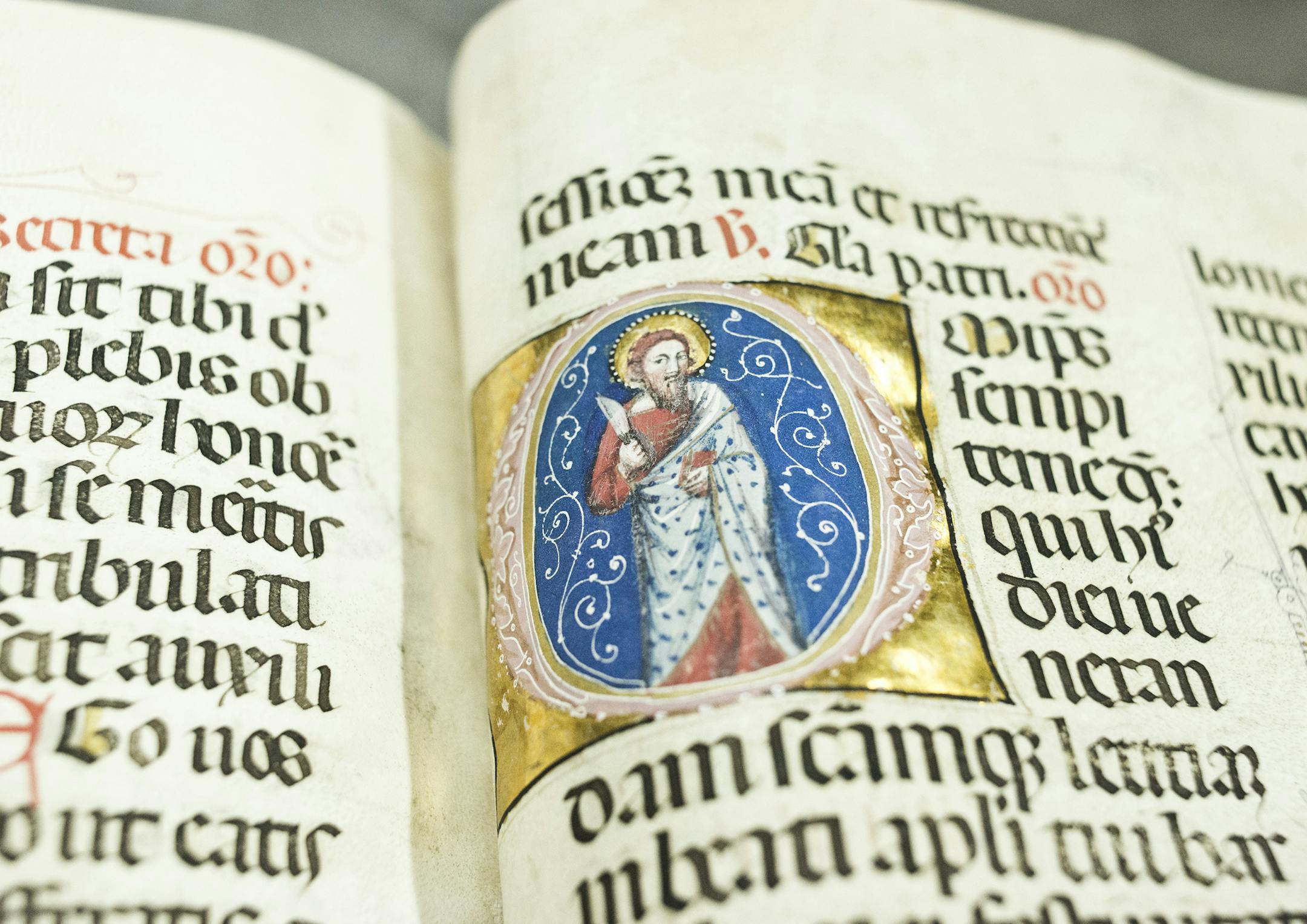
Delicate work to restore St. Francis manuscripts

The medieval manuscripts of St. Francis were restored, parchment by parchment, before they left Italy for the first time in 700 years.

November 21, 2014 at 11:26PM
A detail of manuscript 263 from the Sacred Convent of St. Francis in Assisi, in the restoration laboratory at the Praia Abbey near Padua, Italy, Nov. 5, 2014. A collection of 19 artifacts, which includes 13 manuscripts, that are the most ancient documents of St. Francis’ life and theological tradition, will be at Brooklyn Borough Hall in early January in an exhibition, “Friar Francis: Traces, Words and Images.” (Alessandro Grassani/The New York Times)
A detail of manuscript 263 from the Sacred Convent of St. Francis in Assisi was shown in the restoration laboratory at the Praia Abbey near Padua. (The Minnesota Star Tribune)

TEOLO, Italy – Scattered around the steel table of a monastery in the Veneto region of Northern Italy are manuscripts, one with green, red and intensely blue medieval miniatures of dragons, another adorned with ornate leaves culminating in golden flowers.

A monk gently lays an off-white leather book on the table, and opens it at a long letter A drawn in red ink, the start of a paragraph in gothic letters.

"I never I thought I would have had these in my hands," said the Rev. Pierangelo Massetti, responsible for the restoration laboratory at the Praia Abbey, near Padua. "St. Francis wrote this poem. And this text may be the foundation of the Italian language, the first text ever known in vernacular."

Massetti and his collaborators finished restoring the medieval manuscripts from the Sacred Convent of St. Francis in Assisi before they left Italy for the first time in 700 years. The documents are being shown at the U.N. headquarters until Nov. 28, and then will be open to the public in Brooklyn Borough Hall until mid-January.

The signature of the saint of the poor and neglected, who inspired Pope Francis to choose his name, is nowhere to be seen. Historians agree that he most likely dictated his writings. However, these 19 artifacts are the most ancient documents of St. Francis' life and theological tradition.

St. Francis, born the son of a wealthy cloth merchant in Assisi, chose to give up his prosperous, worldly life and live in poverty, preaching peace and respect for all forms of life.

For this manuscript, the challenge was to restore the original cover, in 13th-century wood covered in goat leather, and then reconstruct the missing fragments, like the spine and the borders, Massetti said. Over the past five months, Massetti, two other monks and three young restoration experts have cleaned all the manuscripts with a paintbrush, page by page.

In some, the medieval ink had perforated the page; in others it had faded. Five of the manuscripts, ranging from the size of a choral book to the pocket format, were unbound, parchment by parchment, and were finally reassembled and stitched back together with a linen thread.

As Massetti prepared to ship the manuscripts across the ocean, he confessed he had had a few agitated months. Restoring the manuscripts was both a professional responsibility and a matter of security for him. "I know it's under my responsibility here," Massetti said. "There is an estimated value, but should they go lost it would be an inestimable loss, impossible to pay back."

New York Times

A restorer works on manuscripts from the Sacred Convent of St. Francis in Assisi, in the restoration laboratory at the Praia Abbey near Padua, Italy, Nov. 5, 2014. A collection of 19 artifacts, which includes 13 manuscripts, that are the most ancient documents of St. Francis’ life and theological tradition, will be at Brooklyn Borough Hall in early January in an exhibition, “Friar Francis: Traces, Words and Images.” (Alessandro Grassani/The New York Times)
The longest restoration work was on Manuscript 328, which interprets the Rule of St. Francis and the poverty of Christ. (The Minnesota Star Tribune)
about the writer

about the writer

More from No Section

See More
FILE -- A rent deposit slot at an apartment complex in Tucker, Ga., on July 21, 2020. As an eviction crisis has seemed increasingly likely this summer, everyone in the housing market has made the same plea to Washington: Send money — lots of it — that would keep renters in their homes and landlords afloat. (Melissa Golden/The New York Times) ORG XMIT: XNYT58
Melissa Golden/The New York Times

It’s too soon to tell how much the immigration crackdown is to blame.