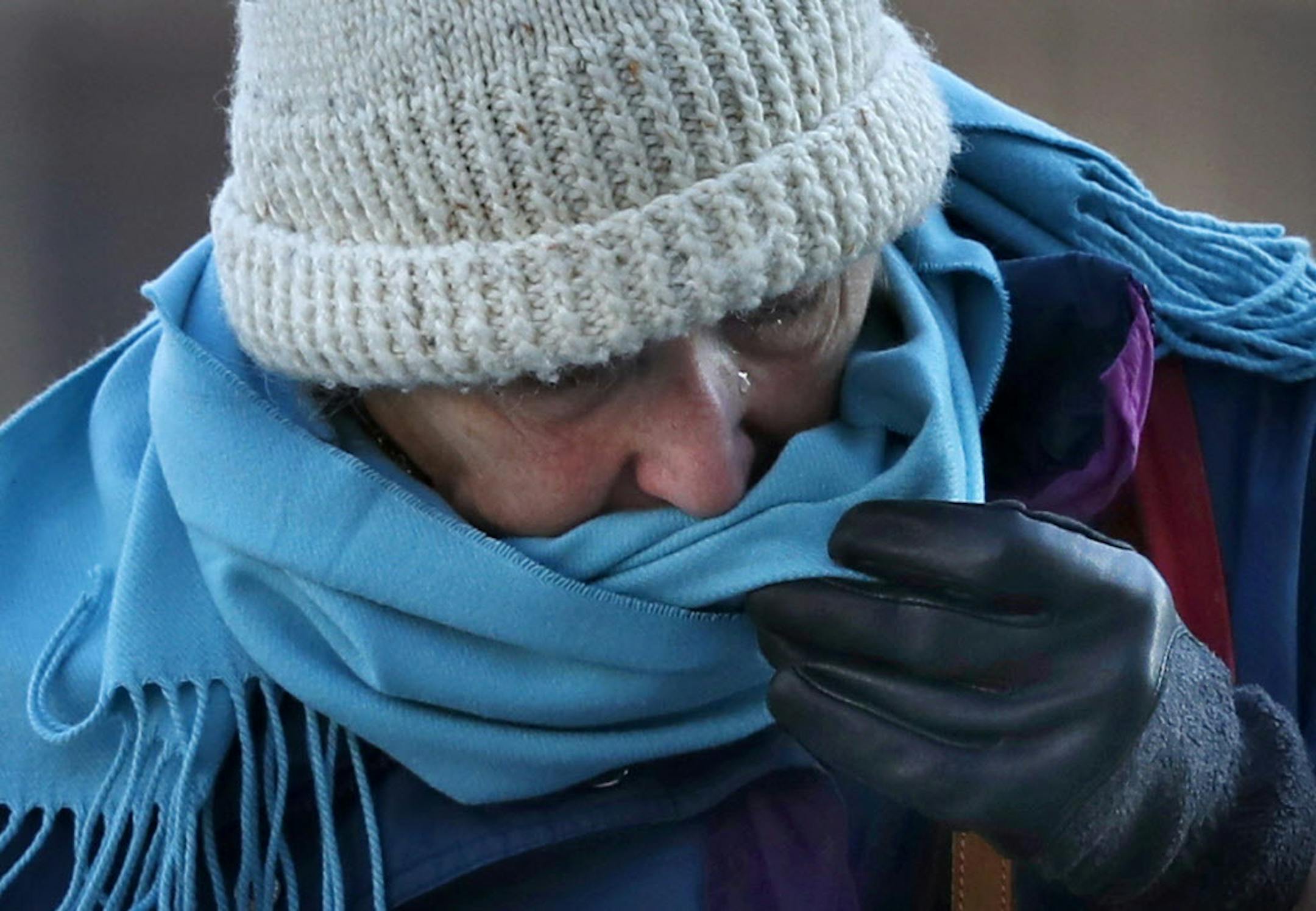
A deep freeze is about to descend on North America, Europe and Asia thanks to record high temperatures across the Arctic.
How's that? "Think of it like a seesaw," said Matt Rogers, president of Commodity Weather Group in Bethesda, Md. If winter temperatures rise north of Alaska, that "forces an equal-opposite downward-southward push. The cold essentially has to go somewhere else."
Meteorologists theorize the phenomenon works this way: Warmth in the northern polar region helps lock in jet-stream kinks that drag cold air south and sets up conditions that weaken the polar vortex, the pressure zone that usually traps the chill in the northernmost part of Earth. Frigid thermometer readings are, as a result, delivered to the Northern Hemisphere. So, warm Arctic, cold continents.
Forecasts show how drastic it could be. For example, Chicago's high on Monday is expected to be 43 degrees and its low 33, according to MDA Weather Services in Gaithersburg, Md. By Friday, the high is predicted to be 18 and the low just 5. Temperatures next week are expected to be well below normal over nearly all the United States, except Florida.
In the Twin Cities, next week's forecasts call for cold, but not record-breaking cold, with highs in the single digits above zero and lows in the single digits below zero from Wednesday through Saturday.
Climate change and the recently ended El Niño conspired over the past three years to heat the planet to record levels. The ice cap dwindled. In September it was the smallest in scope since 2007; its winter growth has been the slowest in chronicled history.
Sea ice keeps the air above it cold, and in November in the Arctic it hit a record low, according to the National Oceanic and Atmospheric Administration. For several weeks, as consequence, a large part of the Arctic has been hotter than normal.
"We have a buoy north of Alaska that went over to freezing around the 10th of December, which is about a month later than it normally happens," said Jim Overland, a research oceanographer at the U.S. Pacific Marine Environment Laboratory in Seattle, who made his first trips to Arctic ice in the 60s.