

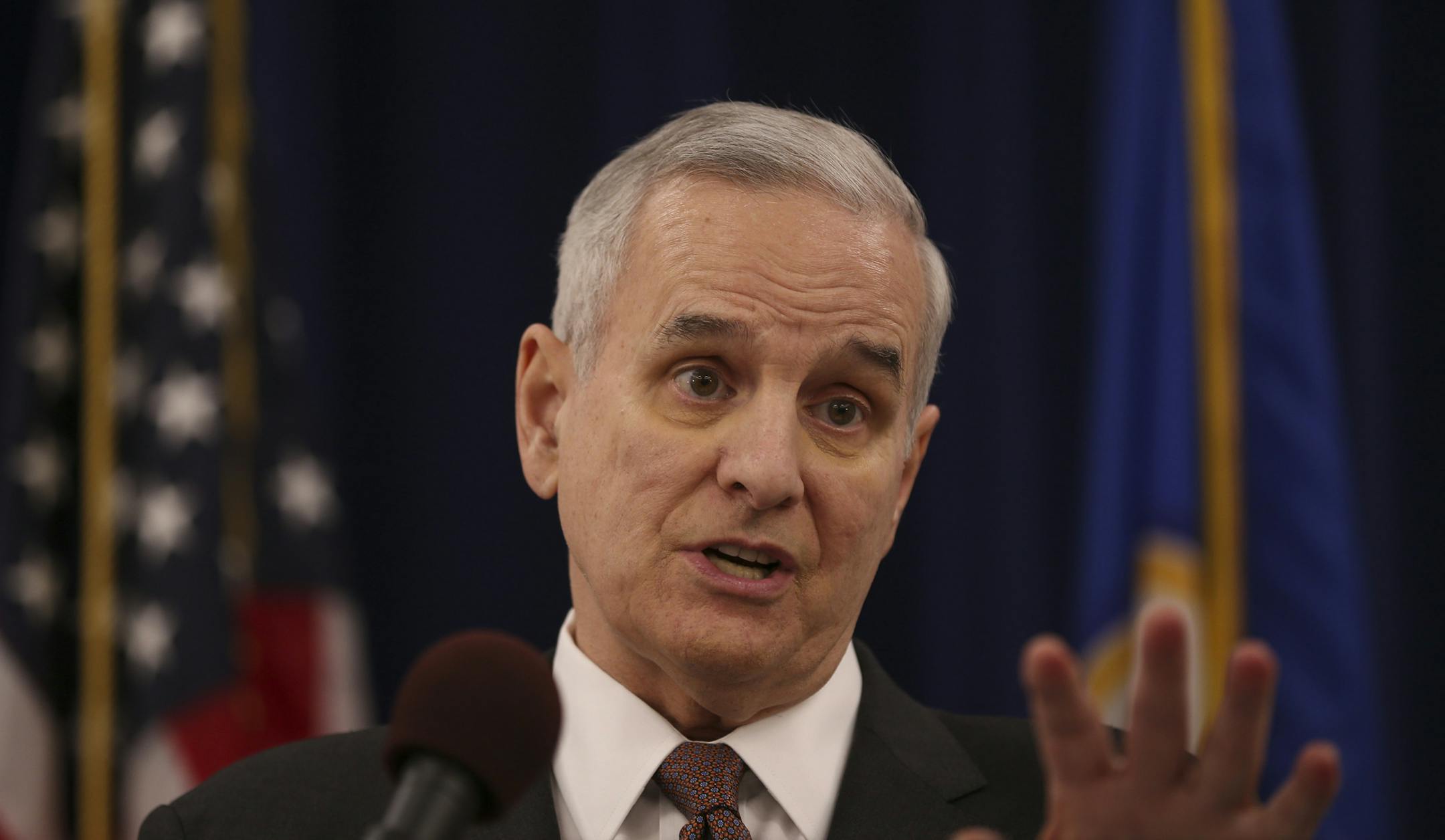
Gov. Mark Dayton on Saturday directed state employees not to travel to North Carolina for nonessential business, citing what he called "appalling" legislation requiring transgender people to use bathrooms based on their gender at birth.
"I am proud of Minnesota for the progress we have achieved to protect the rights and dignity of all people in our state," Dayton said in a prepared statement. "When the rights of some Americans are threatened, it is the responsibility of all Americans to stand in opposition to those discriminatory acts. Therefore, I have instructed employees in all state agencies to refrain from traveling to North Carolina for conferences or other official state business, until the North Carolina governor and State Legislature repeal the discriminatory law they enacted [on March 23]."
Dayton pledged to veto any similar legislation in Minnesota should it reach his desk.
As a result of the governor's directive, Metro Transit said Saturday that it will cancel plans to send some employees to the American Public Transit Association Conference and International Bus Roadeo, an annual convention to be held in Charlotte, N.C., this May.
The roadeo is a training opportunity for bus operators and maintenance teams, who compete against drivers from other cities.
Metro Transit is a state agency governed by the Metropolitan Council. "We fully support the governor's decision and will immediately take steps to adhere to that," said Metro Transit spokesman Howie Padilla.
Dayton previously considered a travel ban to Indiana following passage in that state of the Religious Freedom Restoration Act in March 2015, which allowed businesses to discriminate against gay clientele based on their faith beliefs. He dropped that idea after Indiana clarified the law so that it did not allow discrimination.
The North Carolina Legislature recently called a special session to void a Charlotte ordinance that would have enabled transgender people to legally use restrooms aligned with their gender identity, and would have provided broad protections against discrimination in public accommodations in the state's largest city.
![Gov. Mark Dayton during his news conference Thursday afternoon in the Veterans Service Building in St. Paul. ] JEFF WHEELER ï jeff.wheeler@startribune.com Gov. Mark Dayton held a news conference Thursday, March 3, 2016 to comment on the decision by the State of Minnesota that the 10-year environmental review of Minnesota's first proposed copper nickel mine is adequate, clearing the way fro the next critical steps in PolyMet's $650 million project ñ setting financial assurance and permi](https://arc.stimg.co/startribunemedia/ARE3TSGL4C5X53HA2X6DZJAWTU.jpg?&w=1080)


