

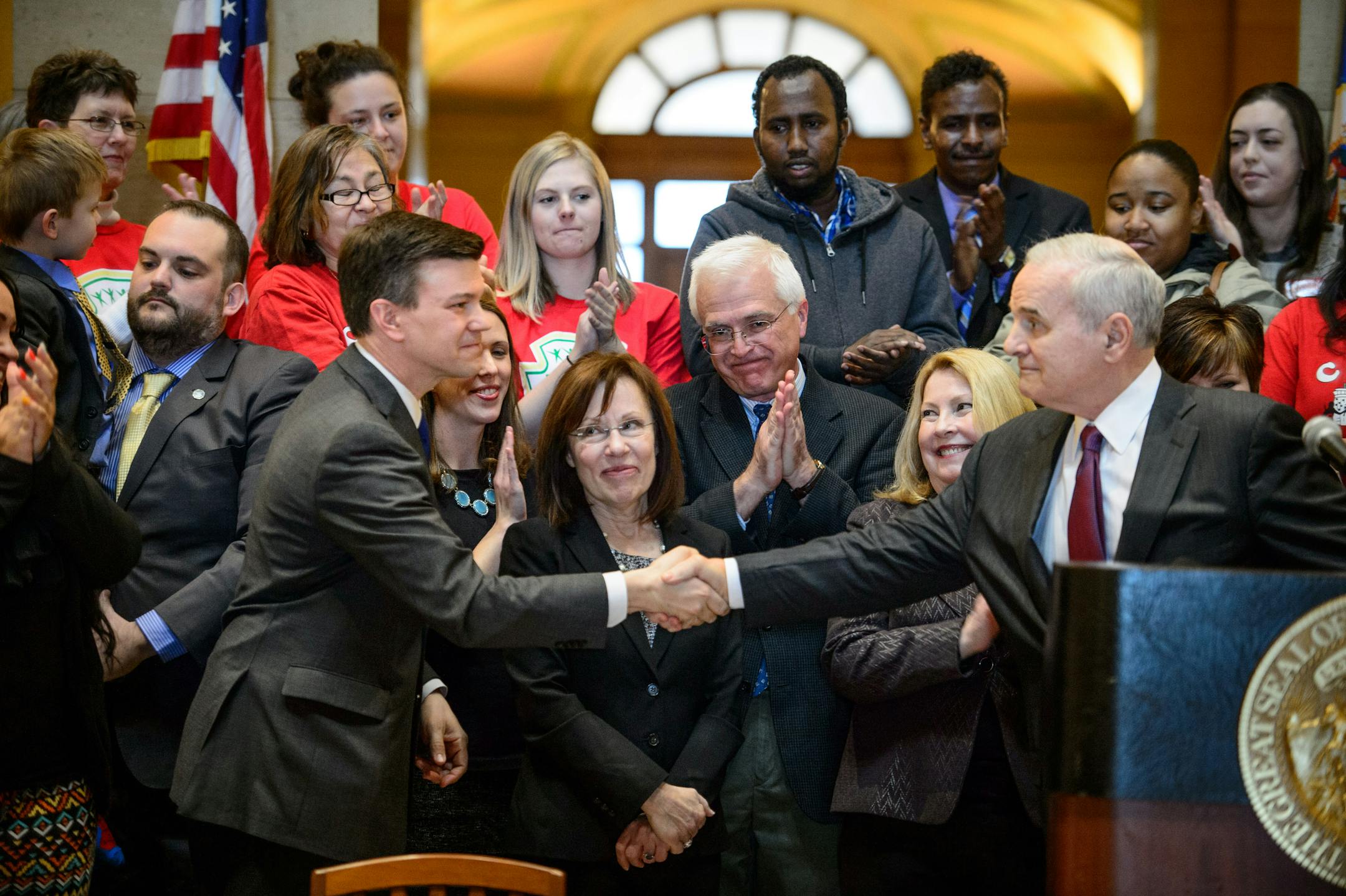
DFL Gov. Mark Dayton signed into law a dramatic increase in the state's minimum wage Monday, giving raises to more than 325,000 Minnesotans.
The new $9.50 base hourly wage takes the state from having one of the lowest minimum wages to one of the highest when it fully kicks in by 2016.
"Minnesotans who work full-time should be able to earn enough money to lift their families out of poverty, and through hard work and additional training, achieve the middle-class American Dream," said Dayton, surrounded by legislators, labor and labor leaders at a ceremonial bill signing in the State Capitol rotunda. "Raising the minimum wage to $9.50, and indexing it to inflation, will improve the lives of over 325,000 hard-working Minnesotans. I thank the Legislature for recognizing the need to make work pay in Minnesota."
Minnesota's dramatic wage increase puts the state at the forefront of a major initiative of President Obama, who has failed to persuade Congress to raise the federal minimum wage to $10.10 and instead focused on pressing his case state by state.
The state's higher minimum wage has angered Republicans and business leaders, who say the higher wage will force them to lay off workers and become a drag on the fragile economic recovery.
"We believe that all Minnesotans deserve the dignity of supporting themselves and their families through hard work," said state Rep. Ryan Winkler, a Golden Valley DFLer who was a chief negotiator of the minimum wage effort. "Raising the minimum wage and indexing it to inflation is an important step to create a rising floor for all wages that will benefit hundreds of thousands of Minnesotans who work hard and deserve to get ahead."
At $6.15 per hour, Minnesota has one of the lowest minimum wages in the nation, lower than neighboring Wisconsin, Iowa, North Dakota and South Dakota. Minnesota is one of only four states with a minimum wage below the national rate of $7.25 per hour.
State officials estimate that the $9.50 base wage will put an additional $472 million in the pockets of Minnesota's lowest-wage workers each year. Supporters say the increase in consumer spending is expected to help local businesses in communities across our state, and provide another boost to Minnesota's growing economy.


