

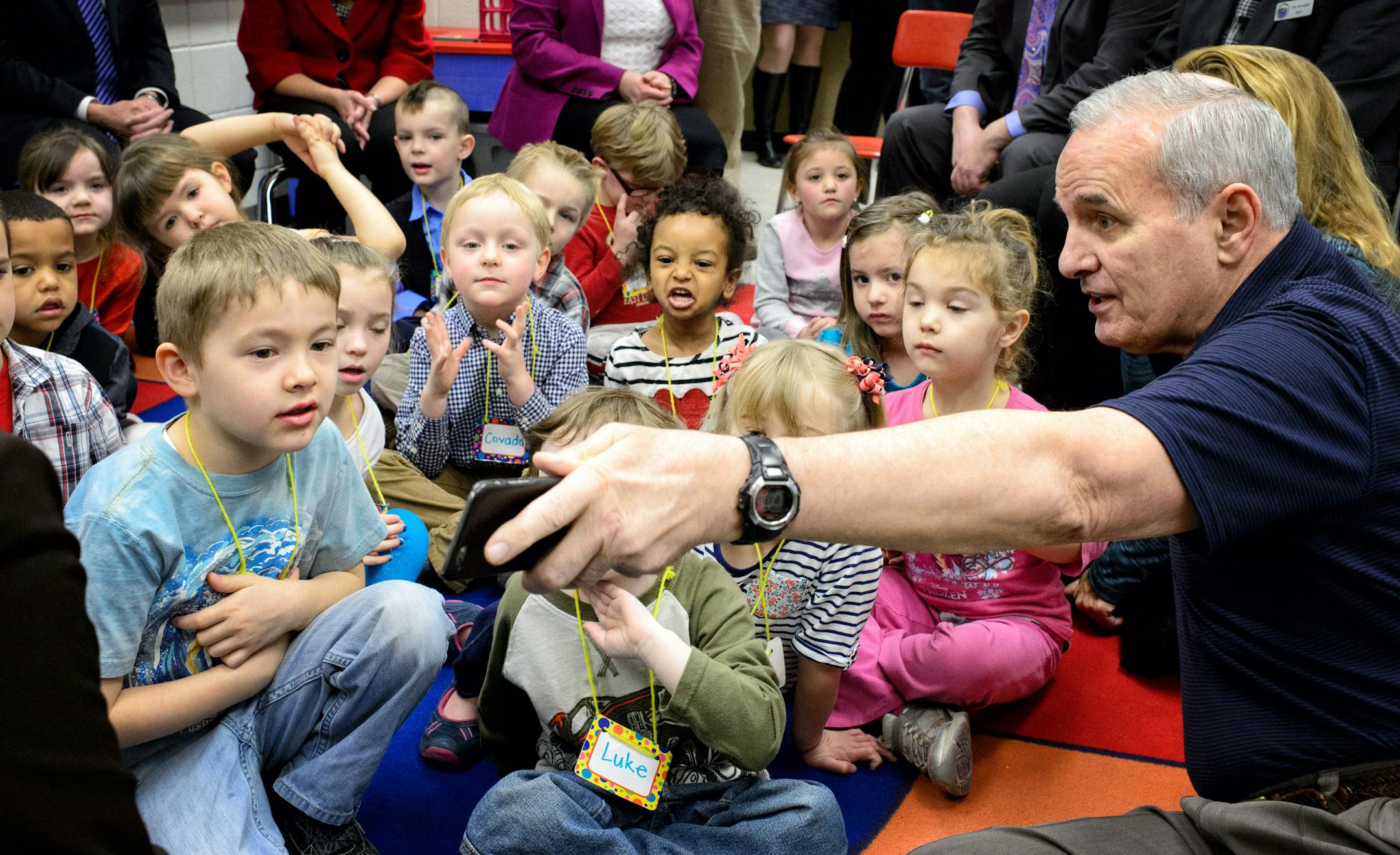
Crouching and sitting on a classroom floor, Gov. Mark Dayton mingled with four-year-olds Friday as he made a pitch for a hefty state spending increase for universal access to preschool in Minnesota.
"You look like you're 65," observed one little boy. "Close. I'm 68," said Dayton, who interacted with kids for about 20 minutes as they sat in a group and later worked on iPads.
Dayton wants lawmakers to approve $348 million in new state spending so that every public school in the state could provide such classes. It's the biggest single general fund spending increase Dayton has proposed this year, and comprises about a fifth of the state's projected $1.9 billion budget surplus.
The group of about 15 children in the pre-kindergarten class at Newport Elementary School were well-behaved despite an unusually large crowd of adults accompanying the governor -- aides and security, area state legislators, school district officials and reporters. Their teachers later said the good showing by the kids was a testament to the benefits of early learning.
"We notice a huge difference between students who do pre-K and those who don't," said Brittany Vasecka, a pre-kindergarten teacher at the school. The classes are half-day and run five days a week.
In all, 80 percent of students in the South Washington County district attend pre-kindergarten classes, district officials said. Under Dayton's proposal, both districts that already provide pre-kindergarten classes and those that don't would both be recipients of the money.
"I don't think we should penalize the school districts that have made this commitment," Dayton said.
But some education advocacy groups have jumped on that lack of a distinction. On Thursday, a business-backed nonprofit called Parent Aware for School Readiness released an analysis contending that about 70,000 low-income kids between birth and age 3 could have access to needed early learning programs if about $100 million less were to be spent on the universal preschool initiative.


