

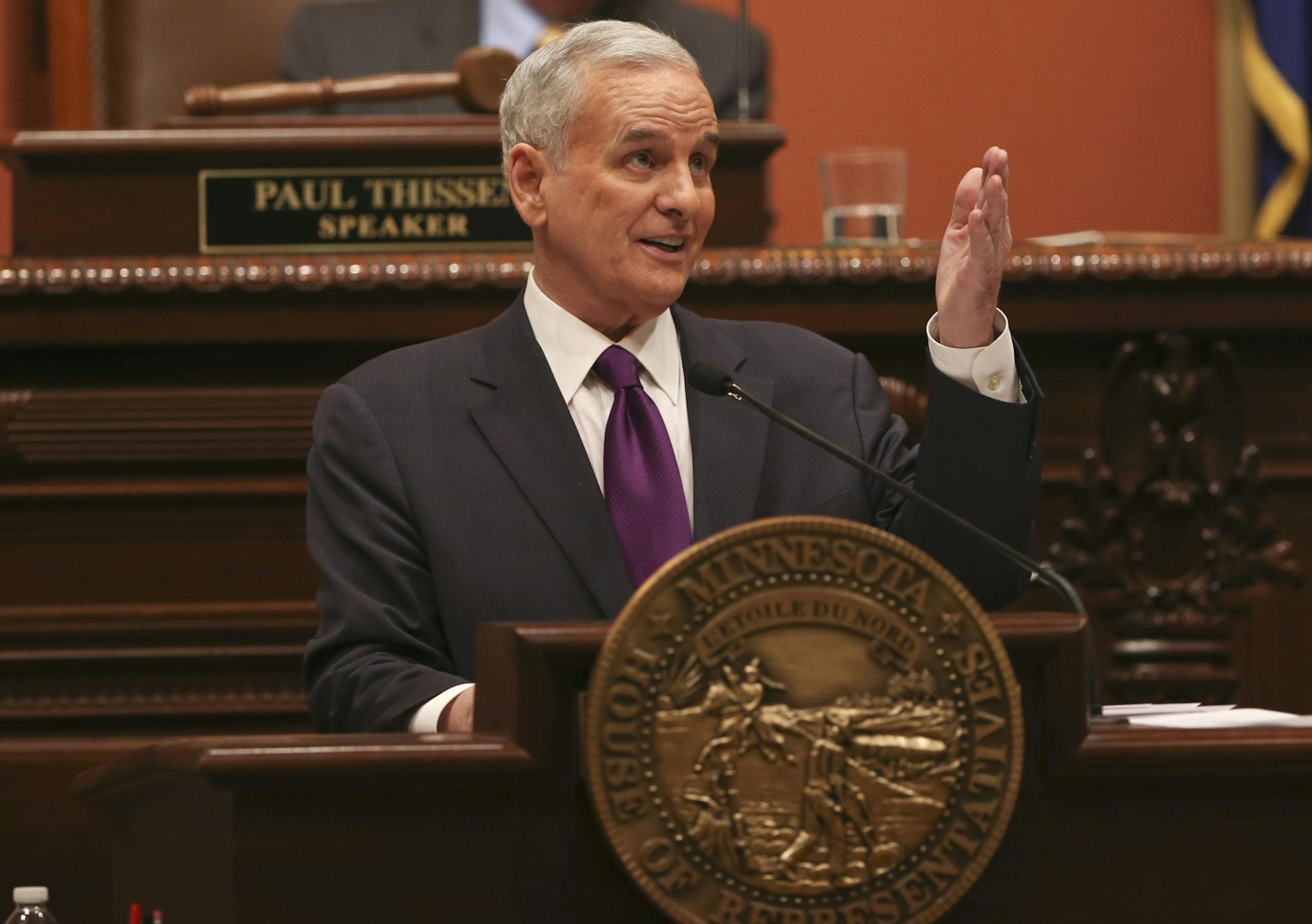
Minnesota's gubernatorial bully pulpit is well-employed when it helps citizens see and prepare for the future. Gov. Mark Dayton did a goodly amount of that kind of preaching in his third State of the State address Wednesday night as he pleaded for renewed investment in education.
"The old order doesn't show any signs of coming back," the DFL governor said. "Our state and our nation are engulfed by the new global economy. We either act now to move ahead, or let ourselves fall behind."
Dayton made his prescription for moving ahead on Jan. 22, in a budget proposal that has rightly encountered considerable resistance -- including from this page -- for its uncompetitive proposal to apply the sales tax to business-related services. He acknowledged the furor, and -- perhaps tellingly -- declined to defend that flawed aspect of his budget plan. Instead, he signaled willingness to entertain other ideas.
"Plan A is the one I have proposed, or something close to it. Plan B is to stick with our current tax structure, or something close to it. Plan C is something better. No one would be happier than me to see a good Plan C," he said.
We'll be offering just such a plan in the weeks ahead. Legislators and other Minnesotans should take him up on that offer, too, and help craft an alternative budget that omits his economically disruptive overreach on business sales taxes.
As they do, they should not lose sight of the future that Dayton described. As state economist Tom Stinson told a legislative panel this week, the new economy will require a better-educated, more-productive workforce than Minnesota has been producing in recent years.
Dayton made the case that lagging education spending, particularly for higher education, is putting Minnesota at competitive risk. He noted that by one measure, Minnesota's higher-education spending ranks 32nd among the states, and that when adjusted for inflation, this year's state postsecondary spending is lower than at any time since 1980-81. Higher tuition and rising student debt have been the result.
"Does anyone believe that continuing to reduce our commitment to higher education is the path to a better Minnesota?" Dayton asked.


