

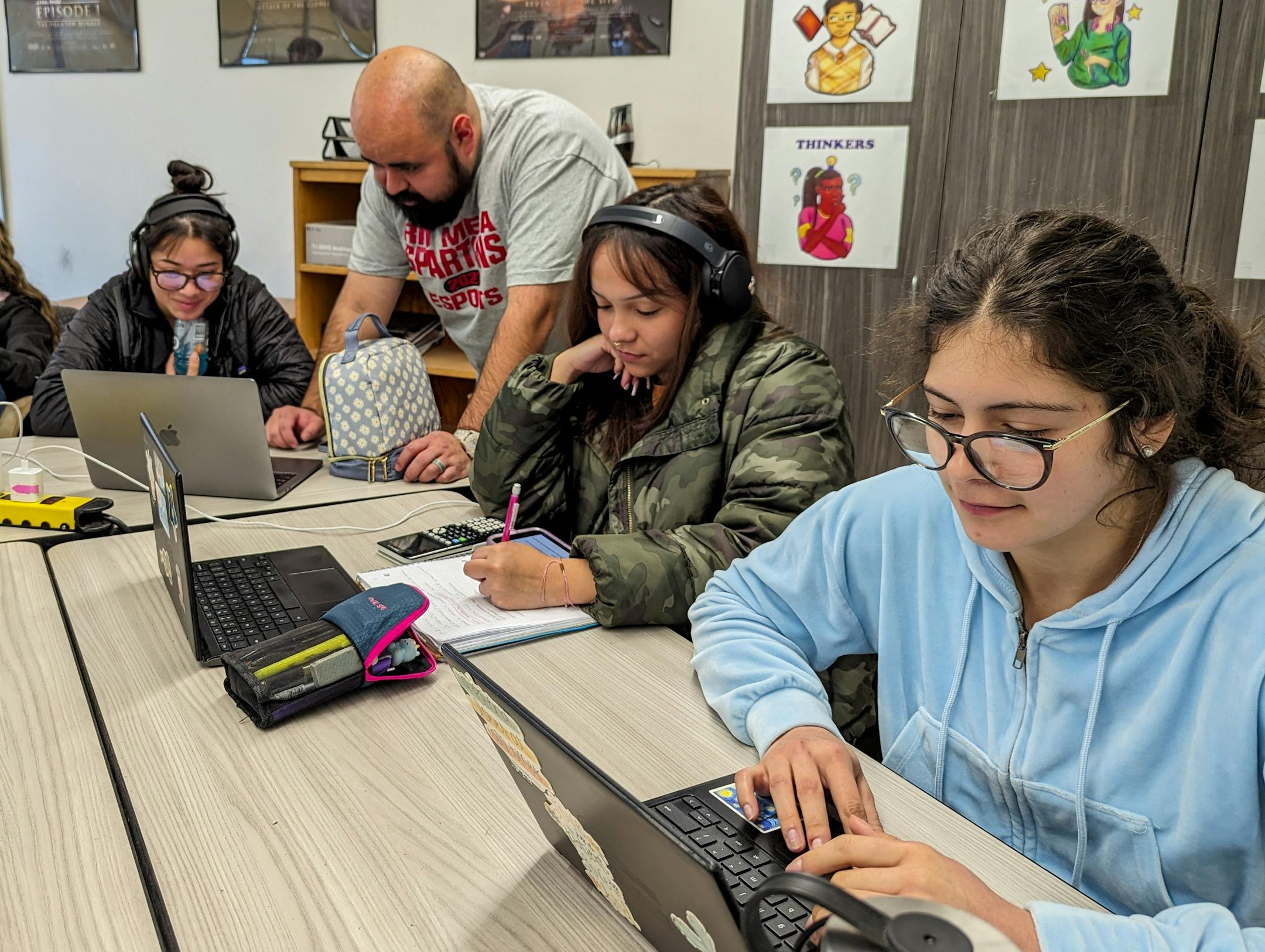
OXNARD, Calif. - On a Wednesday morning in December, Dale Perizzolo’s math class at Adolfo Camarillo High School is anything but quiet. Students chat about the data analysis they’ve performed on their cellphone usage over a week, while Perizzolo walks around the room fielding their questions.
The students came up with the project themselves and designed a Google form to track their phone time, including which apps they used most. They also determined the research questions they’d ask of the data - such as whether social media use during class reduces comprehension and retention.
“It’s more real-world math,” said Nicolas Garcia, a senior in Perizzolo’s class. “We have the chance and freedom to choose what we’re doing our data sets on, and he teaches us how we’re going to work and complement it [in] our daily lives.”
Perizzolo is one of eight math teachers of an increasingly popular data science course offered at most schools in the Oxnard Union High School district, an economically diverse school system northwest of Los Angeles, where 80 percent of students identify as Hispanic. The district rolled out the class in fall 2020 in an attempt to offer an alternative math course to students who might struggle in traditional junior and senior math courses such as algebra II, pre-calculus and calculus.
California has been at the center of a heated debate over what math knowledge students really need to succeed in college and careers. With math scores falling nationwide, some educators have argued that the standard algebra-intensive math pathway needs a revamp, both to engage more students and to help them develop relevant skills in a world increasingly reliant on data. At least 17 states now offer data science - an interdisciplinary field that combines computer programming, math and statistics - as a high school math option, according to the group Data Science for Everyone. Two states, Oregon and Ohio, offer it as an alternative to algebra II.
But other math educators have decried a move away from algebra II, which they argue remains core to math instruction and necessary for students to succeed in STEM careers and beyond. In California, that disagreement erupted in October 2020, after the group that sets admission requirements for the state’s public university system (known as A-G) announced it would allow students to substitute data science for algebra II to help more students qualify for college. Math professors, advocates and even some high school educators argued that the state was watering down standards and setting students up for failure in college.
Then last July, the group reversed its earlier decision, and in February released new recommendations saying that data science courses (and to the surprise of some experts, even long-approved statistics classes) cannot be used as an alternative to algebra II. It remains unclear how the decision will reshape college admissions; additional guidance is expected in May.
In Oxnard, educators say they have been left in the dark about how these decisions affect course offerings for their students. They argue that, more than ever, students need real-world math to help them succeed in the subject. They say the expansion of data science - some 500 Oxnard district students have taken it to date - has reoriented teachers’ and students’ approach to math.


