

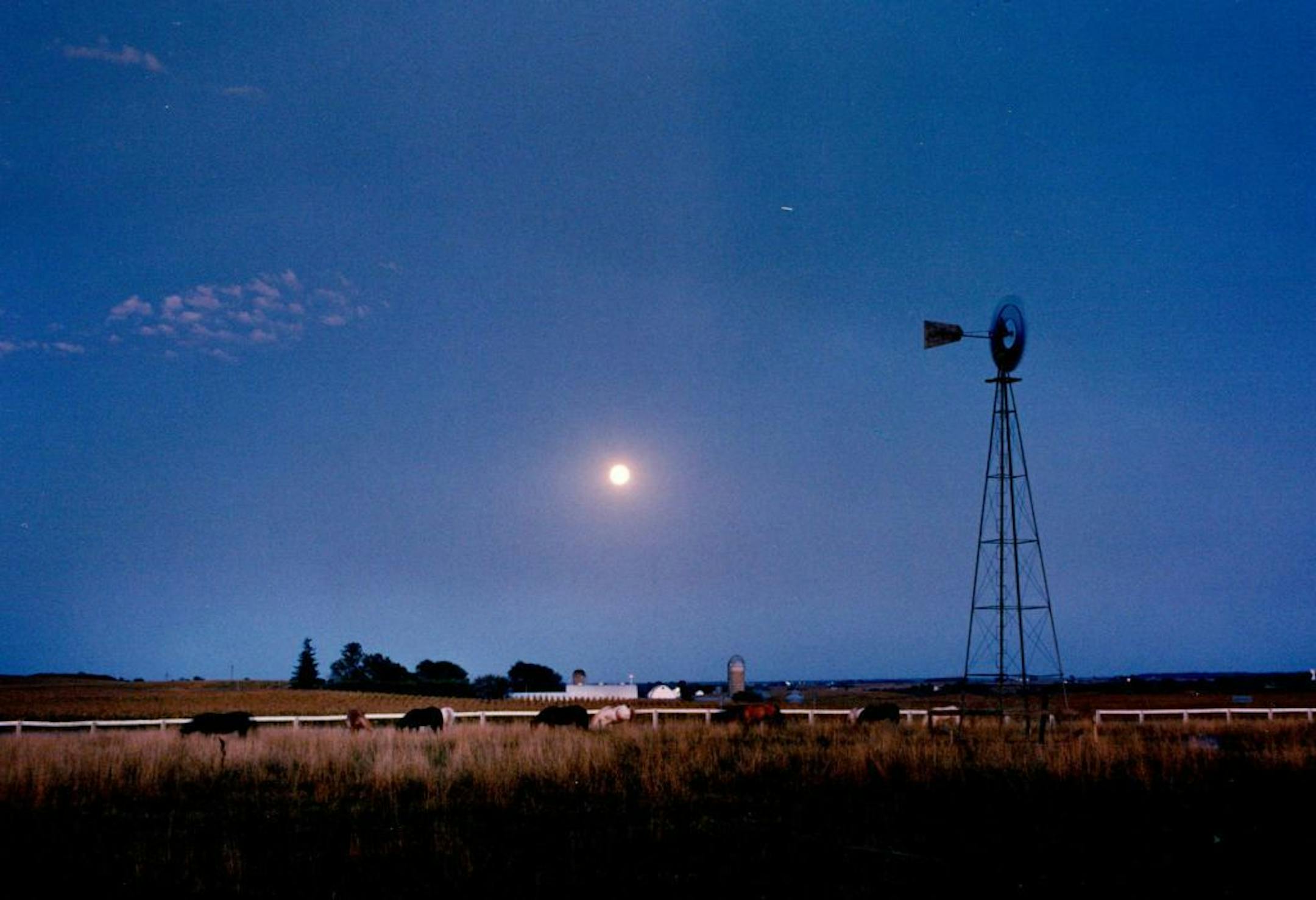
The summer night is the best time of the best time of the year.
Nothing against the summer day, that lovely, green, hot embrace beneath a breathtakingly blue sky that proves to us that Minnesota is not a land of perpetual snow and ice. Without summer days we would be bereft, and perhaps unhinged.
But I love the summer night better. The summer night is, to state the obvious — though it is not, as I will explain, obvious at all — dark. But this darkness is not the same everywhere. We live in the country, close to the cities but not of them. In the country, the summer night is different, darker and quieter. Except when it is lighter and noisier.
We built our house 15 years ago, on five acres of former pastureland in Grant, which used to be known as Grant Township and is now formally the City of Grant, though most people who don't live here have never heard of either. It's a funny name. Grant is anything but a city. It's a rural oasis holding out among the ever-expanding suburbs. We get our mail from Stillwater. A neighbor still cuts hay on our property and others nearby, and I can see several barns from the window in the room where I write. The livestock are gone now, but the hay bales dot the landscape through the summer and into the fall, and as long as they do I'm calling this country.
Our land is near the top of a high, steep ridge that runs from west to east along the southern border of Hugo and then turns sharply to the south, crossing Country Road 7 and curling into Grant. The house is aligned on its long axis with the North Star and looks, from our back deck at the end of the day, directly west to the setting sun. In the mornings, from our bedroom window, we can see the sunrise glinting off the IDS building and lighting up the Minneapolis skyline thirty miles away. This is our view. And because it is high and unobstructed, we can see the edge of the world, the horizon that reminds us that our environment is mostly sky.
The summer night here is short and sweet. As I write this, the times of sunrise and sunset have scarcely changed since the solstice on June 21. The sun came up this morning at 5:31 a.m. It will set a few minutes after 9 p.m. this evening. The purpling dusk will linger another hour. Just six hours later the first light will show in the east.
Sunsets are almost always gorgeous, even on cloudy days and sometimes especially on cloudy days, when the sullen sky reddens and seems almost afire before it fades. For the past few weeks we've had many clear nights and a ringside seat to not only the setting sun but also the setting of two planets — Jupiter, glittering and remote, and Venus, the brightest object in the heavens after the sun and the moon. Venus, which orbits closer to the sun than the Earth, is never seen far above the horizon or for more than a couple of hours before sunrise or after sunset. In late June this year, it nudged close to Jupiter in the western sky, just as the thin crescent of the waxing moon appeared close by.
What comes after the sun is down and the twilight is gone depends. Night in the country is truly dark as it is not in the city, where ambient light pushes back against the night. Here there are no streetlights, no tall, glossy buildings burning their lights all night, no houses near enough to be more than pinpricks of light in the distance. The occasional car wandering along County Road 7 slides though a long curve to the west of us like a firefly hugging the ground.

