Rain pelting our faces, my husband, Tom, and I dove into a flimsy bus stop shelter and squeezed our bicycles in after us. We had been battling a fierce headwind since breakfast and, at 3 o'clock, were still several kilometers from our destination. Dark clouds raced across the sky. The drumbeat of raindrops on the shelter intensified.
We were holed up in a subdivision of tidy brick houses outside Riesa, Germany, where small saplings planted in the new yards bent with the wind. We had no choice but to continue to Riesa: Our suitcases awaited us. I was cold and wet, nearly cashed in. We had cycled only 15 miles.
Tom rifled through his front pack, looking, I thought, for a map. He straightened up, a triumphant grin on his face. "Time for Emergency Chocolate," he announced, and produced a Ritter Sport special dark bar.
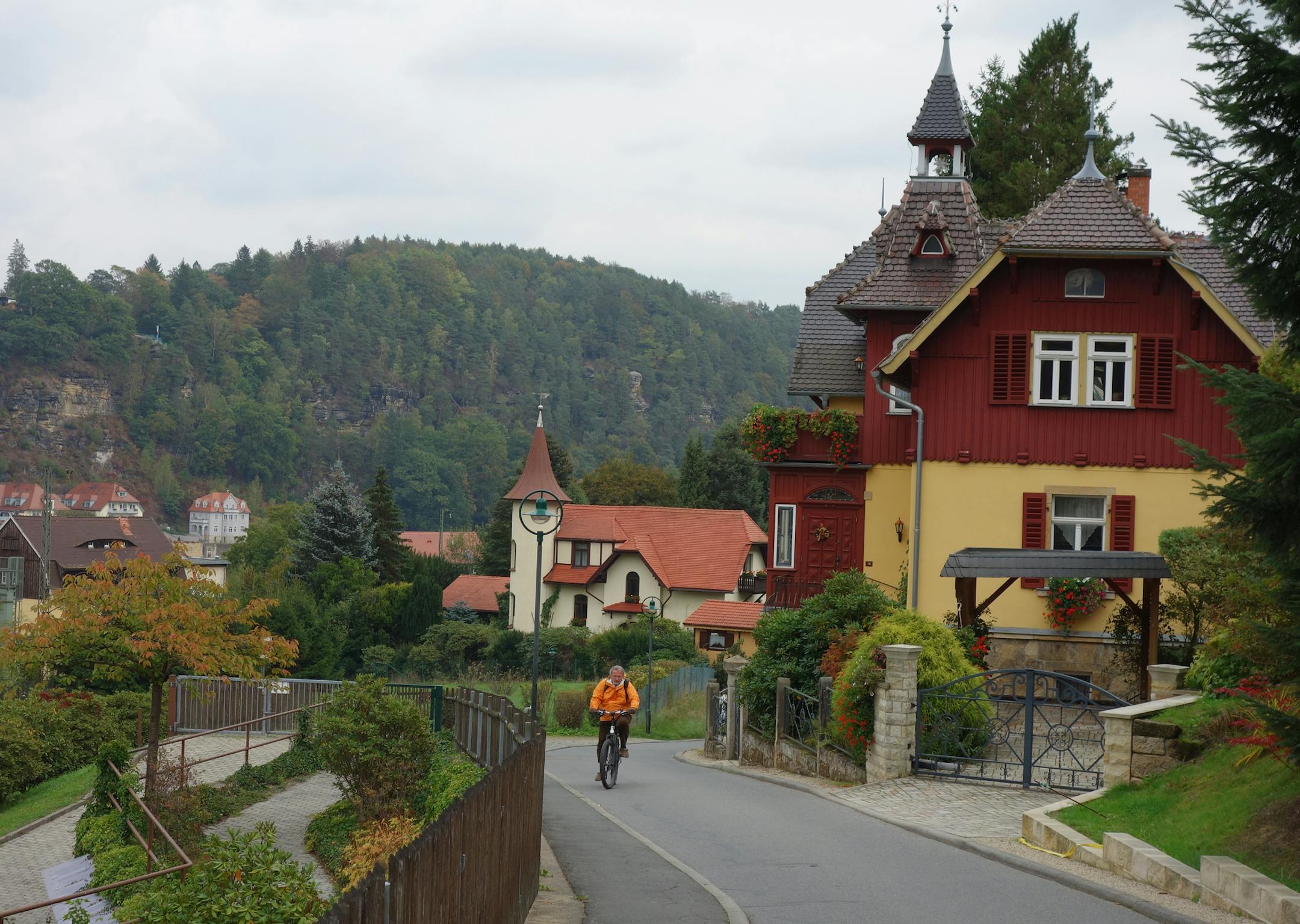
Tom and I were on a six-day, 150-mile bicycle trip in early October, tracing the legendary Elbe River that cuts a shimmering swath through the southeastern German provinces of Saxony and Saxony-Anhalt. The Elbe Radweg is mostly off the radar of American cyclists, but it is Germany's most popular route in a country full of paved bike trails. We had begun in historic Dresden. Broad and slow-moving, the Elbe originates beyond the Czech border and flows north, through Dresden, Meissen, Lutherstadt-Wittenberg, and farther north, Germany's major port, Hamburg, before emptying into the North Sea. The river looked exhausted after Europe's hot, dry summer. We could see cobbles protruding on its margins. Low water levels prohibited large boat traffic on the upper Elbe. We would be on paved paths nearly the entire way, and could see up close the river and the many migrating waterfowl resting on its waters. Outside Dresden, there were a dozen mute swans, strung in a row, white pearls on the blue water.
We met Hans, representative of Rueckenwind Radtouren, at our Dresden hotel. He handed us our rental bicycles, sturdy conveyances with upright handlebars, front packs and back panniers, locks and odometers. I fell in love with my bike the first morning. The gear ratio was excellent and nothing fazed the stoic chain, not even the occasional bobble of cobblestone streets. We received maps, a travel guide to the towns we'd be cycling through, and directions to each hotel that Rueckenwind had booked for us. Rueckenwind would shuttle our bags between hotels. We would carry the minimum: a rain jacket, wallets, water and binoculars. We hoped to see not only geese and ducks, but hawks on the wing and songbirds in the woods. Hans told us that the Elbe was a fall migration flyway.
Perks of a slow, bicycle pace
Our first day of cycling was a trial run upriver to the medieval town of Pirna. We wanted to get the feel of the bikes, and see the Elbe cutting through a sandstone layer, creating high bluffs and a much different feel. The honey-colored sandstone blackens upon exposure to air; the cliffs appeared ancient. They echoed the weathering we'd seen on the restored Frauenkirche, Semper Opera House and Albert Bridge in Dresden. Those structures were built with locally quarried stone. It's easy to discern detail with the slow pace of a bicycle. We began to point out other sandstone structures.
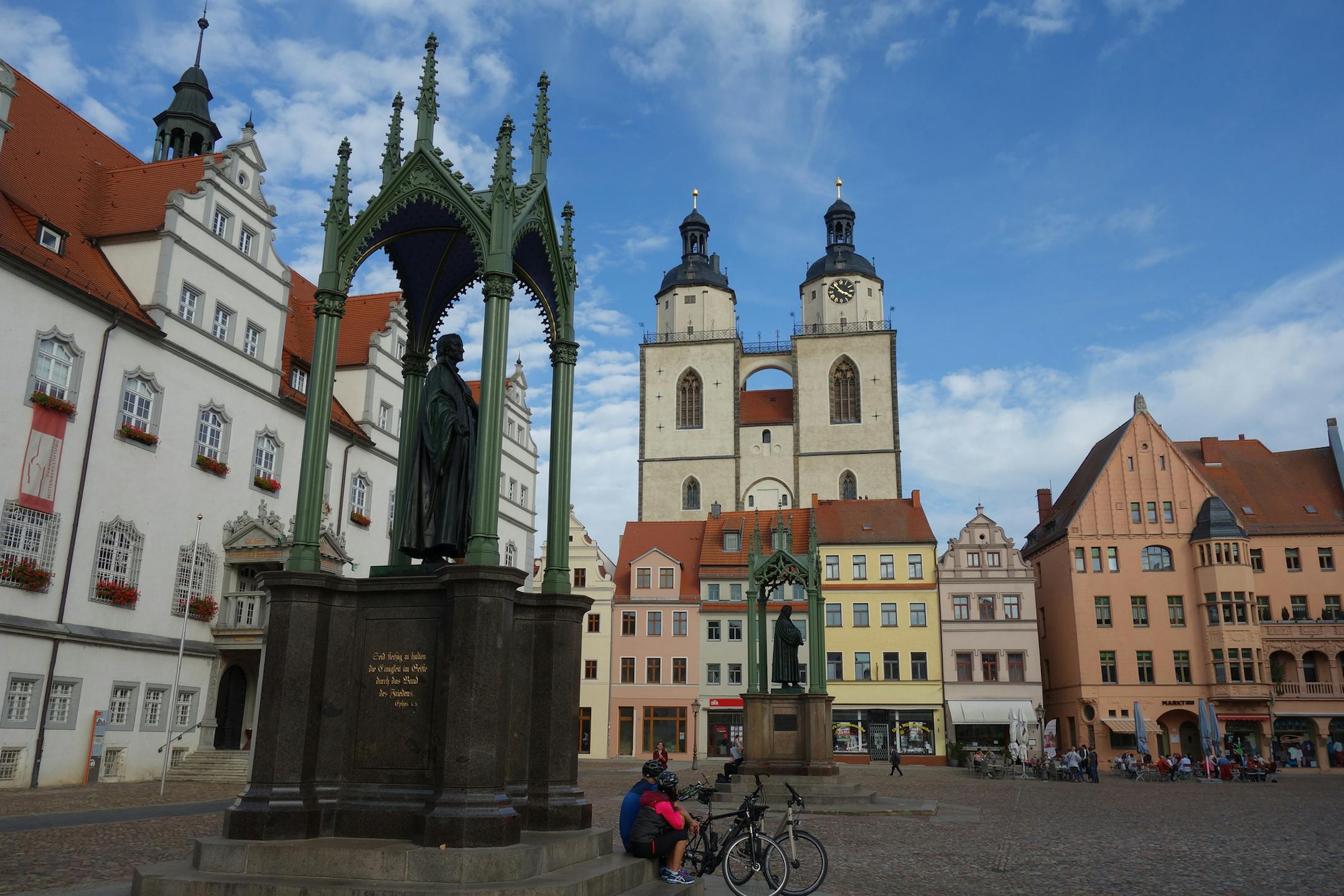
At Pirna, we realized that the Elba River stitches together towns that figured prominently in the Protestant Reformation. Pirna was the birthplace of Johann Tetzel, the Dominican friar whose enthusiasm for selling indulgences (springing souls from Purgatory) to poor folk enraged Martin Luther and propelled his penning of the 95 Theses. Tetzel's house still stands 550 years later. A sculpture in Pirna's center depicts the industrious friar collecting coins from a skinny waif.
Confident with our bicycles, our ability to put in 25 to 30 miles a day and to follow the Elbe Radweg signs marked by a little blue "e," the next day we headed downriver, going north. Over the course of the trip, we never got lost. Every intersection was well marked.