3:21
3:21With the turn of a dial, a windstorm rises and fine white sand swirls around a miniature sphinx, three pyramids and a temple in an "aeolian landscape." Within seconds, drifts form around the sphinx, half-burying its flank and piling up between the pyramids.
Nearby, a full-sized model camel kneels patiently, waiting to lumber into the sunburnt desert pictured behind it. But first there's work to do on an archaeological dig, hieroglyphics to decipher and a tiny mummified crocodile to examine.
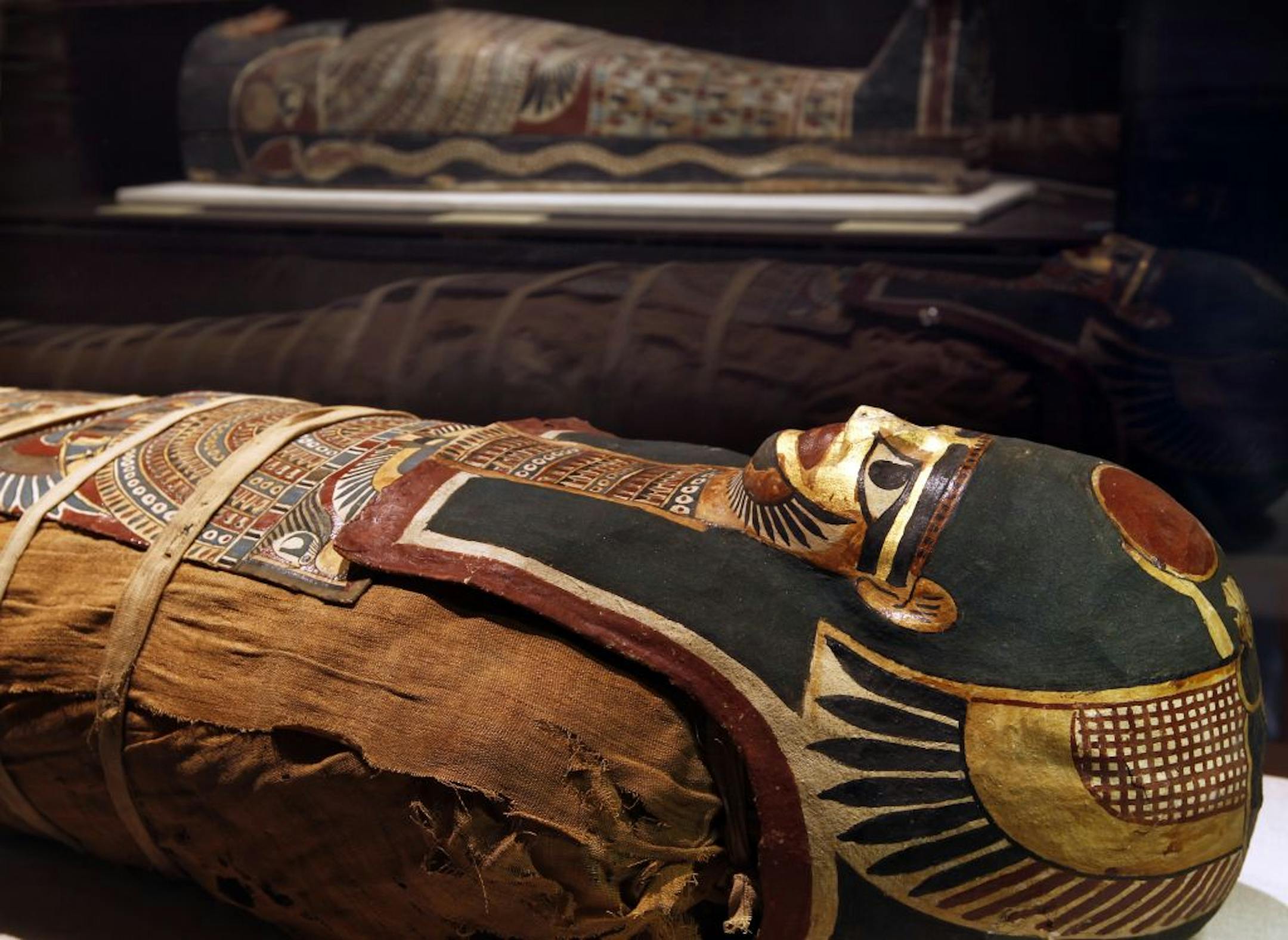
"Lost Egypt: Ancient Secrets, Modern Science," opening Saturday at the Science Museum in St. Paul, is a treasury of kid-friendly activities and career-focused educational fun. With a newly restored human mummy as well as that crocodile and a preserved ibis, "Lost" has enough bodies to satisfy most mummy enthusiasts. Plus forensic reconstructions of mummies' heads, and X-rays and CT scans that peer inside wrappings to reveal crossed arms, curled spines and whatever soft tissue remains.
"Egyptology in past exhibits was not often hands-on," said Joe Imholte, project director for special exhibitions at the Science Museum. "This has a lot of hands-on activities and blends in meaty video interviews with scientists in the field."
The more interactive sections include the camel, on which kids can pose for photos, and a "dig" where they can learn about the lives of the workers who built the pyramids. Exactly how the huge stones were moved is still unknown, but pulleys, ropes, ramps and sleds were probably employed. One activity lets kids build a 3-foot-high pyramid from wooden blocks, while another lets them compare the effort needed to move a "stone" block with or without a sled.
The show, whose work stations and temple-like displays were built by the Science Museum crew, has been on the road for several years. It arrives in St. Paul in the wake of a popular 2010 exhibit that included artifacts from the tomb of King Tut. While the earlier show focused on the royal courts and religious leaders of ancient Egypt, this exhibit emphasizes the intersection of modern science and ancient archaeology.
Rather than royalty, it peers into the daily life of the 10,000 to 20,000 workers -- the butchers, bakers, weavers, grain merchants and stonecarvers -- who served the aristocrats and executed their enormous projects. Digging through the ruins of homes and even garbage heaps, archaeologists can piece together information about the workers' diets, tools, longevity and family life. Among other activities, kids can reassemble a clay pot and fit seals to replicas of wooden document boxes, papyrus scrolls and ceramic storage jars.
Present and past intersect