

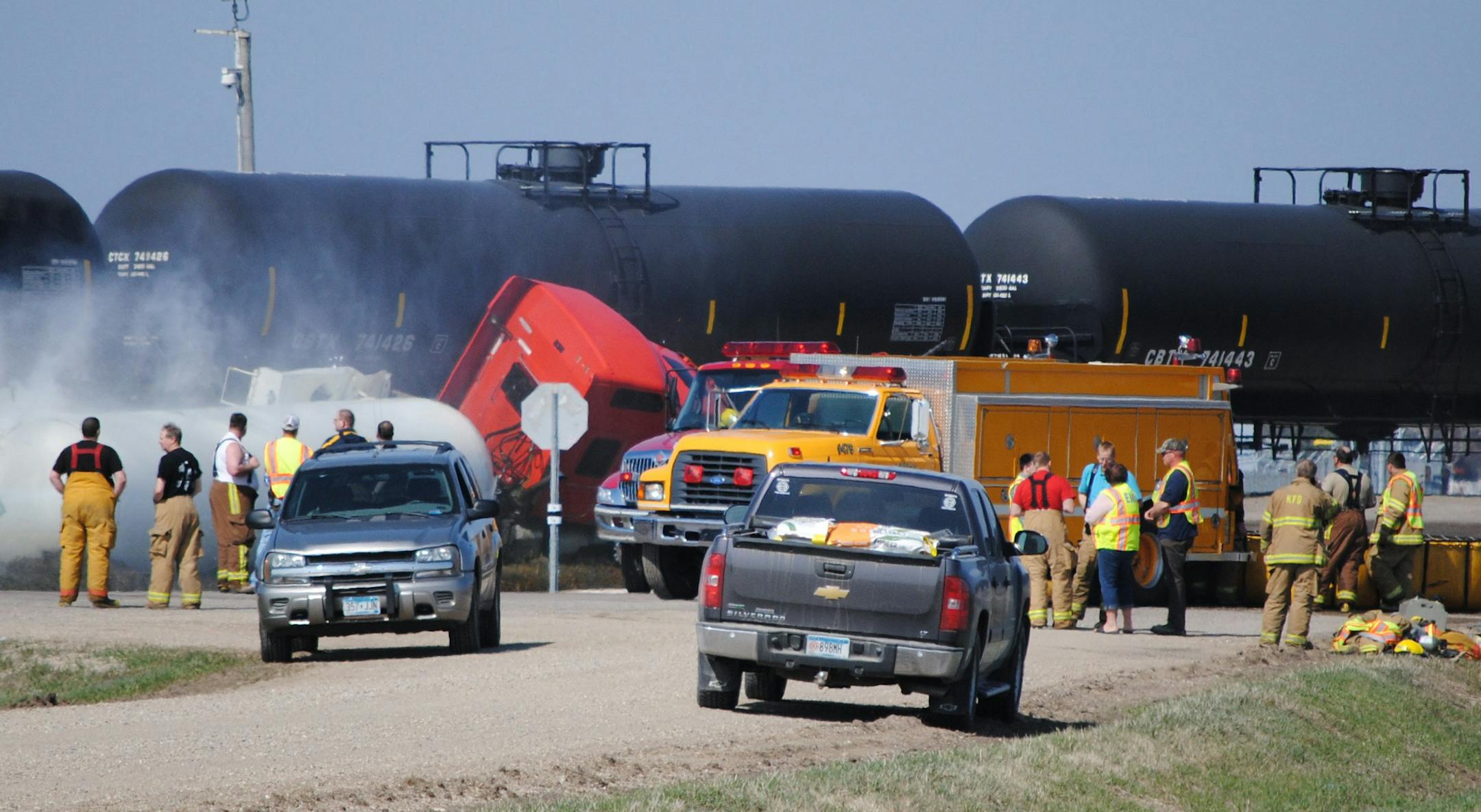
Legislation to address the risks of crude oil flowing through Minnesota has passed key committees at the State Capitol, but stricter rules affecting pipelines were dropped from the Senate measure Friday, leaving the focus mostly on railroads and oil trains.
In the face of opposition from the oil industry, legislators removed parts of the bill relating to emergency response to pipeline accidents. The measure still includes initiatives such as hiring more state rail inspectors and improving rail crossings to cope with the dramatic growth in crude-by-rail shipping from the North Dakota oil fields.
"People get the idea of tanker cars … rolling down our tracks," said Sen. Scott Dibble, chairman of the Senate Transportation Finance Committee. "Even though pipelines are expanding quite a bit, there isn't as much concern about those."
About six crude oil trains, often more than 100 tank cars long, pass through the Twin Cities daily, according to the Minnesota Transportation Department. Recent oil train wrecks, including the fiery explosion of an oil train Dec. 30 in Casselton, N.D., prompted legislators to draft the legislation, which has moved through key committees quickly.
Railroads ended up supporting the measure, even though it will cost them $1.25 million a year to better train and equip local responders. The measure would put signals at some, though not all, grade crossings along oil-train routes, but at taxpayer expense. It also would set standards for how quickly companies must respond to accidents and authorize hiring two or three more state rail inspectors.
"Safety is the rail industry's primary objective," said John Apitz, an attorney and rail group lobbyist. "If this helps the public's sense of safety in the movement of crude oil and other materials, we are in favor of the legislation and will not stand in the way."
But officials from American Petroleum Institute, the oil industry's trade group, and Enbridge Energy, the state's major crude oil pipeline operator, opposed parts of the bill at legislative hearings last week. Some legislators also believed the focus should be on crude-by-rail, an industry that emerged in North Dakota because that state has insufficient pipeline capacity to deliver its oil bounty.
"If a train derails in a community, you have a catastrophe, "said Rep. Jim Newberger, R-Becker, who works as a paramedic. He signed on as co-sponsor of only the rail-related parts of the three-bill package.


