

When domestic cats first evolved some 10,000 years ago, they came in a brown mackerel tabby wrapper.
Still seen today, the pattern of narrow vertical stripes, resembling the bones of a fish (hence the "mackerel" moniker) lines their bodies from spine to belly, with horizontal stripes circling the legs. It's called "wild type" because of the resemblance to the coat of Felis sylvestris lybica, the wild ancestor of today's housecats.
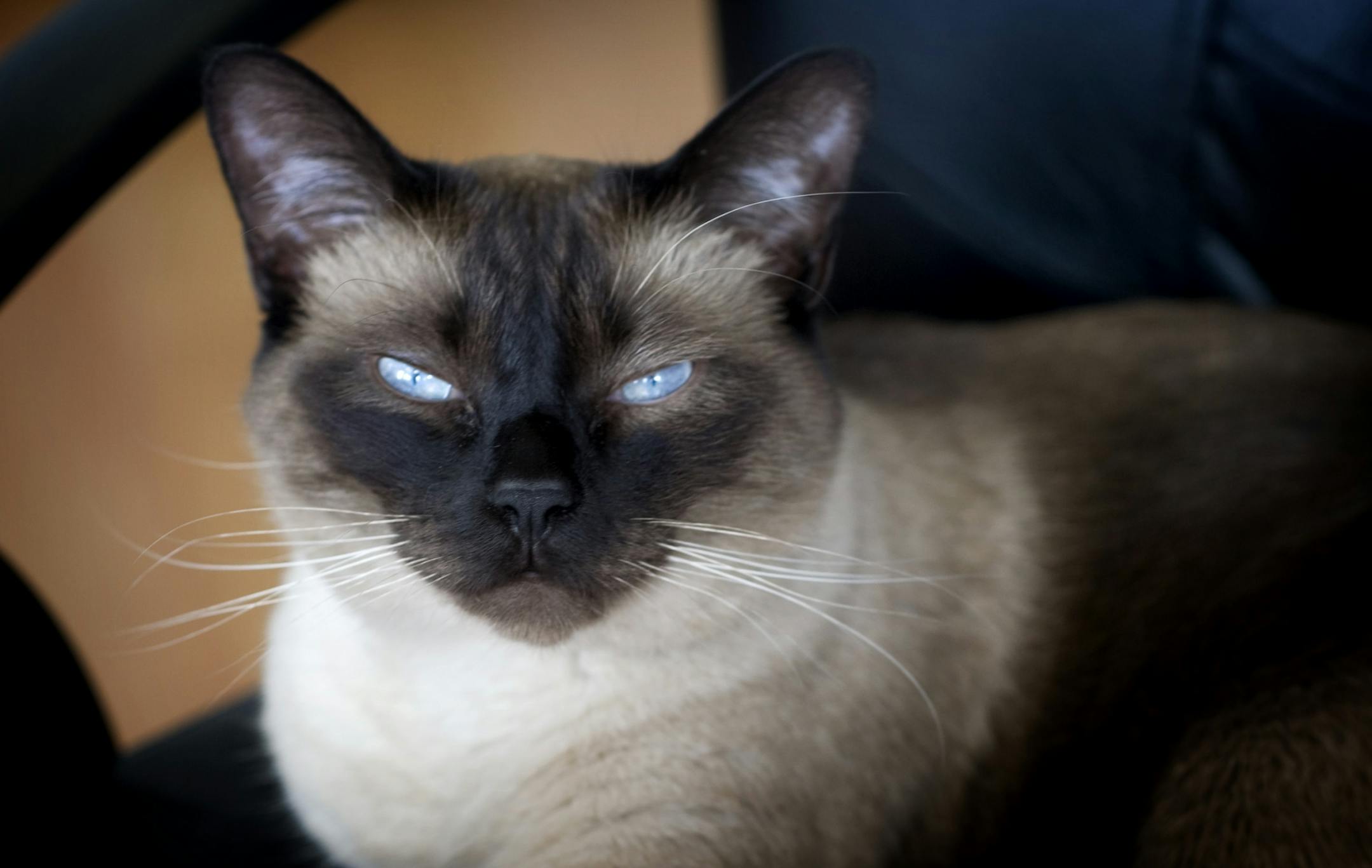
Nowadays, cats come in an array of colors and patterns — approximately 3,000 permutations so far. First were ancient mutations, the classic tabby with a bullseye pattern, and pointed cats like Siamese. The classic tabby mutation occurred in a limited number of cats in the United Kingdom, and all cats with points can be traced genetically to a single mutation event in Asia, says cat judge Lorraine Shelton, whose feline genetics hobby has led her to become a genetics instructor for the International Cat Association's genetics committee. White and white-spotting mutations are thought to have occurred in the Mediterranean.
"Another one that we know has a long history is the mutation from black to blue," she says. "Traditionally, we called those Russian blue cats, or archipelago cats, which seems to suggest a European mutation."
Cats began to be developed into specific breeds in the late 19th century. Those early breeds include longhairs such as Persians and Angoras; British shorthairs; and Manx, Siamese and Abyssinians. In the mid-20th century through the 1980s, there was an explosion of new breeds in the United States based on unusual coat mutations. They included the American wirehair, LaPerm and Selkirk rex.
"Now, what we're seeing in the 21st century is another explosion of new mutations, particularly related to color, that are coming out of Asia and Russia," Shelton says. One of the newest, called bimetallic, is seen in Siberians. The silver tabby cats have golden accents on the legs and belly.
Greater knowledge of the genetics underlying fur color and pattern has contributed to the new cat color palettes. Before the cat genome was first mapped — at a cost of more than $1 million — breeders had to rely on observational, or population, genetics.
"We'd breed one cat to another and see what the babies turned out to be and were able to conclude whether [the color] was a dominant or recessive mutation," Shelton says. "But we didn't know what was happening on a genetic and biochemical level." Today, inexpensive genome sequencing has made investigating and developing new colors much easier.

