

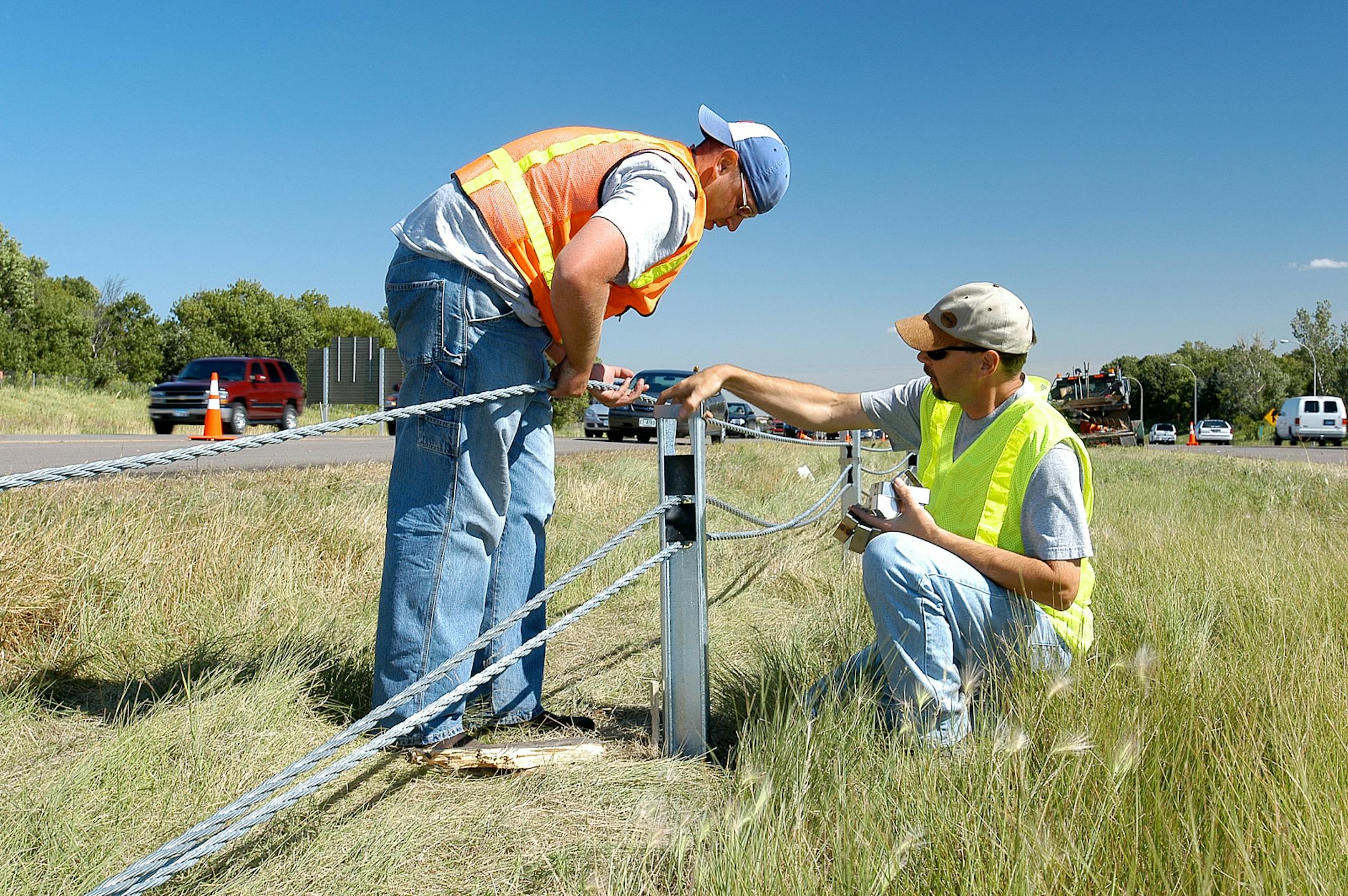
The Minnesota Department of Transportation has been installing cable barriers along highways and freeways for the past 18 years to prevent motorists from crossing the median and colliding with oncoming traffic.
This month, crews are installing barriers made of three or four steel cables strung on posts on Snelling Avenue between County Road C and Interstate 694. With 81 crashes over the past five years, including 10 in which an out-of-control vehicle crossed the median and struck an oncoming motorist, Snelling was put at the top of the list for the safety treatment.
"We try to look at areas the median barrier will prevent deadly or very serious crashes," said Kent Barnard, a MnDOT spokesman.
The crashes on Snelling between 2017 and 2021 mainly resulted in property damage, MnDOT data shows. But with so many crashes, the idea is to prevent anything more serious from happening.
"There is a lot of speeding by drivers going from eastbound 694 to southbound Snelling," Barnard said. "It's why we decided to put barriers on Snelling."
As part of the $927,000 project, MnDOT is also lengthening turn lanes to add more room for vehicles to line up at Lydia Avenue and County roads C2 and C.
Here is how the barriers work: When a vehicle hits the barrier, the posts break and the cables flex, absorbing much of a crash's kinetic energy. This redirects the vehicle along the median, preventing a cross-median crash.
"A concrete barrier can repel a vehicle back into traffic, so [cable barriers] are more forgiving," Barnard said.


