
Craig: Protecting leads tougher in the NFL

As this young season has shown us, pass-happy offenses can score but have trouble killing the clock.

September 24, 2014 at 11:38AM
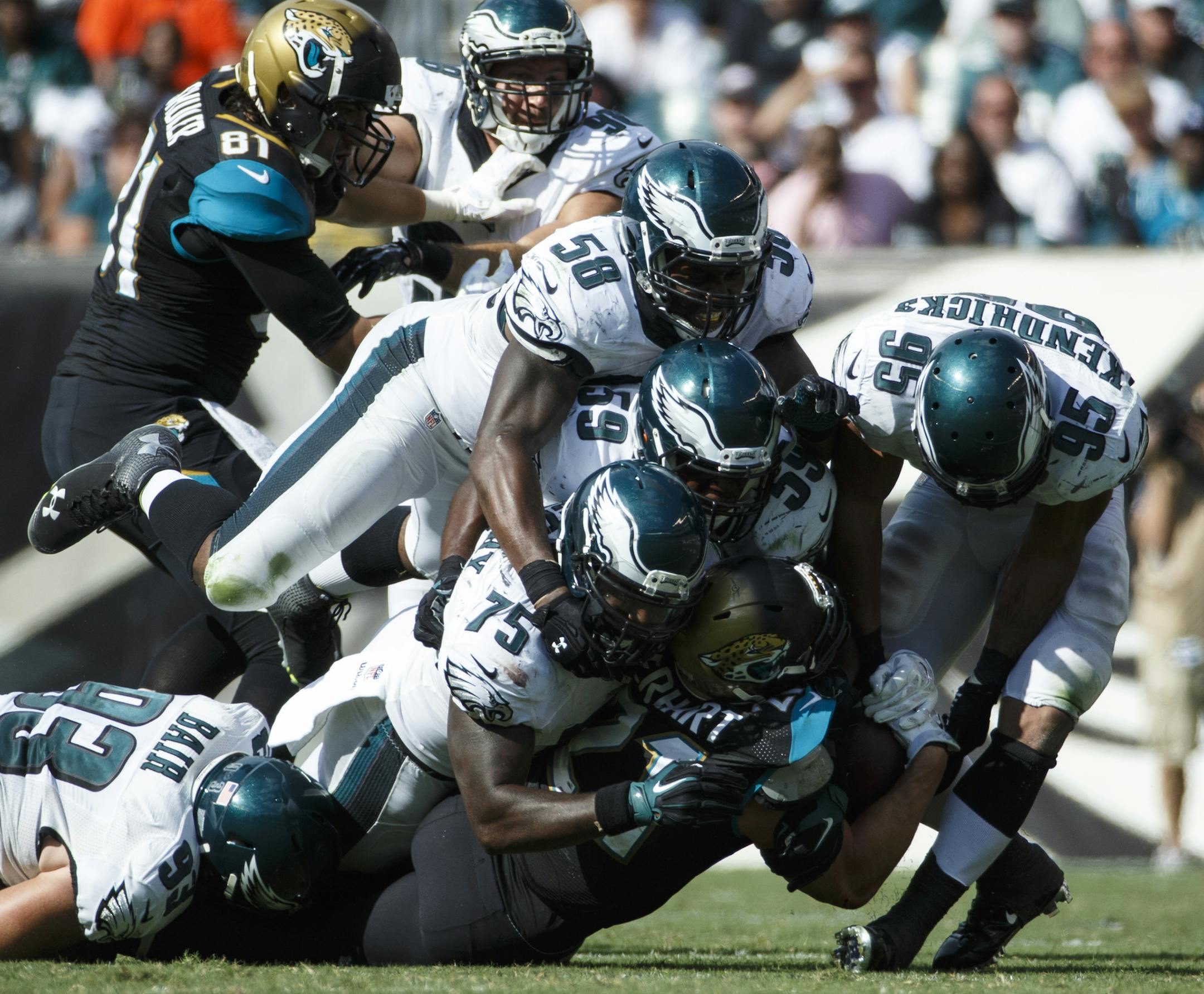
Jacksonville Jaguars running back Toby Gerhart, bottom, gets gang tackled by the Philadelphia Eagles defense, (left to right), Brandon Bair, Vinny Curry, Trent Cole, DeMeco Ryans and Mychal Kendricks during the second half of an NFL football game, Sunday, Sept. 7, 2014, in Philadelphia. The Eagles won 34-17. (AP Photo/Chris Szagola) ORG XMIT: OTKCS196
Toby Gerhart, bottom, and the Jaguars led the Eagles 17-0 but couldn’t muster the running game needed to protect the lead. (The Minnesota Star Tribune)

When the Cowboys turned a 21-0 deficit into a 34-31 victory at St. Louis on Sunday, receiver Dez Bryant reportedly nodded to quarterback Tony Romo and said, "Tony did what Tony do."

Romo certainly played a role in the franchise record-tying comeback. But the Rams also did what too many modern NFL teams do: fail miserably at running the football.

In case you haven't noticed, the NFL is a passing league. It's great for ratings, excitement and coming from behind. It's not so great for protecting leads of any size.

Four teams have blown leads of 17 points or more this season. That ties 2011 for the most after three weeks since the 1970 merger. This also is the first time since 1982 that each week has had one of these monster meltdowns.

On the flip side, the Eagles are the first team in NFL history to start 3-0 after trailing by 10 or more points in each game. This comes three seasons after the Vikings became the first team to start 0-3 after leading by 10 or more points in each game.

The 2011 Vikings couldn't protect those leads with Adrian Peterson, the best running back in the league. So it shouldn't come as a surprise that one of the early NFL story lines is teams blowing big leads and either losing or somehow escaping at the end of regulation or overtime.

In Week 1, the Steelers led the Browns 27-3 at halftime at home. They won 30-27 in overtime. On Sunday, the Seahawks led the Broncos 17-3 in the fourth quarter. They won 26-20 in overtime.

The 49ers have blown halftime leads in consecutive weeks. Because of that, they're slumped next to Tennessee, Miami and the Vikings as 1-2 teams that started 1-0.
Let's take a closer look at the record-tying four blown leads to illustrate how running the ball when the other team knows you're going to run the ball is an antiquated ability for most, if not all, NFL teams.

Week 1, at Philadelphia

The Jaguars led the Eagles 17-0 with 14 minutes, 19 seconds left in the second quarter. They lost 34-17.

What happened: Jacksonville had only 12 yards rushing when it went ahead 17-0. So there wasn't much of a foundation for sustained success, especially when you're talking about protecting a lead for 44 minutes against Chip Kelly's hyperactive offense. The Jaguars offense had 51 snaps in the final 44 minutes. Thirty-three of those snaps (64.7 percent) were passes. Running plays after big lead: 18 for 52 yards (2.9 yards per carry).

Week 2, at San Francisco

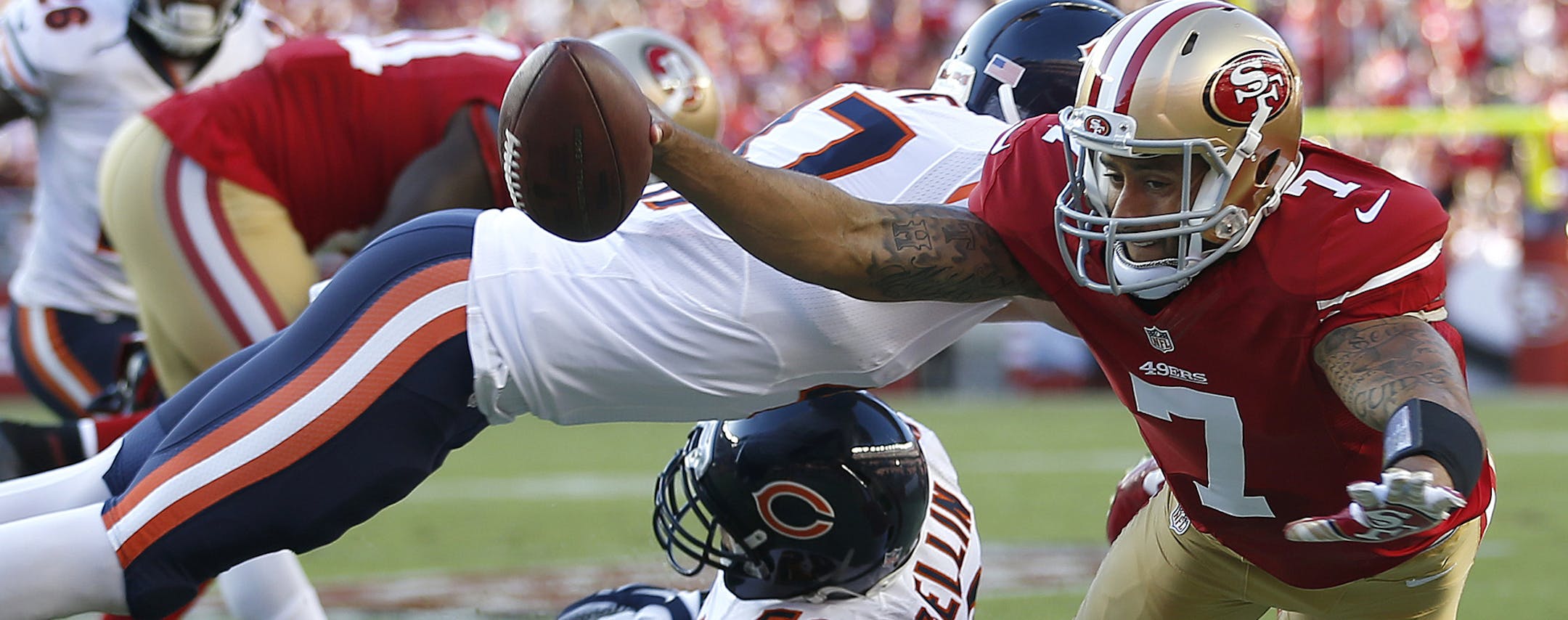
The 49ers led the Bears 17-0 with 2:22 left in the first half. They lost 28-20.

What happened: Injuries and suspension have rocked what used to be the best front-seven defense in the league. So holding the lead rested more with the 49ers running game, which was averaging 6.1 yards when San Francisco went up 17-0. Running plays after big lead: 15 for 54 yards (3.6).

Week 2, at Green Bay

The Jets took a 21-3 lead with 10:38 left in the first half. They lost 31-24.

What happened: The Jets ran the ball 18 times and passed it 10 while building their lead. They soon would find out how difficult it is to hold down Aaron Rodgers for 44 minutes. Running plays after big lead: The Jets averaged 4.6 yards per carry. However, in 42 snaps, they threw the ball 23 times (54.8 percent).

Week 3, at St. Louis

The Rams took a 21-0 lead with 6:06 left in the second quarter. They lost 34-31.

What happened: The Rams' run-pass ratio was 16-14 when St. Louis went ahead 21-0. Running plays after big lead: The Rams' run-pass ratio over the final 36 minutes as 14-28, or twice as many passes. Granted, the Rams had to pass again once the Cowboys caught up. But that's the point. If NFL teams could run the ball, they wouldn't need to pass much after leads of 17-0, 21-3 or 21-0.

Mark Craig • mark.craig@startribune.com

San Francisco 49ers quarterback Colin Kaepernick (7) is pushed out of bounds by Chicago Bears free safety Chris Conte, top, as Shea McClellin helps on defense during the first quarter of an NFL football game in Santa Clara, Calif., Sunday, Sept. 14, 2014. (AP Photo/Tony Avelar) ORG XMIT: FXN104
Colin Kaepernick and the 49ers led the Bears 17-0 before the ground game disappeared. (The Minnesota Star Tribune)
about the writer

about the writer

Mark Craig

Sports reporter

Mark Craig has covered the NFL nearly every year since Brett Favre was a rookie back in 1991. A sports writer since 1987, he is covering his 30th NFL season out of 37 years with the Canton (Ohio) Repository (1987-99) and the Star Tribune (1999-present).

See Moreicon