

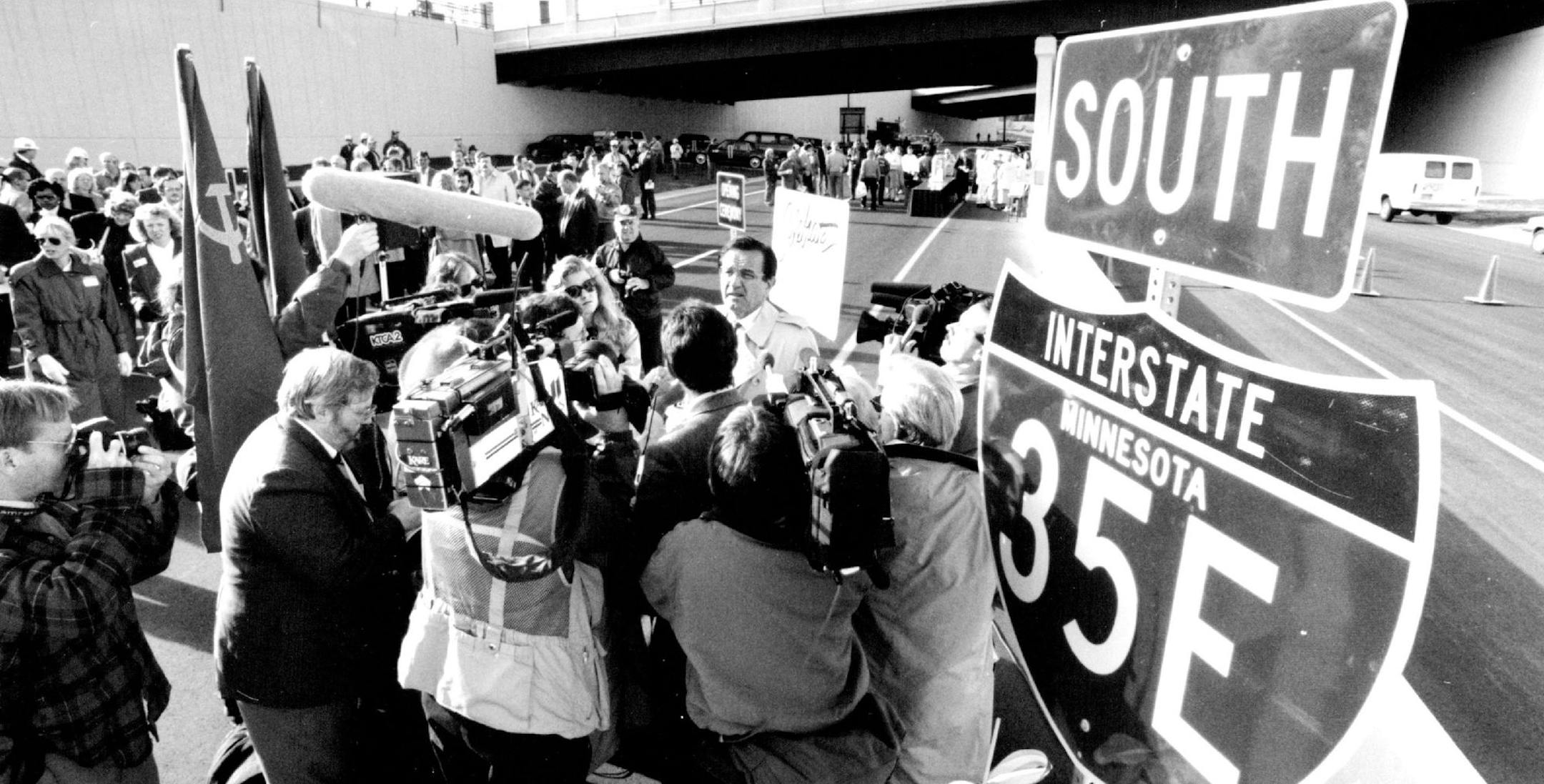
The Star Tribune's "Curious Minnesota" article on Interstate 35E in St. Paul (metro, Feb. 12) presents a good summary of the development of that part of our interstate highway system. But in its brevity there are significant omissions. The characterization of the 45 mile-per-hour speed limit by the gentleman who was a researcher for the Minnesota Department of Transportation (MnDOT) is disrespectful and cynical.
Timing is everything. The actual construction of this stretch of freeway came along after the completion of I-35W in Minneapolis and I-94 in St. Paul. People had seen the damage that those highways were doing to our cities.
In St. Paul, the Rondo neighborhood was destroyed, and people in Merriam Park were increasingly concerned that their success in having 94 constructed "below grade" was too little, too late. It was apparent that highway planners were either ignorant of the negative impact of such massive facilities, or indifferent.
Fortuitously, as the work on 35E began in St. Paul, the federal Environmental Protection Act became law and the 35E project was subject to it. Residents in Protest (RIP) 35E secured the assistance of environmental lawyers Chuck Dayton and John Herman, who took the matter to court.
The court found that the construction could not go forward without at least an environmental impact study, and the project was stopped.
This, of course, was very controversial, but it was not trivial. RIP 35E was not just a few people stirring up trouble, and the political leaders who weighed in were not simply trying to curry favor with their constituents.
This effort went far beyond St. Paul. There were similar efforts throughout the country (although these challenges seldom succeeded) and in Minnesota, the political coalition that insisted on a closer look at the damage wrought by urban freeways included St. Paul, Golden Valley, St. Louis Park and Minneapolis.
In Minneapolis, where 94 later destroyed much of north Minneapolis, the effort led to the permanent cancellation of the planned interstate link from 35W through Northeast to 94. Within St. Paul, the West Seventh, Crocus Hill, Ramsey Hill, Lexington-Hamline and Merriam Park neighborhoods were all solidly opposed to freeway projects that were poised to destroy neighborhoods and quality of life. The environmental damage includes air pollution, noise pollution and visual pollution.


