

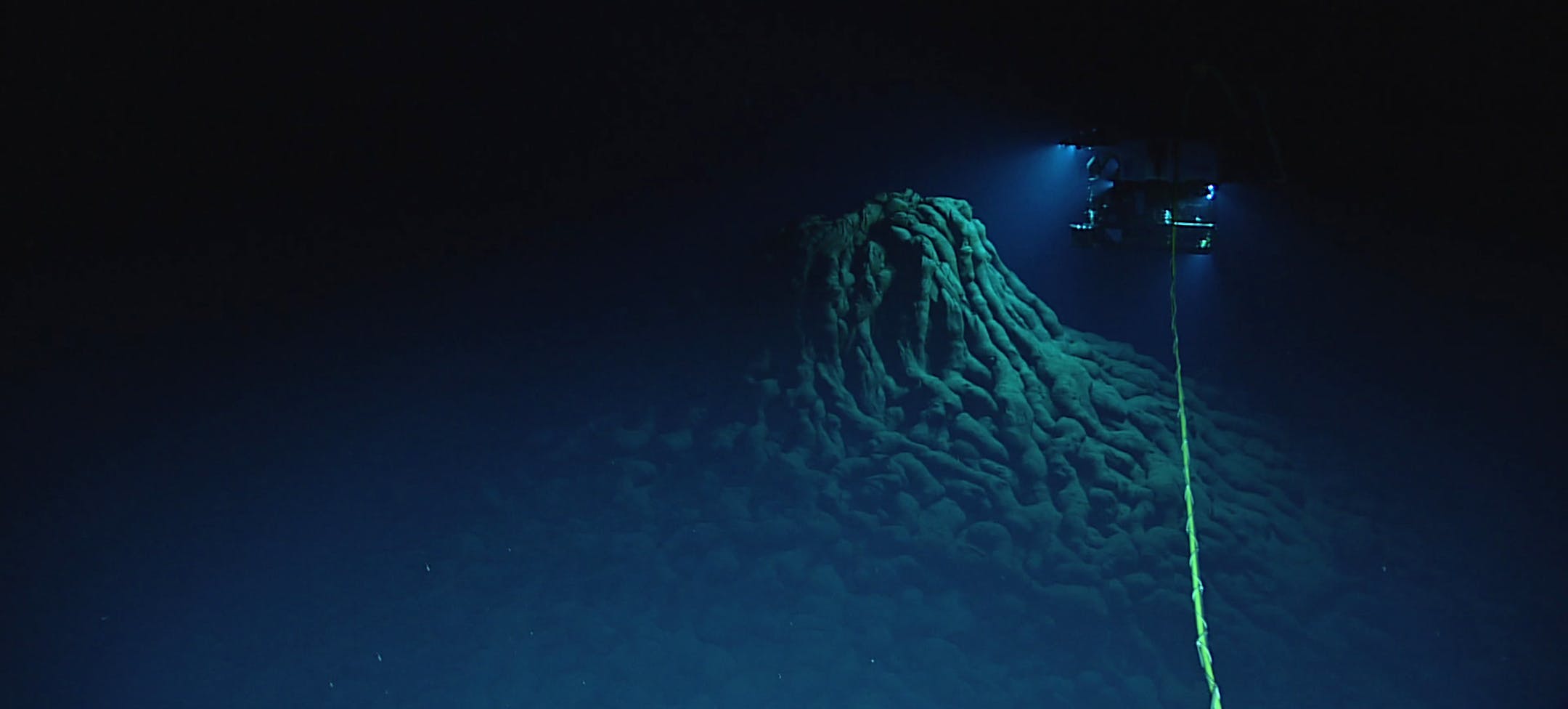
You might know what a hydrothermal vent looks like: black plumes billowing from deep-sea pillars encrusted with tube worms, hairy crabs, pouting fish. But do you know what it sounds like?
To the untrained ear, a hydrothermal vent — or more precisely, a vent from the Suiyo Seamount southeast of Japan — generates a viscous, muffled burbling that recalls an ominous pool of magma. To the trained ear, the Suiyo vent sounds like many things. Yet, Tzu-Hao Lin, a research fellow at the Biodiversity Research Center at Academia Sinica in Taipei, Taiwan, said, "You don't need to be an expert to say what it sounds like to you."
Lin adores acoustics. He has listened to the sea since 2008 and to the deep sea since 2018. He has deployed hydrophones, which are microphones designed for underwater use, in waters off Japan to eavesdrop on the noises that lurk thousands of feet below the surface. He published these recordings in August at a conference of the Deep-Sea Biology Society.
Lin is not interested in focusing on the song of a singular whale or the clatter of ship traffic, but rather on the habitat's soundscape — the totality of all its sounds, human, animal and geological — to glean an area's biodiversity.
Lin joins a growing field of acousticians who believe that sound may be the quickest, cheapest way to monitor one of the most mysterious realms of the ocean. A database of deep-sea soundscapes could provide researchers with baseline understanding of healthy remote ecosystems, and singling out the sounds of communities or even individual species can inform scientists when populations are booming.
"You need to know what the habitat sounds like when it's healthy," said Chong Chen, a deep-sea biologist at Japan Agency for Marine-Earth Science and Technology, or JAMSTEC. "When the soundscape has changed, the habitat may have changed, too."
Light holds little power in the ocean; anything deeper than 656 feet is essentially shrouded in darkness. But sound reigns supreme underwater, where it travels five times faster than in air.
Lin became interested in underwater acoustics around a decade ago as a graduate student at National Taiwan University, on a project observing Indo-Pacific humpback dolphins. He found the work anticlimactic, working long hours and seeing very few dolphins. But as he listened to the recordings, he heard noise pollution and a chorus of other creatures — the sounds of snapping shrimp and choruses of fish. Fish may represent researchers' best bet at parsing deep-sea biodiversity, as many key deep-sea animals are not known to make sound, Chen said.


