

 3:12
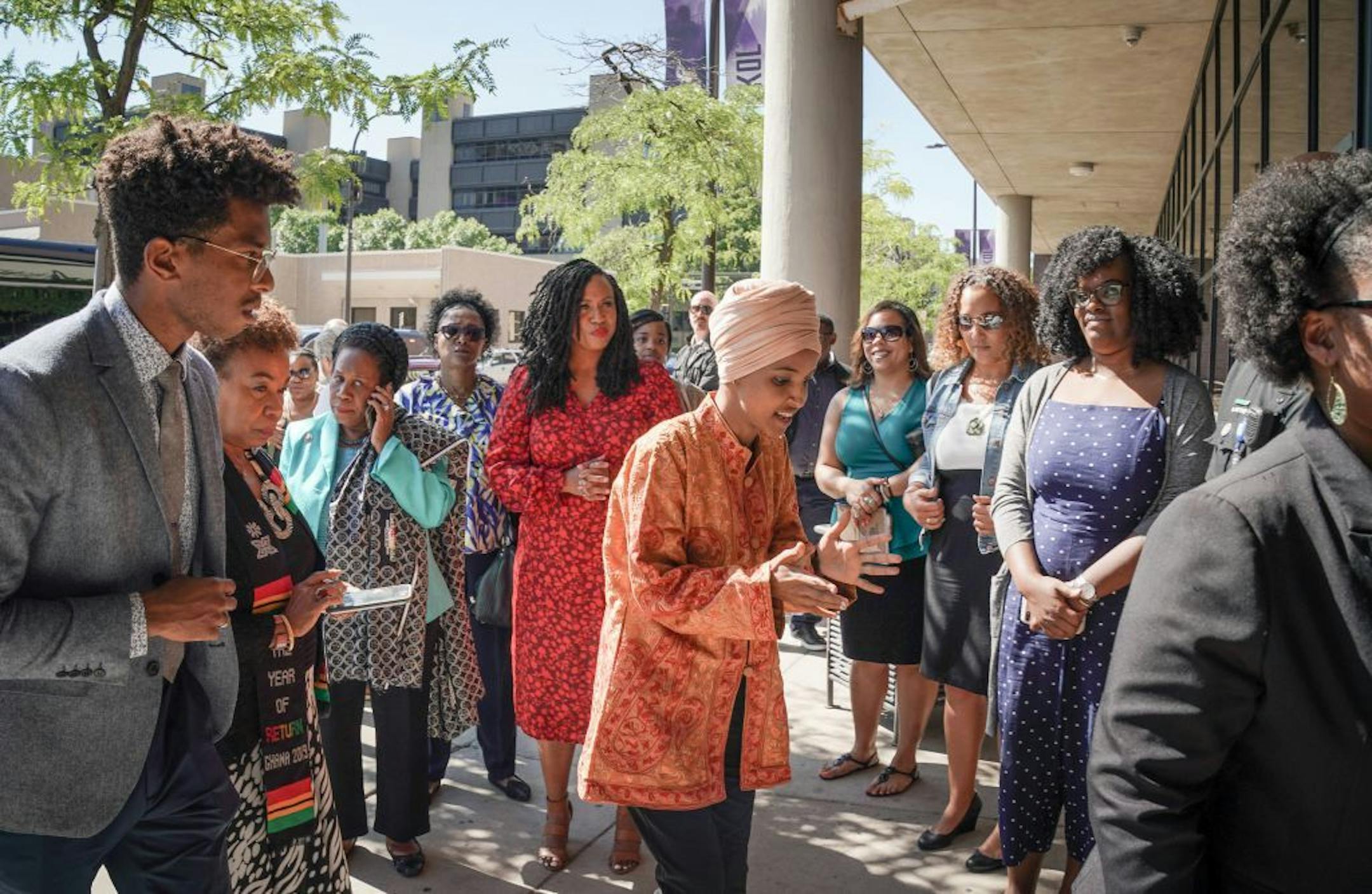
3:12The challenges facing Minnesota's black community sounded daunting and expensive to fix as U.S. Rep. Ilhan Omar hosted a group of colleagues from the Congressional Black Caucus around Minneapolis on Friday.
"Isn't it sad, in 2019, that we still have these challenges?" Rep. Sheila Jackson Lee, of Texas, said at a morning session in downtown Minneapolis to discuss gaps in educational outcomes between whites and blacks in Minnesota. She also decried a lack of access to early-childhood programs.
A long-serving House Democrat from Houston, Jackson Lee suggested an all-encompassing response to shrink documented disparities — not just in education, but also in the criminal justice system, public health, home and business ownership, access to credit and capital, and in other areas: reparations for slavery.
"We are saying that the nation benefited from 250 years of free labor," Jackson Lee said at Loews Minneapolis Hotel.
As the lead sponsor of legislation that would create a federal commission "to be able to discern what the exact response should be," Jackson Lee said that a commission could steer reparations dollars to "child care and child care workers, teaching children of color, historically black colleges, ending the lack of access to credit" and other programs meant to erase disparities.
In recent months, members of the Congressional Black Caucus (CBC) have been visiting U.S. cities to talk about the real-world impact of racial disparities and to spread a message that there are still federal solutions to some of these problems.
Omar said she invited her CBC colleagues to her turf in Minnesota's Fifth Congressional District because the state, despite its strong performance in many quality-of-life measures, also suffers some of the worst disparities between its white majority and its residents of color.
"As many of you know, Minnesota makes the list on the best of everything for a lot of things," Omar said. "Except when it comes to black people. We are always on the list of the highest disparities when it comes to black and people of color here in Minnesota."
![Reps. Sheila Jackson Lee and Barbara Lee looked into an empty cell at the Hennepin County Juvenile Justice Center during a tour. ] GLEN STUBBE • glen.stubbe@startribune.com Friday, August 30, 2019 Rep. Ilhan Omar hosted members of the Congressional Black Caucus—including Reps. Sheila Jackson Lee, Barbara Lee, Ayanna Pressley —for a visit to Minneapolis as part of their “State of Black America” series. Thye had events related to education, criminal justice refor](https://arc.stimg.co/startribunemedia/TN5VO3QLSJQY5DM7VZW7XRWFSY.jpg?&w=1080)
![Jeff Townsend, right, Corrections Institutional Supervisor for Hennepin County, led a tour with Reps. Ilhan Omar, Sheila Jackson Lee, Barbara Lee and Ayanna Pressley along with other officials. ] GLEN STUBBE • glen.stubbe@startribune.com Friday, August 30, 2019 Rep. Ilhan Omar hosted members of the Congressional Black Caucus—including Reps. Sheila Jackson Lee, Barbara Lee, Ayanna Pressley —for a visit to Minneapolis as part of their “State of Black America” ser](https://arc.stimg.co/startribunemedia/Q4ISX7FAS5QVJW2X3RSXQEWDMM.jpg?&w=1080)


